

Finding the Best Grinder for Coffee in the UK
If you're serious about making café-quality coffee at home, your journey starts with a single, crucial tool: the grinder. Forget the fancy espresso machine for a second. The single best investment you can make in your daily ritual is a quality coffee grinder. It's what unlocks the true potential hidden inside your beans.
Why Your Grinder Is the Heart of Your Coffee Setup
A great grinder is the foundation of flavour. It’s what gives you the consistency needed to pull all those delicate, complex notes out of high-quality beans. Without one, even the best beans and brewing gear will fall flat.
Of course, the quality of your beans is just as important. Knowing where they come from and supporting UK roasters, like our local coffee supplier, Long Shot Coffee, can make a huge difference to what ends up in your cup. Think of this guide as your roadmap, written for UK coffee lovers who want to make sense of the options and find the perfect tool for the job.
Understanding the Core Choices
We're going to break down the key decisions you'll face when picking a grinder. Your choice will shape everything from your morning routine to the final taste.
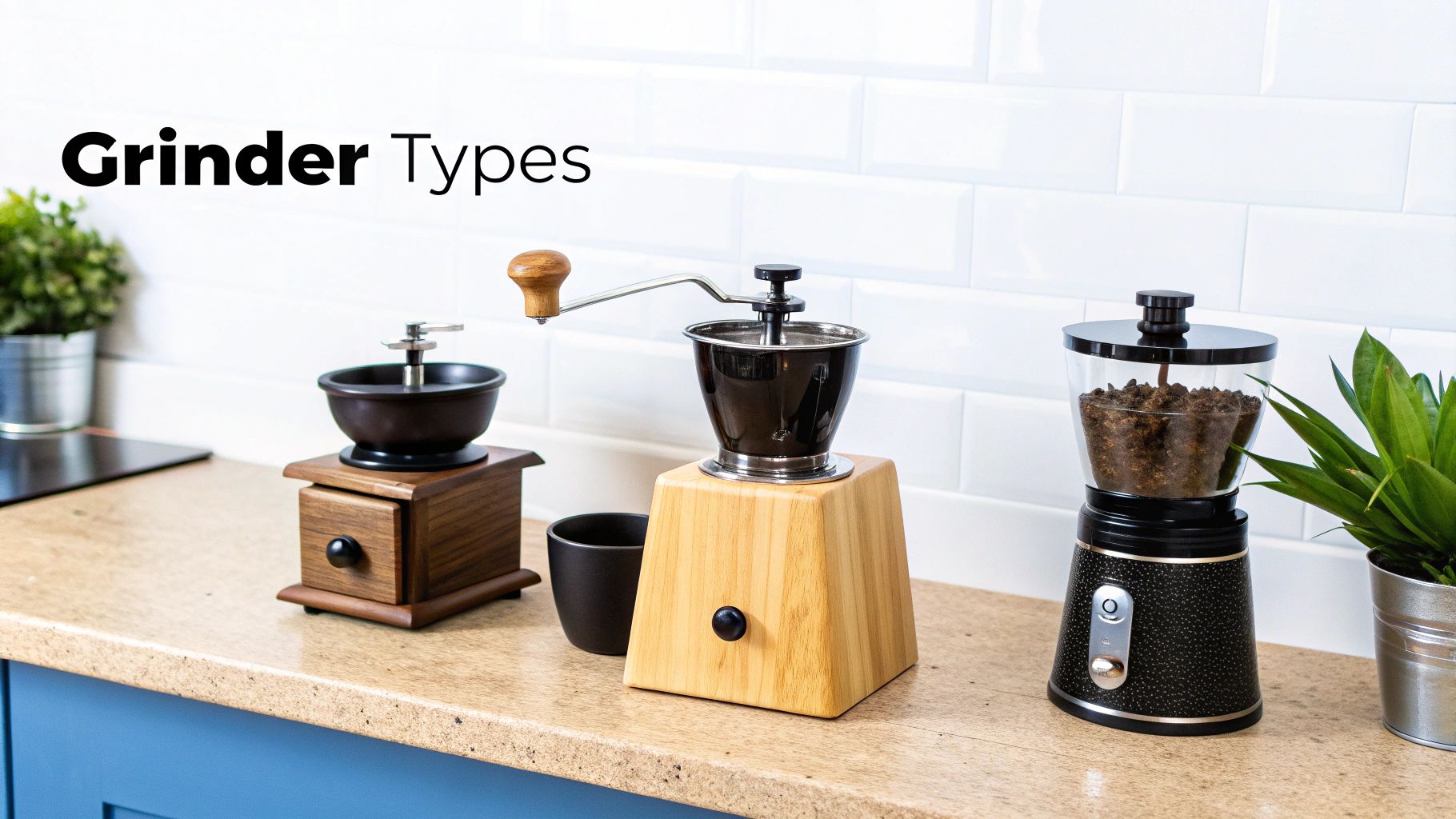
- Burr vs Blade Grinders: We'll get into the difference between the precision milling of burr grinders and the chaotic chopping of blade models.
- Manual vs Electric Models: This is all about lifestyle. Do you want the quiet ritual of a hand grinder or the push-button convenience of an electric one?
Focusing on a fresh grind isn't just a niche obsession anymore; it's a growing trend. The UK coffee grinder market is seeing steady growth, all thanks to a booming coffee culture at home. Projections show the market is set to grow at a compound annual growth rate (CAGR) of around 5.8% from 2025 to 2035. You can read more about this in the full coffee bean grinders market report.
Right, let’s get started on the path to a truly exceptional cup.
Why Grind Consistency Is Your Secret Weapon
Before we get lost in models and features, let's get one thing straight: your grinder is the single most important bit of kit in your entire coffee setup. It’s not just an accessory; it’s the control centre for flavour. The secret to unlocking the vibrant, balanced coffee you find in the best UK cafés isn't the fancy machine—it's the absolute uniformity of the coffee grounds.
Think of brewing coffee like making a perfect pot of tea. If you tossed in a mix of fine tea dust and whole leaves, the dust would over-brew in seconds and turn bitter, while the big leaves would barely release any flavour at all. The result? A weak, harsh cuppa. Coffee works the exact same way, and that's the problem with an inconsistent grind.
The Problem of Uneven Extraction
When you grind your beans, you're creating thousands of tiny particles. Hot water flows over them, dissolving the flavour compounds inside. The goal is to extract just the right amount to hit that sweet, balanced spot. But an inconsistent grind—full of both massive "boulders" and powdery "fines"—makes this impossible.
- The "Fines" (Dust): These tiny particles have a huge surface area and extract incredibly fast. They give up their good flavours first, then quickly move on to releasing harsh, bitter compounds.
- The "Boulders" (Chunks): The larger pieces have much less surface area. Water zips right past them without enough contact time to pull out the sweet, complex notes, leaving behind sour, underdeveloped flavours.
When you brew with this chaotic mix, you get the worst of both worlds in one cup: a confusing muddle of bitterness from over-extracted fines and sourness from under-extracted boulders.
This constant battle between over- and under-extraction is the root of most home-brewing frustration. A consistent grind ends the fight, giving you a clear, clean path to delicious coffee by making sure every single particle brews at the same rate.
Taking Control of Your Flavour
Achieving a uniform grind size is all about taking control. It lets every coffee particle contribute positively to the final cup, giving you the clarity and depth of flavour that speciality coffee promises.
Getting your head around this will completely change how you look at grinders. It’s not about the bells and whistles; it's about finding a precision tool that empowers you to brew with intention and consistency, unlocking the true character hidden inside every bean.
The Critical Choice: Burr Grinders vs Blade Grinders
When you start digging into how to make better coffee, the first real crossroad you’ll hit is the grinder. This isn't just some minor detail for coffee geeks; it's the single most important choice you'll make for the flavour in your cup. The two main players are burr grinders and blade grinders, and honestly, they're in completely different leagues.
Think of a blade grinder as a tiny lawnmower in a box. It has a spinning blade at the bottom that just smashes into coffee beans, chopping them up chaotically. What you end up with is a messy mix of large chunks and fine dust. This inconsistency is a recipe for a bad brew—it’s impossible to get an even extraction, leaving your coffee tasting muddled and disappointing.
A burr grinder, on the other hand, works with precision. It uses two abrasive surfaces, or ‘burrs’, to gently mill the beans into a consistent size. One burr is stationary while the other spins, and the beans are funnelled between them. It’s a controlled, uniform process.
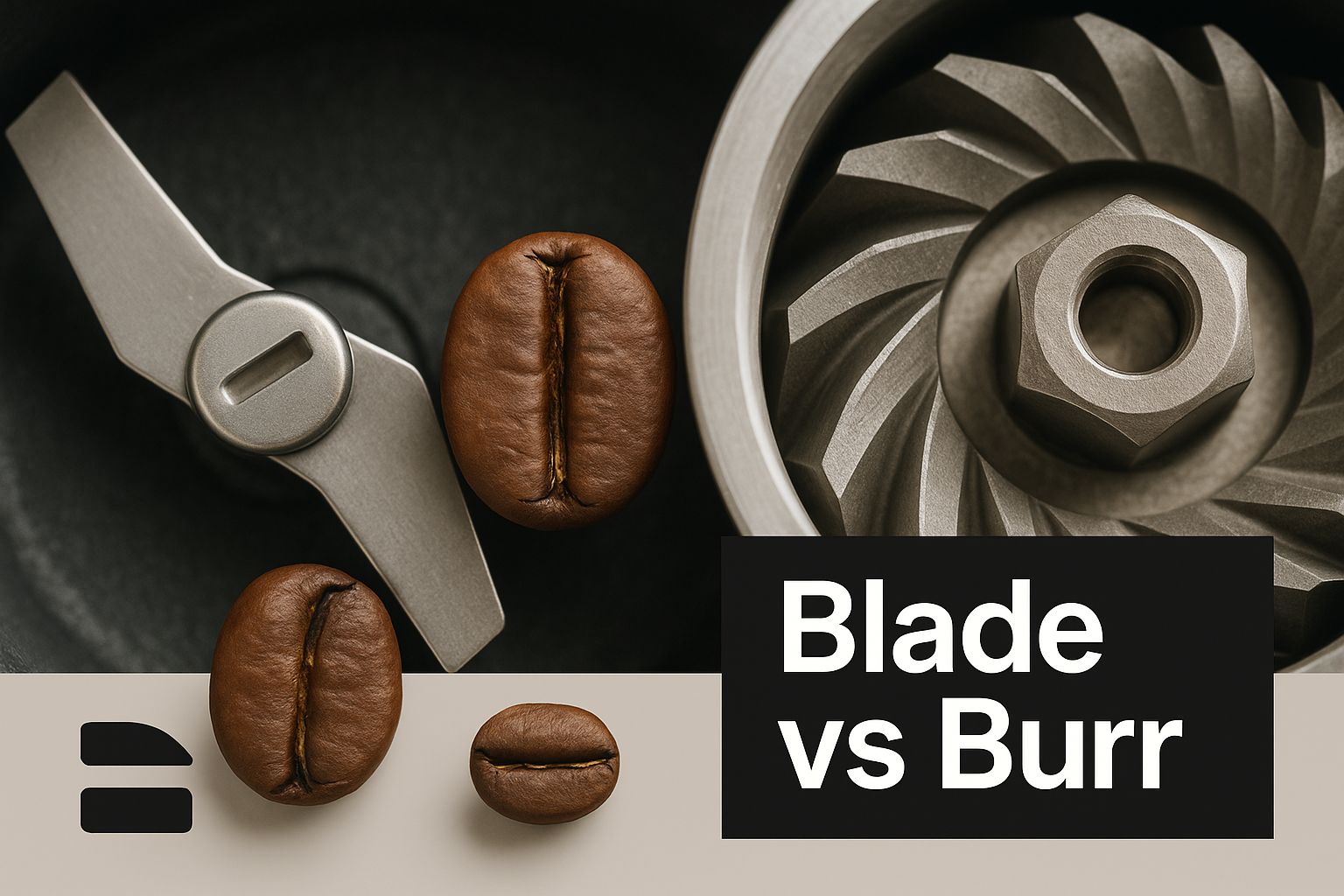
As you can see, one method is about brute force, the other is about finesse. That difference is the foundation of a balanced, delicious cup of coffee.
Flavour Clarity and Control
The magic of a burr grinder is all about control. You can adjust the distance between the burrs with incredible precision, letting you ‘dial in’ the perfect grind size for whatever you’re brewing, be it a French press or an espresso. With a blade grinder, your only control is how long you hold the button down, which is really just guesswork.
This precision has a direct impact on taste. When all your coffee grounds are the same size, they extract at the same rate. This allows all those delicate, interesting notes in a speciality coffee to come forward. With a blade grinder, you’re brewing everything at once: the big chunks under-extract and taste sour, while the fine dust over-extracts and turns bitter.
A burr grinder gives you the power to brew with intention, unlocking the specific flavour profile the roaster worked so hard to create. A blade grinder, by its very nature, leaves flavour entirely to chance.
It seems coffee drinkers are catching on. Market analysis shows that burr grinders are becoming more popular in the UK, with sales projected to grow by over 7% each year between 2018 and 2025. People are realising that consistent grounds are key to better flavour. You can read more in the full coffee grinder market report.
Heat: The Silent Flavour Killer
Here’s something most people don’t think about: heat. That high-speed smashing action in a blade grinder creates a lot of friction, and friction creates heat. This can actually start to cook your coffee grounds before you’ve even added water, baking away the delicate aromatic oils and leaving you with a flat, burnt taste.
Good burr grinders are designed to avoid this. They usually run at a lower speed and are built to dissipate heat effectively, which keeps the bean’s natural flavours and aromas perfectly intact.
Performance Showdown: Blade vs Burr Grinders
So, what's the verdict? It really boils down to what you're after. If you just need to turn beans into powder and don’t care too much about the final taste, a blade grinder is cheap. But if you’re trying to brew genuinely delicious coffee, the choice is clear.
This table breaks it down for anyone starting their home coffee journey.
| Attribute | Blade Grinder (The Smasher) | Burr Grinder (The Miller) |
|---|---|---|
| Grind Consistency | Extremely low, producing a mix of dust and boulders. | High to exceptional, creating uniform particles. |
| Flavour Potential | Muddled, often bitter and sour in the same cup. | Clear, balanced, and highlights bean origin notes. |
| Grind Size Control | Almost none; relies on timing, which is imprecise. | Excellent; precise, repeatable settings for any brew method. |
| Heat Generation | High, which can damage delicate flavour compounds. | Low, preserving the coffee's aromatic oils. |
| Ideal Use Case | Grinding spices; not recommended for quality coffee. | Essential for any speciality coffee brewing. |
At the end of the day, while a blade grinder might look like a tempting budget option, it puts a hard limit on how good your coffee can ever be. Investing in even a basic burr grinder is the biggest and best step you can take towards making incredible coffee at home.
Choosing Your Daily Ritual: Manual vs Electric Grinders
Once you’ve decided a burr grinder is the way to go, your next choice gets a bit more personal. It’s less about mechanics and more about your daily life. The decision between a manual and an electric grinder comes down to how it fits into your routine, your kitchen, and your budget.
This choice really defines the pace and feel of your morning brew. One path is all about the tactile, quiet ceremony of grinding by hand. The other is about speed, convenience, and the flawless consistency that modern tech offers. Neither is better than the other—the best grinder is simply the one that slots perfectly into your world, whether that’s a frantic weekday morning or a slow, mindful Sunday.
The Case for Manual Grinders
Manual grinders are for people who truly savour the process. If you enjoy the ritual as much as the result, this is for you. Picture a quiet Saturday morning, the gentle whirring of the grinder in your hands as you prepare a single, perfect pour-over. That’s the manual experience in a nutshell.
They are incredibly compact and portable, which is a huge plus for smaller UK kitchens where counter space is at a premium. It also means you can pack it up and take genuine, café-quality grinding on holiday or even to the office.
- Unbeatable Portability: Small enough to toss in a bag, so you never have to settle for bad coffee.
- Whisper-Quiet Operation: You can grind your beans at the crack of dawn without waking the rest of the house.
- Exceptional Value: A high-end manual grinder will often outperform an electric model at the same price point, giving you superb consistency for less money.
- No Power Needed: An obvious bonus for camping, travelling, or just keeping your kitchen counter clear of cables.
Of course, there's a trade-off: effort. Grinding enough coffee for more than one or two people can feel like a workout. And if you’re chasing that ultra-fine grind for true espresso, be prepared to put in some serious time and muscle.
For the solo coffee drinker, the weekend ritualist, or the travelling enthusiast, a manual grinder offers a brilliant connection to the brewing process and outstanding grind quality for its price. It turns making coffee from a task into a treasured moment.
The Power of Electric Grinders
Electric grinders are the workhorses of the coffee world. They're built for speed, volume, and pure convenience. Think of that classic UK morning rush, when every single second counts before the commute. With an electric grinder, you just press a button, and seconds later, you have perfectly ground coffee ready to go.
These grinders are a must-have if you brew larger batches, like a full pot for the family or to fuel your home office. They are also non-negotiable for anyone serious about home espresso, where the ability to make tiny, repeatable tweaks is vital for dialling in that perfect shot.
Finding Your Perfect Fit: A Situational Comparison
The right choice becomes obvious when you map it onto your real-life coffee habits. Let’s look at two very different UK coffee rituals.
Scenario 1: The Mindful Sunday Brew
You’ve got time on your hands. You’re making a pour-over just for yourself and want to appreciate every step. The quiet, rhythmic cranking of a manual grinder isn't a chore; it’s part of the appeal. Here, a manual grinder is more than a tool—it's part of the experience.
Scenario 2: The Mid-Week Espresso Rush
It’s 7:30 AM on a Tuesday, and you need a quick, consistent double espresso before you run out the door. The last thing you have time for is fiddling with a hand grinder. An electric grinder delivers your dose in seconds, giving you the precision you need without making you late.
Ultimately, this choice reflects what you value most. Do you want a quiet, hands-on ritual that rewards a bit of patience? Or do you need efficient, repeatable excellence to power your busy day? Answering that will point you straight to the perfect grinder for you.
Matching Your Grinder to Your Brew Method
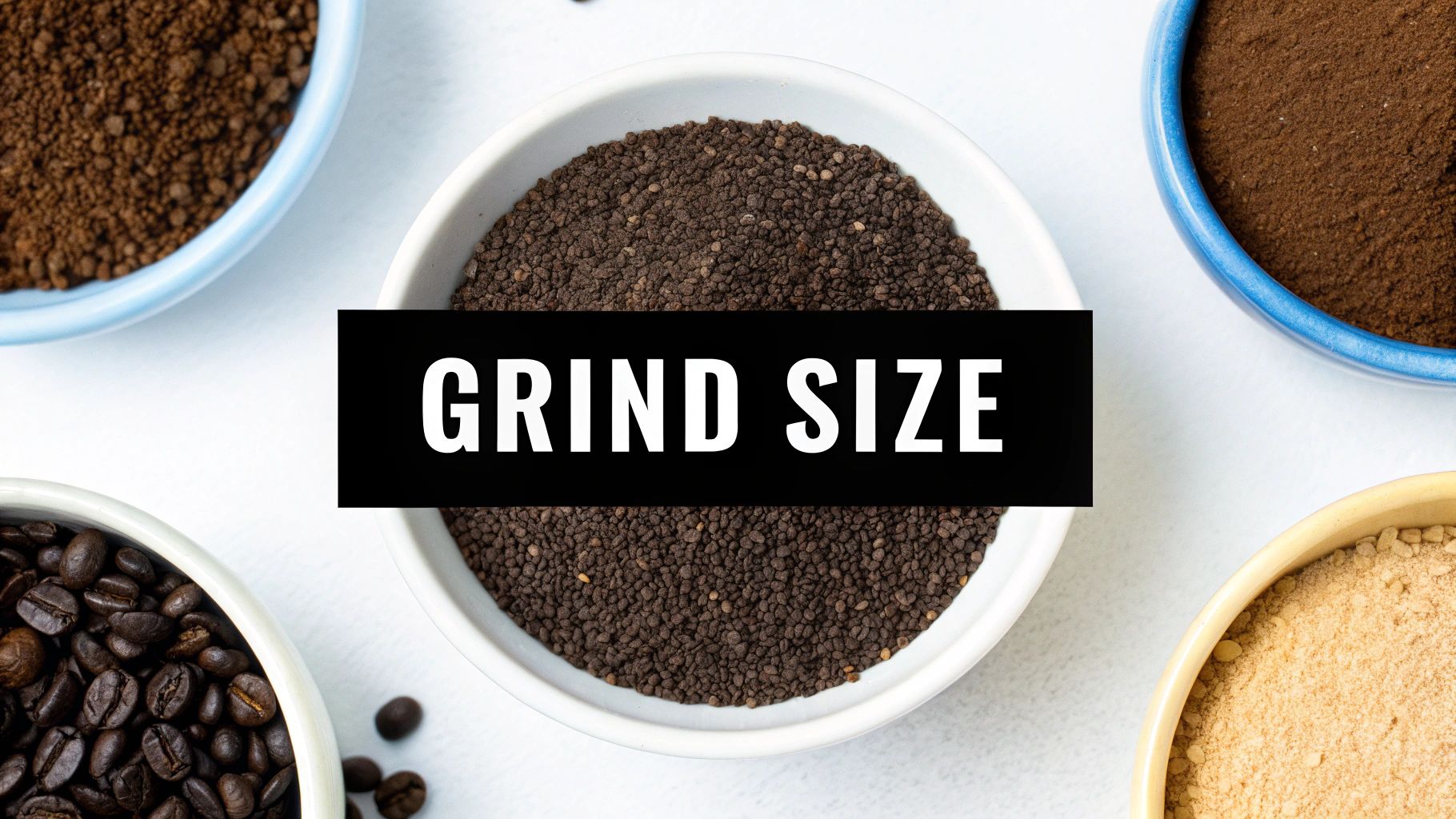
The search for the perfect grinder always circles back to one crucial question: how are you brewing your coffee? Every method, from a delicate pour-over to a powerful espresso, is a different kind of performance. Your grind size is the script, and getting it right is the secret to unlocking the full potential of your beans.
This isn’t just about making coffee grounds smaller. It’s about understanding the physics of extraction. A coarse grind for a French press needs time to infuse slowly, while a fine, compacted puck of coffee for espresso has to stand up to intense pressure. Your grinder is what gives you this control, turning a good coffee into a truly great one.
The dedication to home brewing has exploded in the UK as more of us try to replicate that café experience. This shift led to a 10-15% rise in sales of quality burr grinders between 2020 and 2024, as coffee lovers graduated from pre-ground bags to whole beans. You can learn more about this trend in this report on the growth of the UK home coffee market.
Pour-Over Perfection (e.g., V60)
Pour-over is all about clarity, control, and teasing out the subtle, bright notes of a single-origin coffee. To do this, you need a medium-fine grind—think something with the texture of table salt.
Uniformity is everything here. If you have too many fine particles (known as "fines"), they'll clog the paper filter, stalling the brew and leading to an over-extracted, bitter cup. On the other hand, too many coarse particles will let the water rush through, leaving you with a weak and sour brew.
- Your Goal: A clean, consistent grind that allows for an even extraction, typically taking between two and three minutes.
- Grinder Requirement: A model with clear, repeatable steps in the medium range is perfect. It lets you make tiny tweaks to dial in your brew time perfectly.
The Versatile AeroPress
The AeroPress is the chameleon of the coffee world, loved across the UK for its speed and sheer versatility. It can handle just about anything you throw at it, from a fine, espresso-like grind for a short, punchy shot to a medium grind for a longer immersion brew.
Because it's so flexible, your grinder needs a good range. The best grinder for an AeroPress enthusiast is one that can jump between settings easily without losing its place, giving you the freedom to experiment with the thousands of recipes out there.
The beauty of the AeroPress lies in its forgiveness, but consistency is still king. A quality burr grinder ensures that whichever recipe you follow, your results are delicious and repeatable every single time.
French Press Full-Bodied Flavour
The French press, or cafetière, is a classic for a reason. It’s an immersion brewer that produces a rich, full-bodied coffee with a satisfying, oily texture. The trick to a clean, sediment-free cup is a uniformly coarse grind, like the consistency of rough breadcrumbs.
Grinding too fine is the number one mistake people make. Those tiny particles will slip right through the metal mesh filter, creating that unpleasant sludge at the bottom of your cup. Worse, they’ll over-extract during the four-minute brew, creating a harsh, bitter flavour that completely masks the coffee’s true character.
- Your Goal: A clean separation of grounds and coffee, giving you a rich brew that isn't gritty.
- Grinder Requirement: It absolutely must be able to produce a consistent coarse grind with very few fine particles.
The Unforgiving World of Espresso
Espresso is the ultimate test of a grinder. It demands an incredibly fine and consistent grind that can be packed into a dense puck, creating enough resistance to withstand nine bars of pressure. This is completely non-negotiable.
The tiniest inconsistency will create weak spots in the coffee puck, causing "channelling"—where water finds the path of least resistance and blasts through. This under-extracts some of the coffee (making it sour) while over-extracting the channel itself (making it bitter). It’s a recipe for a bad shot.
To get it right, you need a grinder with micro-adjustments. Look for a stepless model or one with dozens of tiny steps. This lets you "dial in" your shot with surgical precision, making minute changes to find that perfect, syrupy extraction.
Keeping Your Grinder in Top Form
Buying a great coffee grinder is a massive step towards incredible flavour, but it's an investment that needs looking after. Think of it like a high-performance engine; it needs a bit of regular maintenance to keep running smoothly. If you neglect it, stale coffee grounds and rancid oils will build up, contaminating those fresh, beautiful beans you grind each morning.
This build-up doesn’t just taint the taste of your coffee. It can seriously impact your grinder's performance, leading to inconsistent grinds and even mechanical problems down the road. The secret to protecting your investment and ensuring every cup is as clean and delicious as it should be is a simple, consistent cleaning routine.
Your Essential Cleaning Toolkit
You don't need a pro-level workshop to keep your grinder pristine. Most of the essentials are simple items you can find at any local UK supermarket or hardware shop.
- A Stiff-Bristled Brush: The hero for dislodging stubborn grounds from the burrs and chute.
- A Soft Cloth: Perfect for wiping down the exterior and the bean hopper.
- A Small Vacuum Cleaner: A handheld vac or a nozzle attachment is brilliant for getting rid of fine coffee dust.
- Grinder Cleaning Pellets: These are food-safe pellets designed to run through your grinder, absorbing oils and clearing out old residue.
With these simple tools on hand, you can set up a maintenance schedule that’s easy to stick to and genuinely effective.
A Simple Maintenance Routine That Works
Consistency is so much more important than intensity here. If you break the process down into small, regular tasks, it stops feeling like a chore and just becomes part of your coffee ritual. We recommend thinking of it in terms of daily, weekly, and deeper monthly cleans.
Daily (30 Seconds):
After your last grind of the day, just give the exit chute a quick brush out. If you single-dose your beans, using a small bellows to puff out any trapped grounds is an excellent habit to get into. This tiny action stops stale coffee from mixing with tomorrow morning's fresh beans.
Weekly (5 Minutes):
Once a week, it’s time for a slightly deeper clean. Unplug the grinder, take off the hopper, and empty out any beans. Use your brush and vacuum to clear out the grinding chamber and burrs, getting rid of any visible grounds and built-up dust.
A proper clean isn't always about taking the whole thing apart. Running some specialised, food-safe cleaning pellets through your grinder once a month is a brilliant way to absorb and flush out those stubborn, flavour-killing oils that a simple brush just can't reach.
Monthly (15 Minutes):
For this deeper clean, you'll want to carefully take out the upper burr (always check your grinder’s manual first!). This gives you direct access to properly brush and vacuum the burrs and the grinding chamber. This is your chance to tackle the oily residue that can turn rancid and completely ruin the taste of your coffee. Following this up with a cycle of grinder cleaning pellets will leave the internal pathways spotless, ensuring nothing gets in the way of your coffee's pure flavour.
Frequently Asked Questions About Coffee Grinders
Stepping into the world of coffee grinders can feel like learning a new language. To help you make sense of it all, we’ve put together answers to the most common questions we hear from UK coffee lovers, giving you the confidence to choose the right grinder for your setup.
What Is the Real Difference Between Flat and Conical Burrs?
The main distinction between flat and conical burrs comes down to their shape and the kind of grind they produce. Conical burrs use a cone-shaped inner burr that sits inside a ring-shaped outer burr. This design often creates a ‘bimodal’ grind, meaning you get two dominant particle sizes, which can add body and complexity—a quality many people love in their espresso. They also tend to hold onto less coffee grounds and run a bit cooler.
Flat burrs, on the other hand, are two parallel, serrated rings that face each other. They’re known for producing a highly uniform, or ‘unimodal’, grind. This precision is a huge plus for pour-over brewing, where clarity of flavour is everything. It really helps those delicate floral and fruit notes in a coffee to shine through.
Ultimately, your choice of burr type should match your brewing style. If you’re chasing a rich, textured espresso, a conical burr grinder is a fantastic ally. If a crystal-clear cup of filter coffee is your goal, flat burrs might just be your ticket to perfection.
How Much Should I Spend on a Good Grinder in the UK?
Your budget really depends on how deep you want to go with your coffee brewing. For a brilliant entry-level manual grinder that’s perfect for filter coffee, you can expect to spend somewhere between £60 and £120. If you’re looking for a quality electric burr grinder for methods like pour-over or AeroPress, you’ll be looking at around £130 to £250.
However, if you're serious about making true espresso at home, a capable grinder isn’t just nice to have—it’s essential. You should set aside a minimum of £250 to £450 for an entry-level electric model. This will get you the fine, consistent grind and the micro-adjustment control you absolutely need to pull a great shot.
Is a Stepless Grinder Better Than a Stepped One?
Whether a grinder is "better" really comes down to what you're brewing. A stepped grinder has pre-set clicks or settings, which makes it incredibly easy to switch between grind sizes for different methods like French press and pour-over. It’s perfect if you enjoy brewing a variety of coffee styles and want repeatable results every time.
A stepless grinder, in contrast, gets rid of the fixed clicks, offering infinite adjustments between the finest and coarsest settings. This level of fine-tuning is almost non-negotiable for "dialling in" the perfect espresso, where the tiniest change in grind size can make a massive difference to your shot. The trade-off is that it can be less convenient if you frequently switch between, say, espresso and filter coffee.
At Ue Coffee Roasters, we believe the right equipment unlocks the full potential of speciality coffee. From high-performance electric grinders to versatile brewers, we provide the tools you need to elevate your home coffee experience. Explore our curated selection of brewing equipment and find the perfect partner for our exceptional beans at https://www.uecoffeeroasters.com.