

A UK Guide to Sourcing Wholesale Coffee Beans
Venturing into the world of coffee beans wholesale is a huge moment, whether you're finally opening that dream café, levelling up the office coffee, or scaling up your retail brand. But let’s be honest, finding the right partner in the UK's incredible speciality coffee scene can feel daunting. This is your guide to navigating that process with confidence.
Your Guide to Sourcing Wholesale Coffee
Forget sifting through endless supplier lists and trying to decipher industry jargon. We’re going to walk through the entire journey together, from finding a roaster that genuinely gets your vision to the fine art of tasting samples and building a relationship that actually helps your business grow. Think of this as your inside track to buying wholesale with confidence.
The UK's passion for great coffee has created a market that's both vibrant and fiercely competitive. That buzz is a massive opportunity for any business ready to serve something exceptional. It all starts with making smart choices about your most important product.
The Foundation of a Great Coffee Programme
Choosing a wholesale supplier isn't just another transaction on your to-do list; it's the very foundation of your entire coffee offering. The right partner does so much more than just sell you beans. They effectively become an extension of your team, offering the kind of support, training, and insight that is absolutely vital for growth in the UK market.
A great wholesale relationship means you get:
- Consistent Quality: Your customers will come back for that same excellent coffee, every single time.
- Ethical Sourcing: Working with a roaster committed to sustainability and fair practices is something modern UK customers actively look for.
- Expert Support: Getting access to proper barista training, equipment advice, and menu ideas helps you stay miles ahead of the competition.
The UK's coffee stats really drive this home. With around 98 million cups of coffee drunk every day across the country, the potential for a business that serves genuinely brilliant coffee is immense. This huge demand is what fuels our thriving wholesale market. You can dive deeper into the UK's coffee habits in this Balance Coffee report.
Your choice of wholesale coffee beans directly impacts your brand's identity, customer loyalty, and ultimately, your bottom line. It’s the single most important sourcing decision you will make.
By taking the time to get this right, you’re not just setting yourself up to serve delicious coffee—you’re building a memorable and successful brand from the ground up.
Finding and Vetting Your Ideal Coffee Partner
The soul of any great coffee offering is an equally great wholesale partner. And let’s be honest, in the UK's buzzing speciality market, the sheer number of roasters can feel a bit much. But trust me, your perfect match is out there. This isn’t just about placing an order; it’s about building a relationship that becomes a cornerstone of your business.
So, where do you start? Get out there and immerse yourself in the coffee community.
Trade shows like the London Coffee Festival or its Manchester counterpart are brilliant for this. You can meet dozens of roasters face-to-face and cup a huge range of coffees all in one place. It’s the best way to get a feel for a company's vibe and passion before you even think about talking business.
Beyond the big events, just look around you. Pop into the successful independent cafés in your area—the ones you admire. See whose beans they’re using. Their choice is usually a solid stamp of approval for both quality and reliability. Online directories for the UK speciality scene can also be a goldmine for discovering hidden gems you might have otherwise missed.
Looking Beyond the Beans
Once you’ve got a shortlist, the real work begins. A great partnership is about so much more than just the taste of the coffee. You’re looking for a supplier who’s genuinely invested in your success and can offer support that actually makes a difference.
This is where asking the right questions is everything. Before you even get to pricing, dig into what else they bring to the table:
- Barista Training: Do they offer hands-on training for your team? A supplier who helps you dial in your espresso and perfect your latte art is a true partner.
- Equipment Guidance: Can they give you solid advice on grinders, espresso machines, and filter brewers that fit your space and budget? Their expertise here can save you a lot of headaches.
- Technical Support: What’s the plan when your machine goes down mid-morning rush? Knowing they have reliable technicians on call is an absolute lifesaver.
Finding a wholesale supplier is a bit like hiring a key team member. Their expertise, reliability, and values need to align with your own if you want to build a strong, lasting coffee programme.
A good way to structure this vetting process is to have a clear set of questions ready. It keeps you focused and ensures you cover all the crucial points with each potential supplier.
Key Questions for Vetting UK Wholesale Coffee Suppliers
Here’s a checklist of essential questions to ask potential partners. This will help you systematically compare them and ensure they meet your quality, ethical, and business standards.
| Category | Essential Question to Ask | Why It Matters |
|---|---|---|
| Coffee & Quality | Can you provide samples of your core espresso blend and a few single origins? | You need to love the coffee, first and foremost. It must match the flavour profile your customers will enjoy. |
| Sourcing & Ethics | Can you tell me about the farms you work with? How transparent is your supply chain? | UK customers increasingly care about ethical and sustainable sourcing. A roaster with direct relationships can provide powerful stories. |
| Training & Support | What does your barista training programme involve? Is it ongoing? | Proper training ensures consistency and quality in every cup you serve, which is vital for customer retention. |
| Technical & Equipment | Who provides technical support for equipment? What is your typical response time for a call-out? | Downtime costs you money. A supplier with fast, reliable tech support is non-negotiable for a busy café. |
| Logistics & Ordering | What is your minimum order quantity (MOQ) and what are the delivery lead times? | You need a supplier whose logistics fit your business's scale and cash flow. Unrealistic MOQs can be a major hurdle. |
| Partnership & Growth | How do you support your wholesale partners beyond just supplying coffee? | Look for partners who offer marketing support, help with menu development, or host events. This shows they’re invested in your growth. |
Having these answers will give you a much clearer picture of who you’re about to partner with, making the final decision far easier.
Aligning on Values and Vision
Finally, a truly great partner will share your commitment to quality and ethics. Transparency here is a must.
Ask them straight up about their sourcing practices. Can they tell you the story behind their beans? This isn't just fluffy marketing—it’s about making sure the coffee you serve is part of a sustainable and fair supply chain.
Get a feel for their roasting philosophy, too. Are they all about showcasing the unique, wild character of a single-origin Geisha, or are they masters of crafting a consistent, crowd-pleasing blend? Neither is wrong, but their approach has to match the experience you want to create.
It’s this alignment of values that turns a simple supplier transaction into a powerful partnership. And that’s what will truly elevate your brand.
Decoding Bean Quality Through Cupping and Sampling
You’ve got the samples. Now the real fun begins. This is the moment you move past the sales pitches and marketing fluff to connect directly with the coffee itself. The formal tasting process, known as cupping, might sound a bit clinical, but it’s actually the most empowering skill you can develop when buying beans.
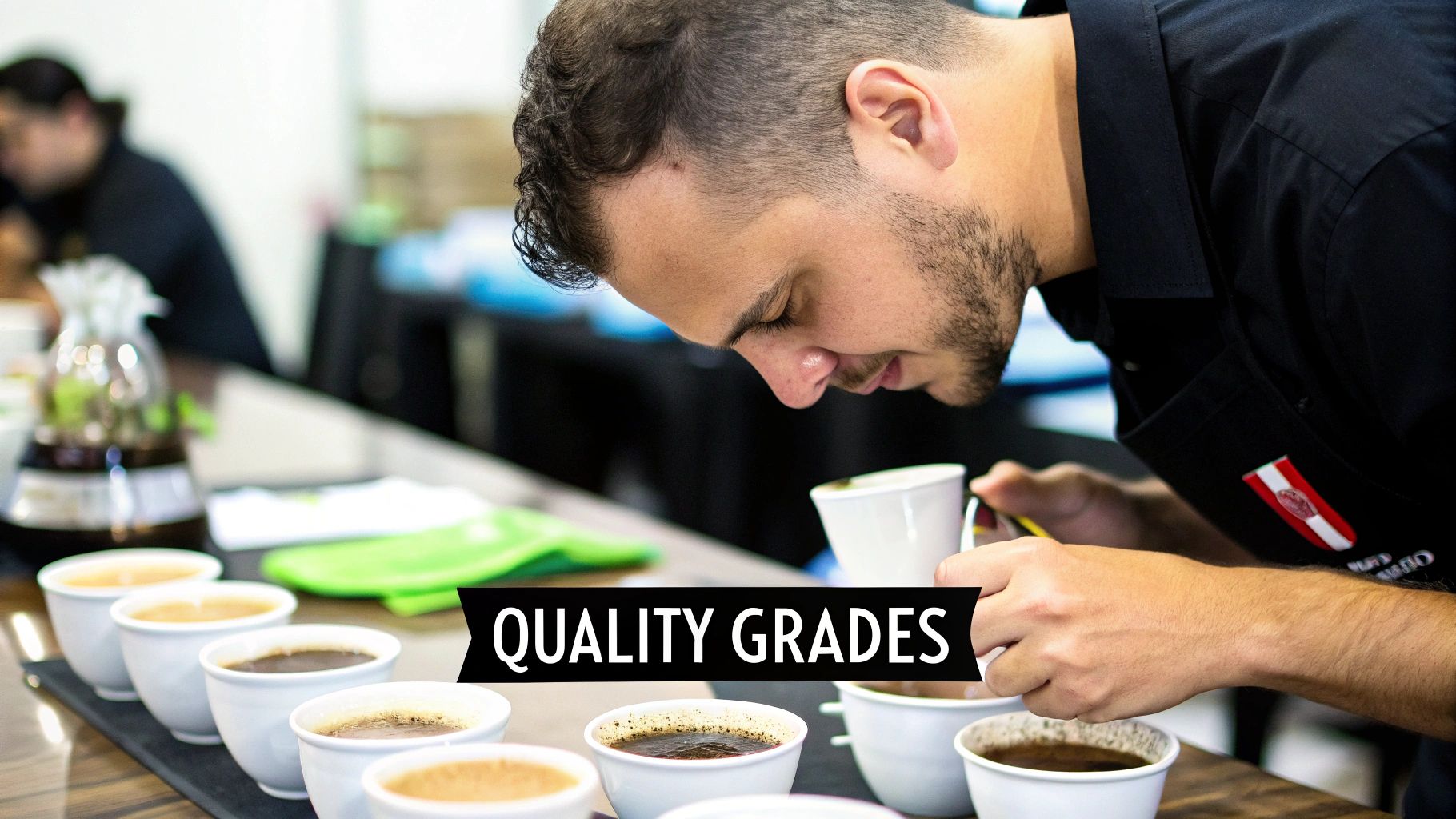
Forget the idea of becoming a master taster overnight. Think of it more like a structured way of paying attention—a method for building a palate you can trust. It’s this skill that lets you properly judge any coffee beans wholesale offering and find the perfect match for your customers.
The Fundamentals of a Cupping Session
At its heart, cupping is a straightforward process designed to strip everything back and let a coffee’s true character shine. You don’t need a high-tech lab; a few bowls, spoons, a grinder, and some hot water will do just fine. The whole point is to standardise the brewing so the only thing you’re judging is the coffee itself.
The process usually breaks down into a few key moments:
- Dry Fragrance: Get your nose in the bowl of freshly ground coffee. What do you smell? Is it nutty, floral, fruity, or earthy? Jot it down.
- Wet Aroma: Pour hot water over the grounds and let them steep. A crust will form on top. When you break it with your spoon, lean in and take a big sniff of the intense aroma that gets released. This is often where a coffee’s personality really comes out.
- Tasting: After a few minutes, skim the floating grounds off the surface. Now for the noisy part. Using a deep spoon, slurp the coffee vigorously. That slurp is essential—it sprays the liquid across your entire palate, helping you pick up its full range of flavours.
This simple routine helps you move beyond a basic "I like it" or "I don't" and into a much richer analysis of what makes each coffee tick.
Cupping empowers you to make informed decisions based on your own palate, ensuring the coffee you choose aligns perfectly with your brand's vision and your customers' tastes.
As you taste, try to focus on a few core attributes. Is the acidity sharp and zesty like a lemon, or is it softer and rounder like a ripe plum? Think about the body—does the coffee feel light and tea-like, or is it heavy and creamy on your tongue? And finally, what are the actual flavour notes?
Distinguishing Origins and Processing
This is where cupping really proves its worth as a sourcing tool. You'll quickly start to notice the huge differences that origin and processing methods create. It’s one thing to read that a washed Ethiopian Yirgacheffe has bright, floral notes, and another thing entirely to taste it next to a deep, chocolatey, natural-processed Brazilian coffee.
Being able to spot these differences is crucial, especially in the UK’s dynamic coffee scene. The UK is a major player, both importing and re-exporting high-quality coffee. In 2023, the country's coffee export volume was around 92,050 metric tons, a testament to the strength of its wholesale market. Knowing your flavour profiles lets you tap into this incredible diversity with confidence. You can read the full research about the UK coffee export market to learn more.
By taking the time to develop your palate, you can confidently pick out a versatile house espresso that will please the masses or identify that show-stopping single origin to feature on your filter menu. It’s a journey of sensory discovery that ultimately gives you the final say on quality.
Navigating Pricing, Orders, and Supply Agreements
This is where your love for fantastic coffee meets the hard reality of running a business. The price you pay for your beans isn't just a number pulled out of thin air; it’s a complex mix of global market trends, your roaster's own costs, and the specific origin and grade of the coffee you’ve fallen for. Getting your head around these details is crucial for building a buying strategy that keeps your cash flow healthy and your hoppers full.
Right now, one of the biggest challenges for UK businesses is market volatility. The speciality coffee scene has been hit by significant price inflation, especially for Arabica beans. Global factors, like unpredictable weather in key growing regions, have pushed prices to historic highs, creating a challenging buying landscape.
Getting to Grips with Pricing Tiers and MOQs
Most UK roasters use a tiered pricing model. It’s simple, really: the more you buy, the less you pay per kilo. This is their way of rewarding bigger, more consistent orders.
This little graphic breaks down how it usually works.
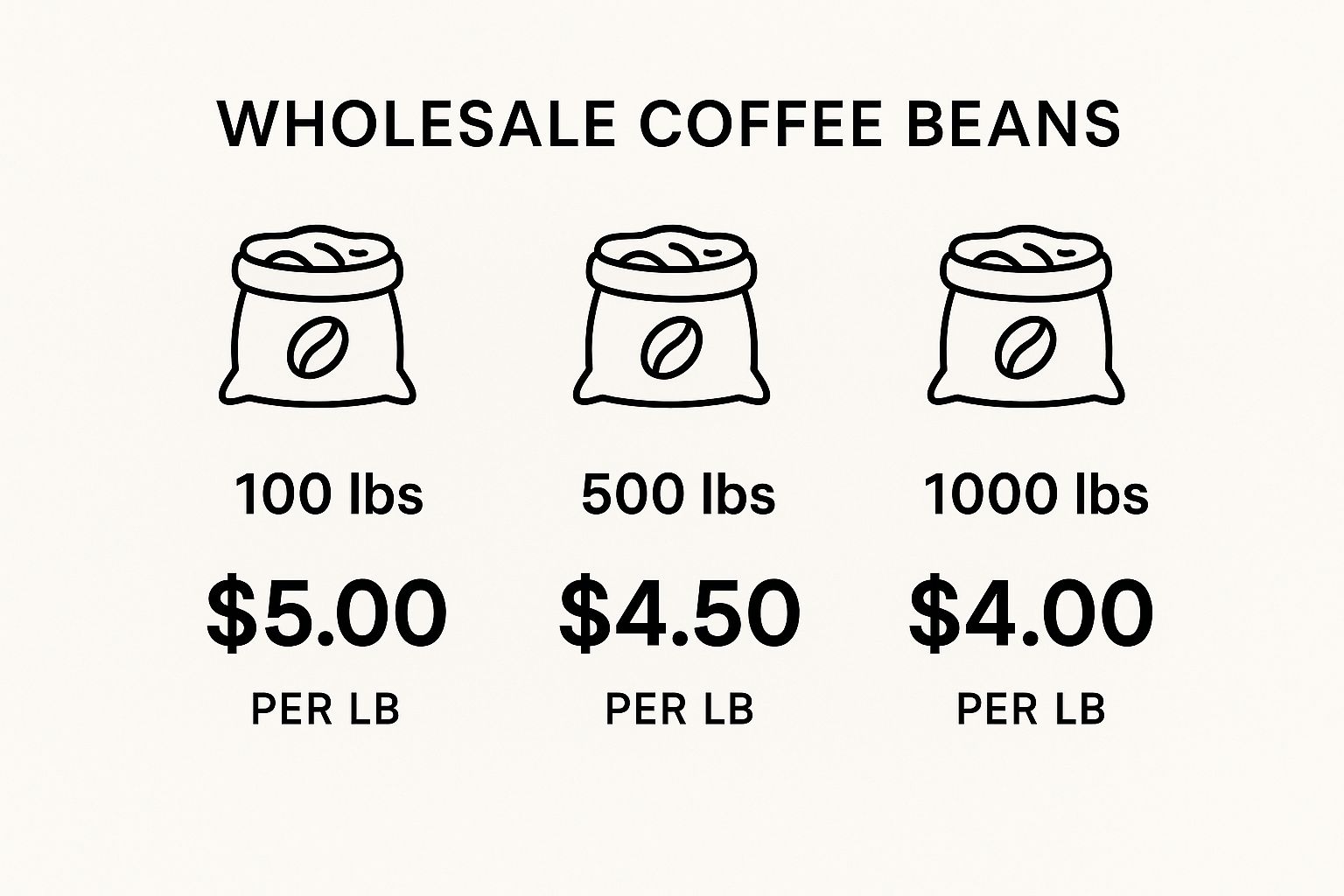
As you can see, committing to a larger volume can seriously bring down your cost per unit. This brings us to the Minimum Order Quantities (MOQs) – the smallest order a roaster will fulfil. For a new café just starting out, a high MOQ can feel like a massive hurdle, tying up precious cash in stock.
Don’t let that put you off. Talk to them. Many UK roasters are genuinely keen to support new businesses and may offer flexible terms. They might be open to a slightly higher price per kilo for a smaller first order, with an agreement to review the terms once your business is established and your volumes are more predictable.
Building a solid, honest relationship with your roaster is your best tool. It shifts the dynamic from a simple transaction to a real partnership where everyone wants the other to succeed.
Wholesale Pricing Model Comparison
To help you understand your options, here’s a look at the common pricing models you’ll come across with UK wholesale suppliers. Each has its pros and cons, depending on the size and nature of your business.
| Pricing Model | How It Works | Best For | Potential Drawback |
|---|---|---|---|
| Tiered Volume Pricing | The price per kilogram decreases as the total order volume increases. | Cafés and offices with consistent, predictable coffee consumption. | Can be costly for businesses with fluctuating demand or limited storage. |
| Fixed Contract Pricing | A set price is agreed upon for a specific period (e.g., 6-12 months), regardless of market fluctuations. | Businesses looking for budget stability and protection from price hikes. | You could miss out on savings if market prices fall significantly. |
| Spot Pricing | You pay the current market price at the time of order. | Small businesses or those wanting to test different beans without long-term commitment. | Highly unpredictable and exposed to sudden price increases. |
| Subscription Model | A recurring order is set up for a fixed quantity at regular intervals (e.g., weekly, monthly) often with a small discount. | Small offices or cafés wanting automated, hassle-free ordering. | Less flexibility to adjust order sizes on the fly. |
Ultimately, the right model depends on your business's needs for predictability, flexibility, and volume. Don't hesitate to ask potential suppliers which models they offer and which might be the best fit for you.
Securing Your Supply Agreement
Once you’ve settled on the numbers, it’s time to make it official. A clear supply agreement is your safety net. It protects you and your roaster by making sure everyone is on the same page from day one.
A good agreement should nail down a few key things:
- Payment Terms: When do invoices need to be paid? Are there late fees? In the UK, 14 or 30-day terms are pretty standard.
- Delivery Schedule: How long will it take to get your coffee after you order? Is there a set delivery day for your postcode?
- Quality Assurance: What’s the plan if a batch just isn’t right? A proper agreement will have a clear process for returns or credits, so you're not left with coffee you can't use.
To get the best deal, it pays to brush up on some powerful contract negotiation strategies. Walking into these conversations with confidence and knowing what you need is the key to building a fair, solid partnership that will help your coffee programme shine.
Managing Your Coffee Inventory for Peak Freshness
You’ve found the perfect roaster and agreed on the terms. Fantastic. But the job isn't done. Now comes the real make-or-break part: getting the logistics right. This is where you ensure the incredible quality you tasted in that first sample cup is the exact same quality your customers get, day in, day out.
Great inventory management isn't just about making sure you don't run out of beans. It's about respecting the coffee and its entire journey, from farm to cup.
First things first, you need to figure out your ‘burn rate’—how quickly you actually get through your coffee. For a café, this is as simple as tracking your daily sales and how much you're putting through the grinder for a week or two. If you’re using 3kg of espresso beans a day, your weekly burn rate is a straightforward 21kg.
Knowing this number is your secret weapon.
It lets you work backwards from your roaster's delivery schedule. Let’s say your supplier needs three days' notice to get an order to your door, and you know you burn through 21kg a week. That means you absolutely must place your next order when you still have at least 9-10kg left. This simple bit of maths creates a seamless restocking system, stopping you from making last-minute panic orders or, even worse, running out completely.
Calculating Your Ideal Order Cycle
A smart delivery schedule is all about finding that sweet spot between freshness and efficiency. Order too little, too often, and you’re drowning in delivery admin and paying more than you need to for shipping. Order way too much, and you’re tying up cash in stock that's slowly going stale.
Think of it like this: roasted coffee is at its absolute peak between 7 to 21 days after the roast date. Your goal is to keep as much of your stock as possible sitting comfortably within that prime flavour window.
Here’s a practical approach for a small UK café:
- Weekly Burn Rate: Work out your average weekly consumption. No guessing!
- Safety Stock: Always keep a buffer. At least three to four days' worth of coffee should be on hand to see you through a surprise rush or a delayed delivery.
- Order Frequency: Aim for a weekly or fortnightly delivery. This keeps your coffee consistently fresh without completely taking over your stock room.
Your inventory system shouldn't be a source of stress. It should be a quiet, efficient machine that guarantees every bag you open is bursting with the vibrant flavour your roaster intended.
The Non-Negotiables of Proper Storage
Once those precious wholesale coffee beans arrive, how you store them is everything. The enemies of fresh coffee are surprisingly simple: oxygen, light, heat, and moisture. Protecting your beans from these four things is completely non-negotiable.
Always, always store your coffee in airtight, opaque containers. The valved bags your coffee arrives in are good, but for any opened bags, dedicated storage canisters are far better. Keep them somewhere cool and dark, well away from direct sunlight or heat sources like the back of the espresso machine or a hot oven.
This careful management is the final act of respect for the coffee and for the people who grew it. By mastering your inventory, you’re completing that chain of quality, turning a simple wholesale purchase into an unforgettable experience for every single customer.
Bringing Your Coffee Programme to Life
You’ve got the beans. Now what? Securing your wholesale supply is a massive step, but it’s just the beginning. The real magic happens when you turn those carefully chosen beans into the heart and soul of your business—a living, breathing coffee programme that keeps customers coming back.
This is where you build a dynamic partnership with your roaster, tell compelling stories, and commit to always getting better.

Your relationship with your roaster shouldn't stop once the invoice is paid. The best UK roasters aren’t just suppliers; they’re partners, genuinely invested in your success. They’re sitting on a goldmine of expertise that can elevate your entire operation, if you know how to tap into it.
Think of it as your gateway to continuous growth and excellence.
Get More from Your Roaster Partnership
Treat your roaster like a collaborator. Their success is tied to yours, making them one of your most powerful allies. Many of the UK's leading roasters offer incredible support that goes far beyond just selling you coffee.
Here's what that often looks like:
- Expert Barista Training: Great roasters can offer professional training to get your team pulling consistently amazing shots. From mastering espresso extraction to pouring silky-smooth milk, this is the stuff that builds a loyal customer base.
- Equipment Help: They can help you dial in your grinders and espresso machines to perfectly suit their coffee. It’s all about making sure you’re extracting the absolute best flavour from every single bean.
- Menu Ideas: Thinking about adding a new single-origin filter or a signature seasonal drink? Your roaster can give you tasting notes, brewing recipes, and creative ideas to keep your menu fresh and exciting.
Don’t be shy about asking for help. Leaning on your supplier’s knowledge shows you’re serious about quality and helps build a strong, collaborative partnership.
Share the Story Behind Every Cup
In today’s crowded speciality coffee scene, a good story is what makes you stand out. Every coffee has its own journey—the farm where it was grown, the people who nurtured it, and the unique flavour profile the roaster coaxed out of it. Sharing that narrative transforms a simple drink into a memorable experience.
When a coffee has a story, it stops being just a transaction. It becomes a connection to a place, a person, and a craft. That’s how you build the kind of customer loyalty that price wars can never touch.
Weave these stories into everything you do. Write the tasting notes on your menu boards. Train your staff to chat with customers about the farm the coffee came from. Post on social media about your roaster’s commitment to ethical sourcing.
This kind of transparency doesn't just educate your customers; it reinforces the value and quality of what you're serving. It shows you care about more than just your bottom line.
This is especially true when it comes to sustainability. If your roaster champions eco-friendly practices or direct trade relationships, sharing that becomes a powerful part of your own brand. Customers are actively looking to support businesses that align with their values. Your choice of coffee can give them one more reason to choose you.
Ready to build a coffee programme that stands out? At Ue Coffee Roasters, we're more than just a supplier; we're your partner in excellence. Discover our exceptional range of wholesale coffee beans and find out how our expertise can help your business thrive. Explore our wholesale coffee solutions.