

Mastering the Coffee Water Ratio
Forget about inconsistent brews and confusing advice. The real secret to incredible speciality coffee at home boils down to one thing: the coffee water ratio. Don't think of it as a rigid rule, but as your most powerful starting point for crafting a cup that’s perfectly dialled in to your taste.
Your Journey to the Perfect Brew Starts Here
This guide is about moving beyond guesswork and starting to brew with real intention. Once you get a handle on the coffee water ratio, you take control of your coffee’s flavour, strength, and aroma. Honestly, it’s the single most important variable separating a decent cup from a truly exceptional one.
That ‘golden ratio’ you hear so much about is just a widely accepted jumping-off point, usually around 1 part coffee to 16 parts water (a 1:16 ratio). The real magic, though, happens when you learn to tweak this baseline to fit your palate and your gear. This is about building intuition, not just blindly following a recipe.
Why This Ratio Is a Game-Changer in the UK
Here in the UK, our love for coffee is massive. We’re drinking a staggering 98 million cups every single day, a figure that shows just how woven into our lives this drink has become. That passion covers everything from a quick instant coffee at home to a perfectly pulled flat white from a speciality shop.
With such varied tastes, a one-size-fits-all approach to brewing just doesn't cut it. For a deeper dive into our national coffee habits, you can check out the full coffee consumption statistics here.
Learning to manipulate your coffee water ratio is what lets you replicate—or even improve on—your favourite café experiences right in your own kitchen. Suddenly, you have the power to:
- Control the Strength: Easily make your coffee bolder or milder without wrecking the flavour.
- Enhance Specific Flavours: Bring out the bright, fruity notes in a single-origin bean or deepen the rich, chocolatey tones of a blend.
- Achieve Unbeatable Consistency: Brew a brilliant cup of coffee, every single time.
By mastering this one concept, you stop being a passenger and become the driver of your coffee journey. It’s the key to unlocking the full potential of every bean you buy.
The goal here is to train your palate. As you start experimenting, you’ll notice how a small shift from a 1:16 to a 1:15 ratio can create a more intense, full-bodied brew that’s perfect for a strong morning start. On the flip side, moving to 1:17 might just reveal the delicate, nuanced flavours hiding in a lighter roast. Your perfect cup is out there, just waiting for you to find it.
The Essential Toolkit for Precision Brewing

You don’t need a counter full of expensive, complicated gadgets to make fantastic coffee. The real secret is consistency. Before we dive into the numbers, let's talk about the simple tools that put a perfect coffee water ratio within anyone's reach. It all starts when you stop guessing and start measuring.
The single most important piece of kit in your brewing arsenal is a digital scale. Ditching vague ‘scoops’ for precise grams is the first proper step towards brewing exceptional coffee you can repeat time and time again. Ideally, you want a scale that measures in 0.1-gram increments, giving you pinpoint accuracy for weighing both your coffee beans and your water.
Your Grinder and Water Quality
Next up is a quality burr grinder. Blade grinders are chaotic—they smash beans into a mix of dust and chunks. This leads to a muddled, uneven extraction where some grounds give up too much flavour (bitterness) while others give too little (sourness). A burr grinder, on the other hand, mills the beans to a consistent particle size, which is absolutely crucial for a balanced, flavourful brew.
Just as important is the water you’re using. Tap water quality varies massively across the UK in terms of its mineral content, or ‘hardness’. Hard water, full of minerals like calcium and magnesium, can easily overpower the delicate, bright notes in a speciality coffee. Go too soft, though, and your brew can taste flat and lifeless.
The fix is surprisingly simple: use filtered water. A basic filter jug is often all it takes to balance the mineral content, stripping out chlorine and other impurities that get in the way of great flavour. This one change can elevate your coffee more than you’d think, letting the true character of the beans shine through.
This simple trio—a scale, a burr grinder, and good water—is the foundation of precision brewing. You don’t need the flashiest models on the market, just reliable tools that do the same thing, the same way, every time.
Here’s a quick checklist for what to prioritise:
- Digital Scales: Find one with a 'tare' function, so you can easily zero out the weight of your brewer. A built-in timer is a fantastic bonus, especially for pour-over.
- Burr Grinder: Even an entry-level hand-cranked burr grinder is a huge leap in quality from a blade grinder, offering far better consistency without a massive price tag.
- Water Filtration: A simple activated carbon filter, like the ones in popular water jugs, is an excellent and affordable starting point for better-tasting coffee.
With these three things sorted, you’re no longer just making coffee; you’re consciously crafting it. This setup gives you the confidence to experiment with your coffee water ratio, knowing your results are built on precision, not just luck.
Calculating and Measuring Your Ideal Ratio
Alright, let's turn all that theory into a real, tangible part of your morning routine. This is where the magic happens, moving from abstract ideas about the perfect coffee water ratio to the simple, practical steps you'll take with your kettle and scales. Don't worry, you won't need a maths degree—just your phone's calculator and a desire for a truly great cup.
The fundamental idea is wonderfully simple: you decide how much coffee you want to end up with, and the ratio tells you exactly how much ground coffee to start with.
Let’s walk through a classic UK scenario. You want to fill your favourite mug, which holds about 300ml. We'll use the common 1:16 ratio as our starting point. The maths is incredibly straightforward.
300 (your target water weight in grams) ÷ 16 (the second number in your ratio) = 18.75g of coffee.
That’s it. For a standard 300ml mug, you'll need to weigh out 18.75g of whole beans before grinding. This logic works for any brew size or method. Fancy making two cups in a French press and need 600ml of coffee? Just run the same calculation: 600 ÷ 16 = 37.5g of coffee. Easy.
Mastering Your Measurements
Once you have your target weights, accuracy is everything. This is where a good set of digital scales becomes your most trusted brewing companion. The key is getting comfortable with the ‘tare’ function—that little button that resets the scale to zero, letting you measure only the ingredient you’re adding.
A typical workflow looks something like this:
- Place your empty brewer (say, a V60 on top of its server) onto the scales and hit tare. The display should now read ‘0g’.
- Add your freshly ground coffee into the filter until you reach your target weight—in our example, 18.75g.
- Press tare one more time. The scales will zero out again, smartly ignoring the weight of your brewer and the coffee grounds.
- Now, start your pour. Slowly add hot water from the kettle, keeping an eye on the display until it hits 300g.
This simple process guarantees you've hit the exact coffee water ratio you were aiming for. It’s the secret to making your results consistent, day in and day out.
A quick heads-up: your coffee grounds will absorb roughly twice their own weight in water. So, if you use 18.75g of coffee, about 37.5g of water will remain trapped in the wet grounds. This means your final drink will be closer to 262g, not the full 300g you poured. This is completely normal and something every barista accounts for.
The image below breaks down this simple workflow, connecting the dots between weighing your beans, applying a ratio, and measuring your water.
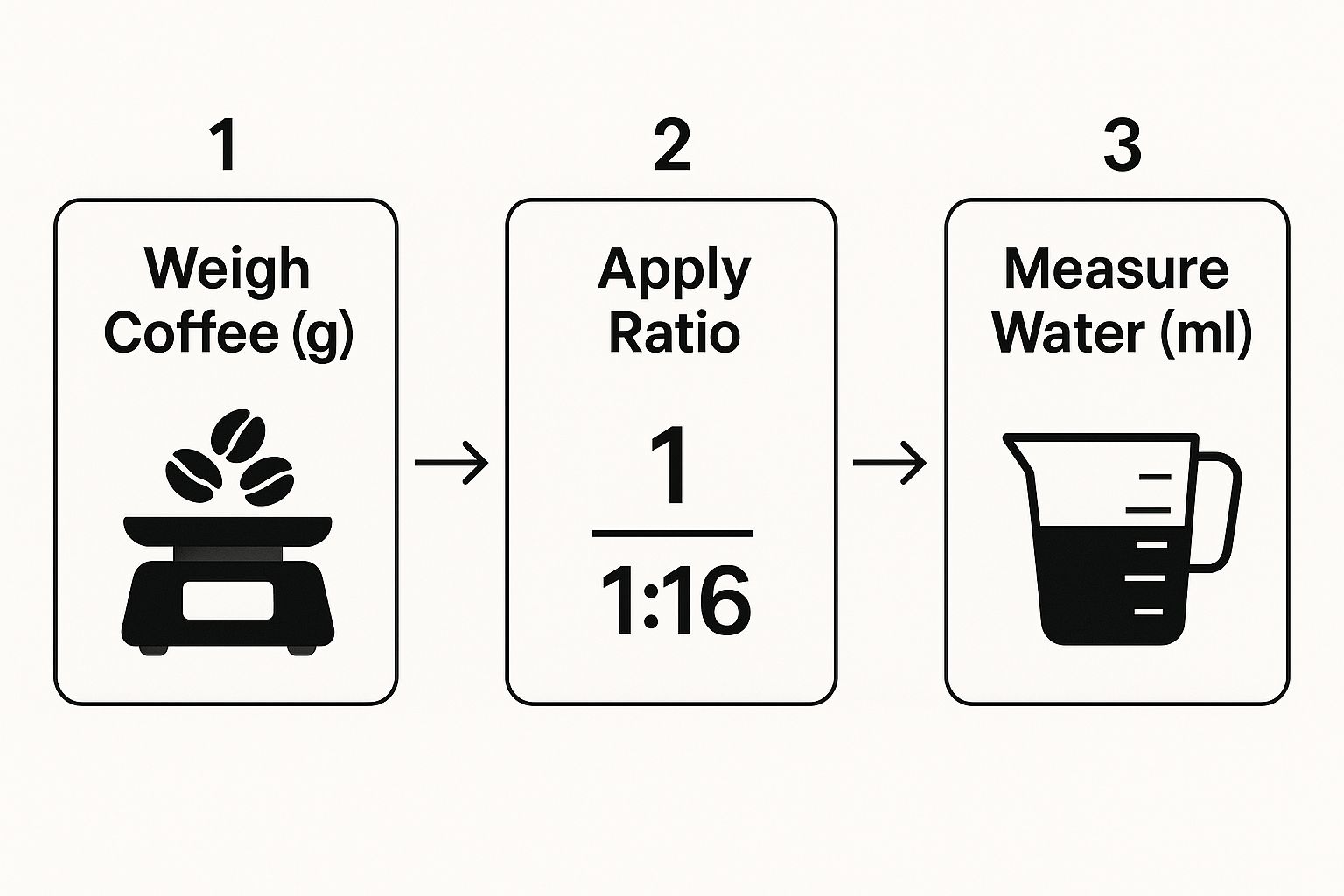
As you can see, turning a desired brew volume into precise measurements is a simple, repeatable process that builds incredible consistency.
Making this a habit removes the biggest variable from your brewing. No more guesswork with scoops, no more hoping for the best. You're now using a clear, logical method to craft your coffee. This foundation of confidence is exactly what gives you the freedom to start experimenting with purpose, knowing you can always come back to a recipe that just works. Precision isn't about being rigid; it’s about giving you the freedom to explore.
Adapting Your Ratio for Different Brew Methods
A good starting ratio is a fantastic foundation, but the real art of brewing begins when you start tweaking that recipe for your specific kit. Every brewer, from a French press to a V60, interacts with coffee grounds in its own unique way.
What works for one won’t necessarily bring out the best in another. This is where you can truly take your home coffee from good to exceptional. It’s a lot like cooking – you wouldn’t use the same heat and timing for every dish. Adapting your coffee water ratio for different brew methods unlocks a whole new spectrum of flavour.
Pour-Over Perfection
For pour-over methods like the V60 or Kalita Wave, which have become mainstays in the UK’s speciality coffee scene, you’re dealing with a relatively quick, continuous extraction. The water flows through the coffee bed, grabbing soluble compounds on its way down. Because of this, a slightly more generous water ratio often works wonders.
We find a great place to start is around 1:16 – that’s one gram of coffee for every 16 grams of water. This ratio gives the water just enough contact time to pull out the delicate, bright, and acidic notes that pour-over is so famous for, without dragging out any unwanted bitterness.
- If your brew tastes weak or watery, try tightening the ratio to 1:15.
- If it’s a bit too intense or bitter, loosen it to 1:17 to mellow things out.
The Full Body of Immersion Brewing
Immersion brewers, like the classic French Press or a clever AeroPress, play by a different set of rules. Here, the coffee grounds are fully submerged in water for the entire brew time. This constant, gentle contact allows for a much fuller, richer extraction.
Because of this, you’ll usually need a stronger coffee water ratio to get a balanced cup with a satisfying body. For a French Press, a 1:14 ratio is an excellent starting point. It creates that bold, robust character that so many people love. Pushing it to 1:12 will give you an even more powerful brew that stands up beautifully to a splash of milk.
The key difference is control. In immersion, extraction is mainly managed by time. In pour-over, it's a dynamic dance between your ratio, grind size, and pouring technique. Adapting your ratio is the first and most impactful adjustment you can make.
The UK's vibrant coffee scene is proof of this pursuit of quality. With spending on out-of-home coffee projected to hit £6.1 billion by 2025 and over 7.9 million people visiting coffee shops weekly, the standard for a great cup has never been higher. The premium coffee shops that dominate the market are constantly fine-tuning their ratios to deliver exceptional taste, and this precision is inspiring home brewers to do the same. You can explore more about the UK's growing coffee market dynamics to see just how much the nation loves a good brew.
A Quick Guide to Common Ratios
Every brewing method has its own sweet spot. While you should always experiment, these recommendations are solid starting points that we use all the time. They’ll get you in the right ballpark, allowing you to fine-tune based on your specific coffee and taste preferences.
Brew Method Ratio Starting Points
| Brew Method | Recommended Ratio (Coffee:Water) | Typical Grind Size | Expected Flavour Profile |
|---|---|---|---|
| Pour-Over (V60, etc.) | 1:16 | Medium-Fine | Clean, bright, delicate, acidic |
| French Press | 1:14 | Coarse | Bold, full-bodied, rich, robust |
| AeroPress | 1:15 (for filter-style) | Medium-Fine | Versatile, clean, can be intense or mild |
| Espresso | 1:2 | Very Fine | Concentrated, syrupy, intense, complex |
| Cold Brew | 1:8 (for concentrate) | Coarse | Smooth, low acidity, sweet, chocolatey |
Think of this table as your cheat sheet. From here, you can start making small adjustments to nail the perfect cup for your palate.
The Intensity of Espresso
Espresso is a different beast entirely. It’s not just another brew method; it’s a highly concentrated coffee extract that forms the backbone of the lattes, flat whites, and cappuccinos that fill UK café menus. Here, the coffee water ratio is incredibly tight.
A standard espresso shot uses a ratio of 1:2, meaning for every 1 gram of ground coffee, you get 2 grams of liquid espresso in the cup. A typical double shot, for instance, might use 18g of coffee to produce around 36g of liquid. This intense concentration is what creates espresso's powerful flavour and velvety texture.
Even tiny changes here have a massive impact. A 1:1.5 ratio creates a thick, syrupy 'ristretto', while a 1:3 ratio produces a longer, milder 'lungo'.
Tasting and Tweaking Your Brew to Perfection
You’ve carefully weighed your beans, calculated your coffee water ratio, and brewed with precision. Now for the most important part: the tasting. This is where you move beyond simply following recipes and start building real brewing intuition. The goal is to connect what you taste in the cup to a specific, actionable tweak.
Think of your starting ratio—say, 1:16—as your baseline. That first sip tells you everything you need to know about where to go next. Is the coffee tasting a little thin, weak, or disappointingly sour? These are classic signs of under-extraction. The water just hasn’t had enough time or contact to pull out all the good stuff from the grounds.
To fix this, you have two simple levers to pull:
- Go for a finer grind. This increases the surface area of the coffee, letting the water extract more flavour, more quickly.
- Strengthen your ratio. Try moving from 1:16 to a punchier 1:15. Using more coffee relative to the water gives you a more concentrated, impactful brew.
Decoding Bitterness and Harshness
On the other hand, what if your coffee comes out unpleasantly bitter, harsh, or with a dry, astringent finish? This points straight to over-extraction, where the water has been too aggressive and started pulling out undesirable, bitter compounds. It’s a really common issue, but luckily, it’s just as easy to solve.
You simply reverse the fix for under-extraction. Either coarsen your grind to slow the whole process down or adjust your coffee water ratio to be a little more forgiving. Shifting from 1:16 to a milder 1:17 gives the coffee more breathing room, usually resulting in a smoother, more balanced cup.
Your palate is the ultimate judge. Learning to identify "sour" versus "bitter" is the skill that transforms your brewing. Sourness is a sharp, acidic tang, while bitterness is a deeper, often lingering harshness. Once you can tell them apart, you know exactly how to adjust.
This desire for a perfectly dialled-in cup is reflected right across the UK. A recent survey looking at how different professions consume coffee indirectly shows just how varied our ratio preferences can be. Journalists and media staff lead the pack, suggesting a potential preference for a stronger coffee water ratio, perhaps for more caffeine per cup. Meanwhile, other professionals average fewer cups per day, and may prefer a ratio that highlights more subtle flavours. You can explore more on how UK work life shapes coffee habits and see how these patterns influence home brewing.
By using this troubleshooting framework, you’re no longer just making coffee—you are crafting it. Every bean and every brew method presents a new puzzle, and now you have the tools to solve it. This is how you find that perfect, inspiring cup, every single morning.
Common Questions About Coffee Water Ratios
Diving into the world of precise coffee water ratios always brings up a few questions. That's a good thing! It's a journey of discovery, and every question you ask is a step toward becoming a more confident, intuitive home brewer.
Here are some of the most common queries we see from coffee lovers across the UK, with practical answers to help clear up any confusion.
Does the Roast Level Affect the Ideal Ratio?
Absolutely. The roast level of your coffee beans has a massive impact on how they extract.
Lighter roasts are denser, and their cellular structure is less porous. This makes their delicate, complex flavours a little harder to draw out. For these beans, you might find a slightly stronger ratio, like 1:15, or even just using hotter water helps to unlock those bright, floral, and acidic notes.
On the other hand, darker roasts are far more brittle and soluble. They give up their flavours very easily and can quickly turn bitter if you push the extraction too far. To avoid that, a slightly weaker ratio, maybe around 1:17, often gives you a more balanced and less harsh cup. Always start with a baseline you know (like 1:16) and let your taste buds guide the final adjustments.
How Can I Approximate Ratios Without a Scale?
While a scale is the gold standard for consistency, you can definitely get close using volume measurements. It's a great way to start brewing better coffee before you decide to invest in some scales.
A standard, level coffee scoop—the kind that often comes with a new brewer—holds roughly 10 grams of ground coffee. A typical UK mug holds about 300ml of water. Armed with that knowledge, you can get very close to a 1:15 ratio:
- Coffee: Use two level scoops for approximately 20g of coffee.
- Water: Fill your 300ml mug with hot water, which is equivalent to 300g.
No, it isn't perfectly precise, but it's a fantastic and repeatable workaround. It will produce a much, much better cup than pure guesswork.
The most important thing is to be consistent. Whether you use a scoop or a scale, using the same measurement every single time is what allows you to make deliberate changes and really learn what you like.
Should I Measure Water Before or After Heating?
For the best accuracy, you should always measure your water by weight (grams), not by volume (millilitres). Water actually expands when heated, meaning 300ml of cold water will take up more space once it’s near boiling. This can easily throw your ratio off.
The best practice is to place your entire brewing setup (your V60 and server, for instance) on your scales and press the 'tare' button to zero it out. Then, pour the hot water directly from your kettle until you hit your target weight. This method guarantees you're measuring the exact amount of water that actually interacts with your coffee grounds.
Finally, don't forget that coffee grounds absorb about twice their weight in water. So, if you use 20g of coffee, around 40g of water will be left behind in the grounds. If you pour 300g of water, your final drink will weigh around 260g—a key detail to remember when you're aiming for a specific final volume in your cup.
At Ue Coffee Roasters, we believe that everyone deserves to brew an exceptional cup. From our carefully sourced single-origin beans to our hands-on brewing masterclasses, we're here to support every step of your coffee journey. Explore our collection of speciality coffee and premium brewing gear today.