

Discover equipment for a coffee shop: Essential Gear
Right, let's talk about the hardware. Getting your coffee shop kitted out is one of the most exciting (and daunting) parts of the whole venture. The hum of a great grinder and the hiss of an espresso machine—that's the sound of your dream coming to life.
But where do you even start? The truth is, your equipment is the engine room of your entire business. It’s where those beautiful, perfectly roasted beans get transformed into the drinks that will have customers coming back day after day. This isn't the place to cut corners.
The Foundational Coffee Shop Equipment Checklist
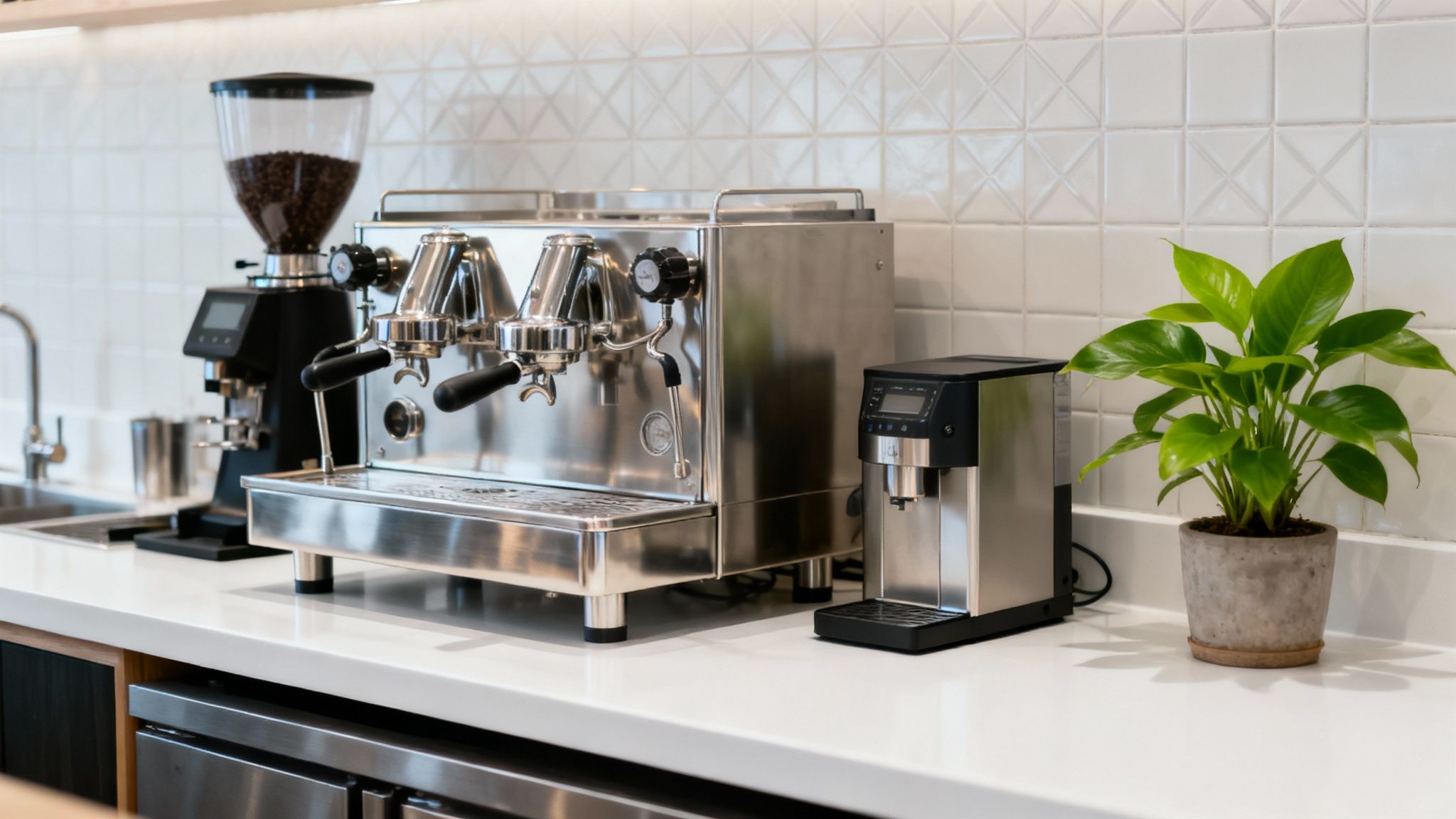
Before you get lost in the sea of shiny stainless steel, let’s focus on the absolute essentials. There are three core pieces of kit that form the bedrock of any serious coffee programme. Getting this trio right is non-negotiable.
The Holy Trinity of Coffee Hardware
At the heart of your bar, three machines work in perfect harmony to produce consistently brilliant coffee. Think of them as a team—each one is just as important as the last.
- Commercial Espresso Machine: This is your showpiece, your workhorse, the heart of the entire operation. It's what turns out the rich, complex espresso shots that form the base of almost everything on your menu, from a punchy flat white to a silky latte.
- High-Quality Burr Grinder: Newcomers often overlook the grinder, but trust me, it’s just as crucial as the espresso machine. A top-notch burr grinder gives you a consistent particle size, and that consistency is the secret to a balanced, delicious, and repeatable extraction.
- Water Filtration System: It's a simple fact: coffee is over 98% water. That means the quality of your H₂O has a massive impact on the final taste in the cup. A proper filtration system not only makes your coffee taste cleaner and brighter but also protects your expensive machines from limescale build-up, which can be a real killer.
Your equipment is an extension of your craft. Choosing the right tools is the first and most important step in honouring the coffee bean and delighting your customers.
To make it even clearer, here’s a quick breakdown of why these pieces are so vital.
Core Coffee Brewing Equipment at a Glance
| Equipment Type | Primary Function | Why It's Essential |
|---|---|---|
| Commercial Espresso Machine | Extracts concentrated coffee (espresso) under high pressure. | It’s the workhorse for the majority of popular coffee drinks like lattes, cappuccinos, and flat whites. Your reputation often rests on its performance. |
| High-Quality Burr Grinder | Grinds whole coffee beans into a uniform particle size. | Consistency is king in coffee. An even grind ensures a balanced extraction, preventing sour or bitter flavours and unlocking the bean's full potential. |
| Water Filtration System | Removes impurities, chlorine, and minerals from tap water. | Protects your expensive machinery from damaging scale build-up and ensures the water doesn't impart any off-flavours, allowing the coffee's true profile to shine. |
Getting this core setup sorted is your primary mission. Once you have these three locked in, you have a solid foundation to build upon.
Gearing Up for High-Volume Service
While that main trio will handle all your espresso-based drinks, a bustling shop needs a bit more firepower, especially for those morning rushes. This is where a batch brewer comes into play. It lets you brew large volumes of excellent filter coffee quickly and efficiently, so you can serve customers without a long wait.
And don't forget to double-down on water quality. For ultimate consistency and machine protection, many top-tier shops invest in advanced solutions like commercial RO systems. It’s a serious investment, but one that pays dividends in both flavour and the longevity of your other equipment.
The demand for great equipment is huge. The UK coffee machines market was valued at an estimated USD 699.77 billion in 2024 and is only expected to grow. It just goes to show how critical the right machinery is if you want to stand out in a competitive field.
Building Your Menu Beyond the Coffee
A truly magnetic coffee shop is about so much more than a great flat white. It’s about creating an entire experience. Your core brewing setup is obviously the star of the show, but it's the supporting cast of equipment that unlocks real menu diversity, boosts your profits, and keeps the whole operation running without a hitch. This is where you go from being just another coffee bar to a proper local destination.
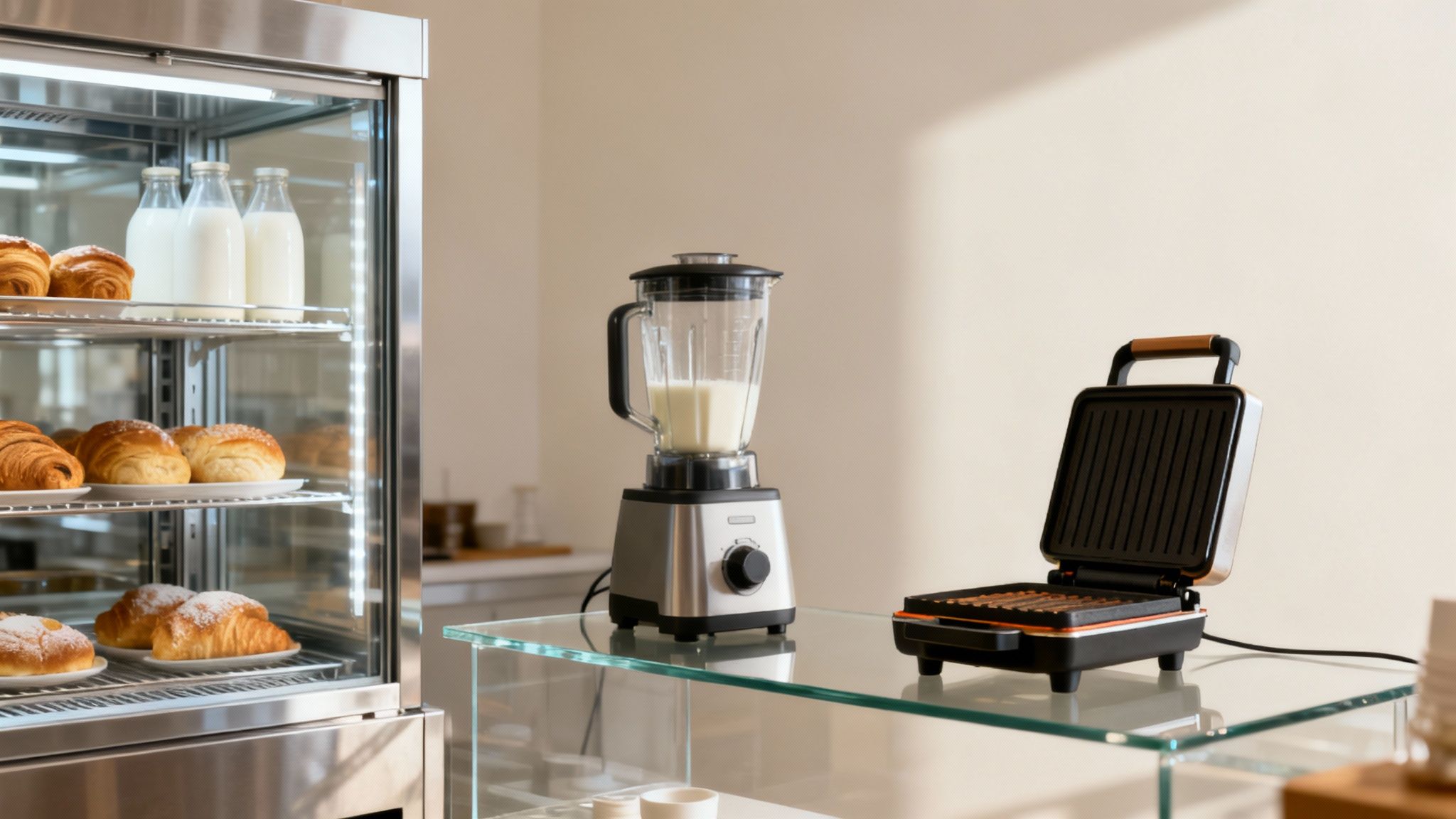
This expansion all starts with smart investments in gear that supports a broader menu. Just think about the irresistible smell of a perfectly toasted panini or how appealing a blended frappe is on a warm day. These aren't just nice-to-haves; they significantly increase your average spend per customer.
Expanding Your Food and Drink Offerings
To move beyond just coffee, you'll need the right tools for the job. A high-speed commercial blender, for instance, is your ticket to crafting smoothies, frappes, and other blended drinks that come with seriously high-profit margins. They're especially popular with a younger crowd and an absolute lifesaver during the warmer months, opening up a whole new revenue stream.
Likewise, introducing a simple food menu can be incredibly profitable without needing a full-blown kitchen. Consider these essential additions to your equipment for a coffee shop:
- Commercial Refrigeration: This is non-negotiable. You’ll need under-counter and display fridges to safely store milk, alternative milks, bottled drinks, and fresh food. A well-lit display fridge is also a brilliant way to drive impulse buys of cakes and sandwiches.
- Panini Press or Compact Oven: These bits of kit let you offer hot food like toasted sandwiches, pastries, and croissants with minimal space and training. Honestly, the aroma alone can be one of your best sales tools.
- Commercial Ice Machine: The unsung hero of any busy cafe. A reliable ice machine is absolutely crucial for iced lattes, cold brews, and frappes—all staples that sell year-round. Don't let a lack of ice become your bottleneck when the sun comes out.
Investing in versatile equipment is about more than just adding items to a list; it’s about creating new reasons for customers to visit and stay longer. Each new offering is an opportunity to forge a stronger connection.
The Unsung Heroes of Operational Efficiency
Beyond the customer-facing gear, a few key pieces work behind the scenes to keep your shop running smoothly and professionally. A commercial dishwasher is a perfect example. Washing by hand might seem fine at the start, but a proper commercial unit saves a massive amount of time and ensures everything is properly sanitised during a frantic rush. It's a critical factor for both health standards and slick service.
Once your menu is sorted, getting the presentation right is the final touch. Well-designed physical menus really elevate the customer experience and help guide their choices. You can find excellent professional menu printing services that will make your offerings look as good on paper as they taste. It’s a small detail, but it reinforces the quality and care you put into every part of your business, turning a simple visit into something memorable.
Choosing Your Espresso Machine
Let's be honest, your espresso machine is more than just a piece of kit. It’s the heart of your shop, the engine that powers every single flat white and long black that goes out. This one purchase will shape your workflow, define your coffee’s quality, and sit right in the middle of your bar for everyone to see.
It’s easy to feel overwhelmed by the choice, but the goal isn't just to buy the fanciest model. It's about finding the machine that truly fits your vision.
Getting this right is especially vital in today’s market. The UK’s coffee shop scene is booming, now accounting for around 6.0% of the entire eating-out market's turnover. With the sector projected to be worth £6.1 billion in 2024/25, the right equipment is your ticket to claiming a piece of that pie. You can find more great insights into the UK coffee market's growth at Lumina Intelligence.
This decision really does set the stage for your future success and how smoothly your bar will run day-to-day.
Volumetric or Manual: Which Is Right for You?
One of the first big decisions you’ll face is whether to go for a volumetric or a manual (often called semi-automatic) machine. They each serve a very different purpose.
A volumetric machine is your best friend for consistency and speed. Your barista hits a button, and the machine pushes a perfectly measured volume of water through the coffee. It’s a godsend for a busy shop with a few different people behind the bar, as it guarantees every customer gets the same great espresso, no matter who’s working.
On the other hand, a manual machine puts all the control, and all the craft, into your barista’s hands. They start and stop the shot themselves, dialling it in by eye and feel. This is where the artistry comes in, allowing for tiny adjustments on the fly, but it absolutely demands a higher skill level to keep things consistent. If you’re opening a small, craft-focused spot where one head barista will be pulling most of the shots, it’s a beautiful way to showcase your coffee philosophy.
Matching Machine Size to Your Ambition
Next up is capacity, which comes down to "group heads"—basically, how many espressos you can make at once.
A little one-group machine might be fine for a small deli counter, but for a proper coffee shop, you’ll want to start with at least a two-group machine. If you’re expecting to be slammed with a morning rush and long queues, investing in a three-group machine from the get-go will save you from serious bottlenecks down the line.
Think of your espresso machine as a long-term business partner. Choose one that can not only handle your opening day rush but also grow with you as your reputation builds and your customer base expands.
Finally, you need to think about the money. Buying a machine outright means you own an asset, which is great. But leasing can be a lifesaver for a new business, keeping those initial costs down and often bundling in maintenance packages. That peace of mind can be priceless when you're just starting out.
Leasing vs Buying Your Espresso Machine
Deciding how to pay for your machine is just as important as choosing the model. Both leasing and buying have clear pros and cons that can have a big impact on your finances and day-to-day operations.
| Factor | Leasing | Buying |
|---|---|---|
| Upfront Cost | Low initial outlay, preserving startup capital for other needs. | High initial investment, a significant chunk of your budget. |
| Maintenance | Often included in the contract, offering predictable monthly costs and support. | Your responsibility; unexpected repairs can be costly and disruptive. |
| Ownership | You never own the machine; payments are ongoing operational expenses. | The machine is an asset you own outright and can sell later. |
| Upgrades | Easier to upgrade to newer models at the end of the lease term. | Upgrading requires selling the old machine and purchasing a new one. |
There's no single right answer here. It all comes down to your business plan, your cash flow, and what you feel most comfortable with. Take a hard look at both options to figure out which path gives your dream the best shot at success.
Why Your Grinder Is Your Secret Weapon
Everyone’s eyes are drawn to the shiny, chrome-plated espresso machine. It’s the centrepiece, the engine of the whole operation. But here’s a secret every seasoned barista knows: the real workhorse, the piece of kit that makes or breaks every single cup, is the grinder.
Your grinder is the quiet hero on the counter. It dictates the absolute potential of your coffee before a single drop of water even touches it. Think of it this way: you can have the most expensive, all-singing, all-dancing espresso machine in the world, but it can’t save a bad grind. On the other hand, a truly exceptional grinder can make a more modest machine punch well above its weight.
It’s the foundation of flavour, which is why a commercial burr grinder isn’t just a nice-to-have. It's a non-negotiable for anyone serious about serving incredible coffee.
Consistency Is King
So, what makes a burr grinder so special? It uses two revolving, abrasive surfaces (the burrs) to crush coffee beans into particles of a consistent, uniform size. That consistency is everything. It allows water to pass through the coffee bed evenly during extraction, pulling out all the sweet, complex flavours you want.
Compare that to a standard domestic blade grinder, which just smashes beans into a chaotic mix of boulders and dust. That leads directly to a messy, unbalanced cup—a muddle of sourness from the under-extracted big chunks and bitterness from the over-extracted fine particles.
Your grinder doesn’t just prepare coffee; it unlocks it. Investing in a high-quality grinder is a direct investment in the flavour, consistency, and reputation of your coffee shop.
The whole industry is moving towards equipment that guarantees this kind of quality. In fact, the UK market for automatic professional drip coffee machines hit around USD 4.3 million in 2024, with coffee shops being the biggest buyers. It shows a huge trend towards machinery that delivers the same fantastic result every time—and that process always starts with a precise grind. You can dive deeper into the rise of automated coffee equipment on Grand View Research.
On-Demand vs Doser Grinders
When you start looking at professional equipment for a coffee shop, you’ll quickly run into two main types of grinders: doser and on-demand.
- Doser Grinders: These are the older style. They grind a whole batch of coffee into a chamber, and the barista dispenses it a "dose" at a time. The problem? That ground coffee is sitting there, going stale, losing its delicate aromas with every minute that passes.
- On-Demand Grinders: This is the modern standard, and for very good reason. They grind the exact amount of coffee you need, fresh, directly into the portafilter for every single shot.
Going for an on-demand burr grinder is one of the smartest calls you can make. It protects the integrity of your expensive beans, gives your baristas total control, and ensures that every customer gets a consistently delicious coffee. That’s how you build a reputation and keep people coming back.
Designing an Efficient Bar Workflow
Getting your hands on the best equipment for a coffee shop is a brilliant milestone, but the real magic happens when you arrange it all into a seamless, elegant dance behind the counter. Your espresso machine and grinders are the stars of the show, but their performance is only as good as the stage you set for them. A truly efficient bar workflow is your secret weapon for calm, consistent service—even when the queue is snaking out the door.
It all starts with the less glamorous stuff: logistics. Before any machine hums to life, you need to plan for its basic needs. Heavy-duty kit like your espresso machine requires its own dedicated, high-amperage electrical circuit. At the same time, every piece of brewing equipment needs access to pristine water, which means thoughtful plumbing and a strategically placed filtration system. Nail these foundations now, and you’ll save yourself a world of pain and costly refits later on.
The Art of Ergonomic Bar Design
Once the technicals are sorted, it’s time to focus on the human element. Ergonomics is all about designing a workspace that cuts out wasted movement. For a barista, every step saved is precious energy conserved and a few more seconds shaved off a customer's wait time. The goal is to create a logical sequence of actions, from taking an order to handing over the finished drink.
This is what we call the 'bar flow'—a natural pathway that guides a barista through their tasks without them even thinking about it. Let's trace the journey of a single latte:
- Order Point: The till and POS system should be right next to where the action starts: the grinder and espresso machine.
- Espresso Station: The grinder, knock box, and espresso machine need to form a tight little triangle. No long walks between them.
- Milk Station: Your milk fridges and steam wands should be partners, allowing a barista to steam milk while the espresso shot is pulling.
- Finishing & Hand-off: You need a clear bit of counter for lids, sugars, and final touches that leads directly to the customer collection point.
When you create this intuitive path, a barista can often stand in one spot and simply pivot to complete 80% of their tasks. This is what separates a chaotic, clunky bar from a composed, professional one during that morning rush.
The process of crafting a quality coffee relies on a clear, repeatable flow from bean to cup.
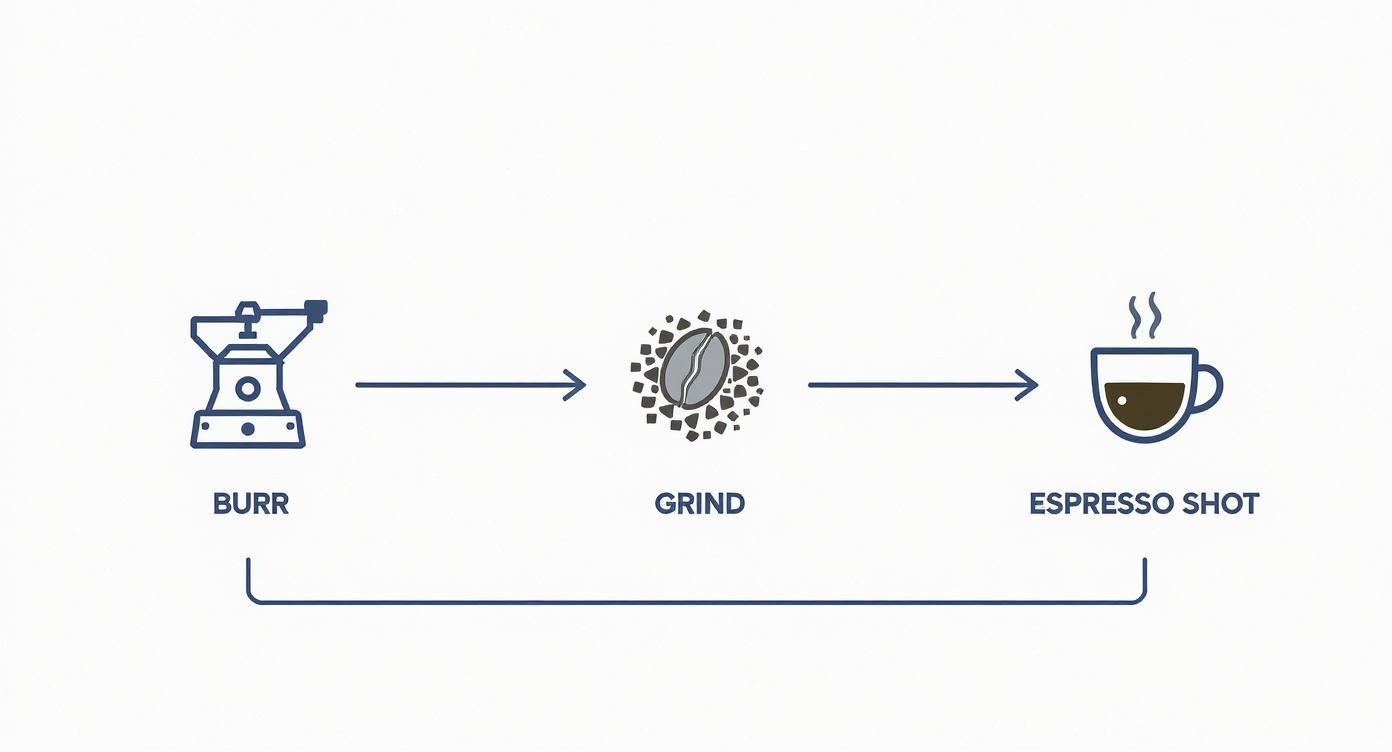
This visualisation really drives home how the quality you establish at the grinder is carried through every single step that follows.
Minimising Movement Maximises Output
Think about it in real-world terms. If a barista has to walk three steps to the fridge for milk for every single latte, that adds up to hundreds of wasted steps an hour. Pop a small milk fridge directly under the espresso machine, and that problem disappears entirely. It’s the small details that have a massive impact: storing cups near the machine, syrups next to the steaming station, and cleaning cloths within arm's reach.
A well-designed bar doesn’t just look good; it feels good to work in. It empowers your team to work with grace and precision, turning a high-pressure job into a fluid, rewarding craft.
By mapping out these movements and thoughtfully placing every piece of kit, you’re building an environment that’s genuinely designed for success. It’s an investment in your team's wellbeing and your shop's ability to serve customers brilliantly and swiftly—which is, after all, the ultimate goal.
Your Coffee Shop Equipment Questions Answered
Taking the leap to open your own coffee shop is an incredible journey. But let's be honest, it comes with a mountain of questions—especially when it comes to the hardware, which is almost always your single biggest investment. Getting clear, straight answers is the only way to build a business on a solid foundation.
So, let's tackle some of the most common queries we hear from aspiring café owners about their equipment. This is all about giving you the confidence to make smart, informed decisions that will pay off for years to come.
What’s the Most Common Mistake People Make When Buying Equipment?
Easy. Underfunding the coffee grinder. It’s so tempting to get starry-eyed over a beautiful, top-of-the-line espresso machine, but if you pair it with a budget grinder, you've just shot yourself in the foot. An inconsistent grind guarantees poor espresso, no matter how incredible your machine is.
Think of your grinder as an equal partner to your espresso machine. Its quality is non-negotiable.
Another classic pitfall is simply misjudging your capacity. Buying gear that’s too small for your actual customer volume will create painful bottlenecks during your busiest hours. On the flip side, over-investing in a massive three-group machine for a tiny footprint is just a waste of capital and energy.
How Much Should I Actually Budget for the Essentials?
Being realistic from the start will save you a world of pain. For all the essential new equipment, a sensible starting budget usually falls somewhere between £20,000 and £50,000. Of course, this number can swing wildly depending on your concept, size, and ambition.
Your espresso machine and grinder duo will eat up the biggest slice of that pie, often landing between £10,000 and £20,000 on their own. The rest of your budget has to cover every other cog in the machine:
- Commercial refrigeration (both under-counter units and display fridges)
- Batch brewers and other filter coffee gear
- High-speed blenders for smoothies and a compact oven or panini press for food
- A seriously reliable ice machine
- Your point-of-sale (POS) system and a commercial dishwasher
If that number makes you wince, don’t panic. To make your capital go further, you can look into leasing the big-ticket items or sourcing warrantied, refurbished equipment from a reputable supplier.
Should I Buy New or Used Equipment?
Ah, the classic dilemma. This really comes down to balancing your budget against your appetite for risk.
New equipment gives you undeniable perks: the latest tech, peak reliability, and a manufacturer's warranty for that all-important peace of mind. The catch? It demands the biggest upfront investment.
Used equipment, on the other hand, can offer massive savings. It might even put a higher-spec machine within your reach. The trade-off is the lack of a warranty and the built-in risk of hidden faults or just a shorter operational lifespan.
A savvy hybrid approach is often the smartest way forward. Invest your money in new core items—the heart of your operation, like the espresso machine and grinder—and then source less critical pieces like sinks, shelving, or a secondary fridge from the second-hand market.
What Equipment Is Often Forgotten but Totally Essential?
The single most overlooked piece of kit is a high-quality water filtration system. It's not glamorous, but it's absolutely critical. Bad water doesn't just make for flat, lifeless coffee; it creates limescale build-up that will destroy your expensive machines from the inside out.
The other unsung hero? A dedicated commercial ice machine. If you plan on serving iced lattes and other cold drinks (which are hugely profitable), you simply cannot afford to run out of ice. A little domestic unit won’t cut it.
Finally, never, ever underestimate the need for an efficient commercial dishwasher. It’s the cornerstone of good hygiene and a smooth workflow, ensuring you can keep up with the rush without compromising on standards.
At Ue Coffee Roasters, we know that the right equipment is just the start. Our expertise is in providing a complete refreshment solution, from sourcing incredible wholesale coffee beans to supplying state-of-the-art automatic bean-to-cup machines for any business. We partner with you to elevate your entire coffee offering, providing the tools, training, and support you need to serve an exceptional cup, every single time. Explore our solutions and see how we can help bring your coffee vision to life at https://www.uecoffeeroasters.com.