

How Do You Make a Flat White Coffee? Easy Steps at Home
Learning how to make a proper flat white is one of those skills that turns your daily coffee from a simple routine into a bit of an art form. It’s a deceptively simple process: pull a rich double shot of espresso, steam some whole milk into a velvety microfoam, and combine them to create a perfectly balanced, robust drink. This guide will walk you through how to get it just right.
Why The Perfect Flat White Is Worth Mastering

A truly exceptional flat white is so much more than a morning caffeine hit; it’s a moment of craft and pure enjoyment. It strikes that perfect chord between a bold, nuanced espresso and sweet, creamy milk, giving you a coffee experience that’s both strong and incredibly smooth.
Unlike a latte with its thicker foam layer or a cappuccino with its airy cap, the flat white is all about its signature velvety texture. The goal is a thin layer of microfoam—that’s milk steamed to a glossy, wet-paint consistency—which blends seamlessly with the espresso rather than just sitting on top of it.
The Rise of a Modern Classic
The flat white has cemented its place as a staple in the UK's vibrant coffee scene. It's the go-to for anyone who really appreciates a proper coffee flavour but still wants the creamy texture of a milk-based drink.
Its popularity isn’t just a feeling, either. It’s consistently one of the nation's top choices, especially among younger coffee drinkers. With around 80% of Brits visiting coffee shops every week, the demand for high-quality, well-made drinks like the flat white has never been higher. You can find plenty of insights about UK coffee consumption trends online.
Getting this drink right in your own kitchen brings a unique kind of satisfaction. It elevates your daily coffee ritual into a genuine skill you can be proud of. Every cup becomes a small canvas, an opportunity to create something genuinely special.
The beauty of the flat white lies in its simplicity. It’s an honest drink that showcases the quality of the coffee and the skill of the person making it.
Gathering Your Tools and Ingredients

Before you can pull that perfect shot, you need to get your setup right. Think of this less as a rigid shopping list and more like an artist assembling their palette. It's not about having the most expensive gear on the market, but about having the right gear for the job.
The espresso machine is the heart of your operation, and its steam wand is your magic wand for creating that signature velvety milk. You don't need a massive commercial machine; plenty of home models pack the punch needed for a great espresso shot and powerful, consistent steam.
Of course, the equipment is only half the story. The ingredients are the very soul of the drink.
Your Core Components
Your choice of coffee beans dictates the entire flavour profile. For a classic flat white, you can't go wrong with a good medium roast. I always look for beans with tasting notes of chocolate, caramel, or toasted nuts—these flavours harmonise beautifully with the natural sweetness of steamed milk.
Then there’s the milk. To get that incredible, glossy microfoam, fresh, cold whole milk is non-negotiable. Seriously. The higher fat and protein content is what allows you to create a stable, silky texture that actually integrates with the espresso, rather than sitting on top like a fluffy hat. It’s what puts the "flat" in flat white.
The secret to a brilliant flat white lies in the quality of its two parts. Exceptional coffee beans and perfectly textured fresh milk aren't just ingredients; they are the entire experience.
Finally, think about your canvas. A traditional flat white is served in a 150-180ml ceramic cup. This isn't just for looks; this size ensures the ideal ratio of espresso to milk, giving you a drink that's perfectly balanced in strength and texture. It's the finishing touch that lets your skills truly shine.
Your Home Barista Toolkit for a Perfect Flat White
Getting started can feel a bit daunting with all the gear out there. This table breaks down the essentials, explaining what to look for and why each piece is a total game-changer for your flat white journey.
| Component | What to Look For | Why It's a Game-Changer |
|---|---|---|
| Espresso Machine | A machine with a powerful steam wand and stable temperature control. | Consistent pressure and steam are crucial for both a balanced espresso shot and silky microfoam. |
| Coffee Beans | Freshly roasted, medium roast beans with notes of chocolate or caramel. | The foundation of your drink's flavour. Freshness makes a world of difference. |
| Whole Milk | Fresh, cold, full-fat milk. | The protein and fat content are essential for creating that signature velvety, stable microfoam. |
| Burr Grinder | A grinder that provides a consistent, fine grind. | An even grind ensures an even extraction, preventing a sour or bitter shot. |
| Digital Scales | A scale with 0.1g accuracy. | Precision is key. Weighing your coffee dose and yield takes the guesswork out of espresso. |
| Milk Jug | A stainless steel jug with a sharp spout, around 350-500ml. | The shape helps you create a vortex for texturing milk, and the spout gives you control for pouring latte art. |
| Ceramic Cup | A 150-180ml (5-6 oz) cup. | The perfect size for the ideal coffee-to-milk ratio, ensuring a balanced, flavourful drink. |
With these key pieces in place, you have everything you need to move beyond just making a flat white and start mastering it.
Pulling the Perfect Espresso Shot

The espresso shot is the very soul of your flat white. This is where that deep, complex flavour is born, and getting it right is a huge step forward on your journey as a home barista. It’s a delicate dance between grind, dose, and pressure that, when you nail it, creates a flawless foundation for the milk.
This is about more than just pushing a button; it’s about developing an intuition for your coffee. You’ll soon learn to spot the signs of a great extraction before you even take a sip. The first clue is the colour—that deep, reddish-brown crema is a beautiful sign of a well-balanced shot.
Then, you watch the flow. A perfect shot doesn’t gush out. It pours slowly and consistently, looking like warm honey. That syrupy stream is a visual promise of the rich flavour and full body waiting in the cup.
Dialling In Your Shot
To get that honey-like flow, you first need to "dial in" your grinder. The goal is a grind consistency that feels like fine sand or table salt. If it's too coarse, the water will rush through, creating a sour, weak shot. Go too fine, and you’ll choke the machine, resulting in a bitter, over-extracted flavour.
This is where precision really makes a difference:
- Dose Correctly: Always use digital scales to weigh your ground coffee. For a standard double shot that suits a flat white, you’re looking for 18-20 grams.
- Distribute Evenly: Give the side of your portafilter a few gentle taps to settle the grounds into a flat bed. This helps prevent "channelling," where water finds weak spots and extracts unevenly.
- Tamp Firmly: Apply firm, level pressure with your tamper. The goal isn't to press as hard as you can, but to create a compact and perfectly flat puck of coffee for the water to pass through uniformly.
Think of pulling an espresso shot as telling a story. The grind size is your vocabulary, the dose is your plot, and the tamp is your punctuation. Each element must work in harmony to create a compelling result.
This meticulous preparation is now central to the UK's coffee culture. With daily consumption soaring from 70 million to around 98 million cups per day, people have become far more discerning. They expect higher quality, both at home and in cafés. This precise, skilled approach is exactly what makes the flat white a modern favourite. You can find more insights on the UK's growing demand for quality coffee.
Watching that perfect shot pour is one of the most rewarding moments in coffee making. It’s the culmination of your careful preparation and a beautiful prelude to the final drink.
Creating That Silky Microfoam
If the espresso is your flat white's heart, then the microfoam is its soul. This isn't the stiff, airy foam you'd find piled on top of a cappuccino; we're chasing something far more elegant. Our goal is microfoam—milk steamed to a glossy, liquid-paint consistency that integrates seamlessly with the espresso.
Mastering your steam wand is a journey of feel and sound, and it's where your drink truly comes to life. The entire process hinges on two quick but distinct phases: 'stretching' and 'texturing'. First, you introduce a tiny amount of air, then you create a swirling vortex to break down any bubbles and create that signature velvety smoothness.
This infographic breaks down the core technical benchmarks for achieving that perfect microfoam at home.
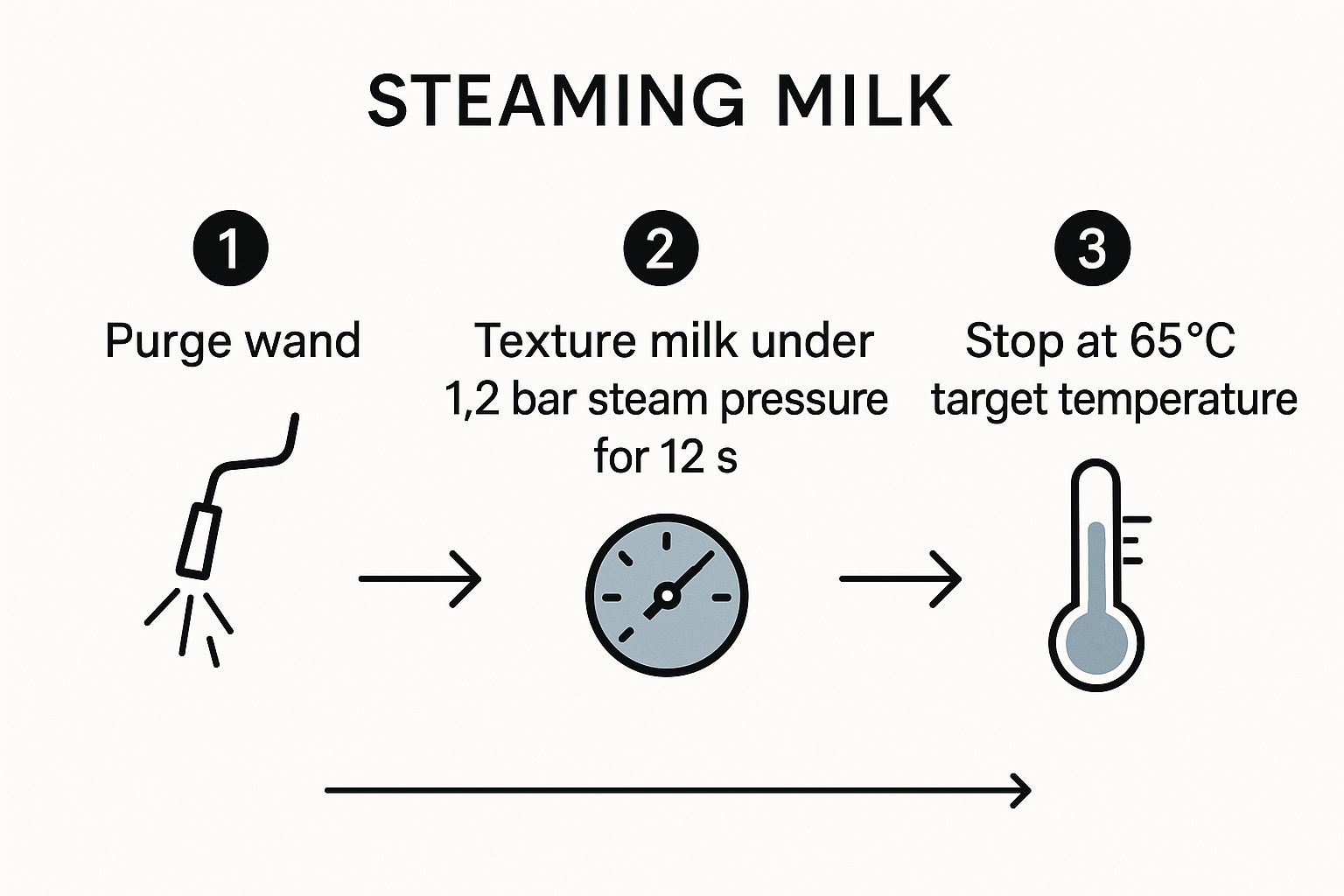
The key takeaway? Steaming milk is a brief, precise process where temperature is your ultimate guide. Get it right, and you preserve the milk's natural sweetness. Get it wrong, and you risk scorching it.
The Art of Stretching and Texturing
First thing's first: purge your steam wand with a quick blast to clear out any condensation. Now, position the tip of the wand just below the surface of your cold milk and turn on the steam. You want to hear a gentle, consistent hiss—a bit like tearing paper. That's the sound of air being incorporated just right.
This 'stretching' phase is incredibly short. It only lasts until the jug feels lukewarm to the touch. The moment you feel that warmth, it's time to transition.
Dip the wand slightly deeper into the milk, positioning it off-centre to create a whirlpool. This is the texturing phase. The vortex folds the milk into itself, refining the texture and breaking down any larger bubbles until it’s perfectly smooth and glossy. Keep a hand on the side of the jug; as soon as it becomes too hot to comfortably hold (around 65°C), kill the steam.
Never let your milk scream or boil. A high-pitched screech means the wand is too deep while you're trying to add air. Boiling will completely destroy both the texture and the sweet flavour you've worked so hard to create.
Once you're done, give the jug a firm tap on the counter to pop any rogue bubbles and a gentle swirl to polish the milk. You should be left with a jug of liquid velvet, ready for that final, magical pour. This is the skill that, once honed, truly separates a good coffee from an unforgettable one.
Bringing It All Together with the Final Pour
This is the moment of magic. All your hard work comes down to this: uniting that perfectly pulled espresso with your silky, textured milk. The final pour is so much more than just mixing two liquids; it’s an art form that dictates the final texture, flavour, and look of your flat white.With your espresso shot waiting patiently in the cup and your glossy milk swirled and ready in the jug, it’s time to bring them together.
Start by tilting your cup at a slight angle. Begin pouring the milk from a bit of a height, say 10-15cm above the cup. This initial distance helps the milk dive right under the espresso's rich crema, mixing everything together beautifully without washing out that gorgeous coffee colour.
As the cup begins to fill, you'll want to lower the spout of your milk jug much closer to the surface of the coffee. This is the key move. Bringing the jug closer allows that velvety microfoam to flow out and sit right on top, creating that classic, appealing contrast.
The secret to a great pour is a single, steady, confident motion. If you hesitate or stop-start, you'll break the flow of the microfoam. Trust your prep and watch the magic happen.
Pouring Your First Heart
Fancy trying some simple latte art? The heart is the classic starting point and the perfect signature for a beautifully made flat white. It's easier than it looks, I promise.
As you lower your jug for that final part of the pour, aim the stream of milk directly into the centre of the cup. You’ll see a white dot appear, which will then expand into a nice circle.
Just as the cup is about to become full, lift the jug slightly and pull the stream of milk straight through the centre of the circle you just made. This quick, final motion is what draws the foam into that familiar heart shape—a perfect testament to your new barista skills.
Your Journey as a Home Barista
Making a world-class flat white at home is a skill that grows with every single cup you brew. This isn’t about hitting perfection on day one; it’s about enjoying the process. Think of each attempt as another step on your path, a chance to refine your technique and really get to know your coffee.
Remember the core pillars we’ve covered. It all comes down to:
- Quality Ingredients: Starting with fresh beans and cold, whole milk.
- A Flawless Espresso: Nailing that rich, syrupy heart of the drink.
- Silky Microfoam: Getting that signature velvety, paint-like texture.
- A Graceful Pour: The final, artistic flourish that brings it all together.
As you get deeper into the craft, you might even start noticing the business side of things. Seeing how professional shops use tools like loyalty applications designed for cafes can give you a new appreciation for the industry you're now a part of.
This is your craft now. Experiment with different beans, tweak your technique, and discover what makes the perfect flat white for you. The satisfaction of that first incredible, homemade flat white is just around the corner.
And you're not alone in this passion. Your efforts are part of a huge movement—the UK coffee shop market is valued at around £13 billion annually, driven by favourites just like the flat white. You can dive deeper into UK coffee market trends to see the full picture.
Your Flat White FAQs Answered
As you get to grips with making a flat white, a few questions are bound to pop up. Don't worry, every home barista has been there. Getting these common queries sorted will build your confidence and help you troubleshoot any snags along the way.
One of the first hurdles is usually figuring out the real difference between a flat white and a latte. It all comes down to the coffee-to-milk ratio and the final texture of the milk. A flat white is a more intense, smaller drink, typically a double espresso in a 150-180ml cup. The star of the show is a very thin, velvety layer of microfoam that melts right into the coffee.
A latte, on the other hand, is much milkier, served in a larger glass, and topped with a thicker, more distinct layer of foam. Think of the flat white as more coffee-forward, and the latte as more milk-forward.
Can You Make a Flat White Without an Espresso Machine?
While a proper espresso machine gives you the ideal base, you can absolutely make a brilliant version at home without one. The trick is to brew a very strong, concentrated coffee that comes as close as possible to an espresso shot. A Moka pot or an AeroPress are both fantastic for this job.
For the milk, gently heat it on the hob—just be careful not to let it boil. Next, grab a handheld frother to create a vortex. The secret is to incorporate as little air as possible to keep the texture silky smooth, not bubbly. It won’t be an exact replica, but it’s a great way to enjoy that classic flat white experience.
The most common mistake when you're starting out is creating milk that’s too bubbly. This almost always happens from adding too much air right at the beginning. You only need to "stretch" the milk for the first few seconds until it’s lukewarm, then dip the steam wand deeper to just spin the milk and polish the texture.
Remember, starting with very cold, fresh whole milk is the single best thing you can do for a successful steam every time. It has the perfect protein and fat structure needed to create that glossy, paint-like microfoam you're after.
Ready to elevate your office coffee game with beans perfect for crafting flat whites? Ue Coffee Roasters provides premium, speciality coffee and state-of-the-art bean-to-cup machine solutions, bringing café-quality drinks directly to your workplace. Discover our offerings at https://www.uecoffeeroasters.com.