

How to Make Coffee Stronger for a Bolder Brew
If you’ve ever found yourself wishing your morning coffee had a bit more oomph, you’re not alone. Getting a richer, more intense brew is all about mastering a few key variables. It often comes down to simple adjustments: using more coffee grounds, grinding your beans a little finer, or even swapping to a darker roast or a punchy Robusta bean.
These tweaks put you in the driver's seat, giving you total control over the flavour and strength of every single cup you make.
Your Journey to a Bolder Cup of Coffee
So, you want to learn how to make stronger coffee. I'm talking about a cup that's genuinely robust and rich in flavour, not just bitter or loaded with caffeine. This guide is for every passionate home brewer in the UK who has stood in a great coffee shop, sipped something incredible, and thought, "How do I get this at home?"
That desire for a more powerful brew usually comes from a real love for flavour—it's about turning a daily routine into a ritual that truly excites your taste buds. This has become especially true here in the UK, where more of us are trying to replicate café-quality coffee without the high street price tag. With Brits knocking back an estimated 98 million cups a day, making each one count feels more important than ever. You can get a deeper look into the UK's coffee habits in this insightful report on coffee consumption statistics.
The secret to a stronger brew isn't a single magic trick. It's about understanding how all the pieces of the puzzle—the beans, the grind, the water—fit together to create the final cup.
To get you started on this journey, we need to focus on the core pillars that define a stronger coffee experience. Once you get a handle on these, you’ll be well on your way to transforming your daily brew from just okay to genuinely outstanding.
- Bean Selection and Roast Profile: It all starts with the beans. We'll dig into how to choose beans with naturally bold and intense flavour profiles that set the stage for a strong cup.
- Grind Size and Extraction: The fineness of your grind is one of the most powerful tools you have. A tiny adjustment here can completely change the body and strength of your coffee.
- Coffee-to-Water Ratio: Think of this as the recipe for your brew's concentration. Nailing this ratio is the most direct way to get the strength you’re after.
- Brewing Technique and Time: Your brew method and how long you let it steep are the final, crucial steps. This is where you unlock all that bold, satisfying flavour.
Right then, let's get you ready to transform your daily ritual. It’s time to brew a better, bolder cup together.
Quick Guide to Stronger Coffee At a Glance
Before we dive deep into each technique, here’s a quick overview of the main variables you can play with. Think of this table as your cheat sheet for brewing a more potent and flavourful cup.
| Variable | How to Adjust for Strength | Why It Works |
|---|---|---|
| Coffee-to-Water Ratio | Increase the amount of coffee grounds relative to water. | More coffee solids are extracted into the same volume of water, creating a more concentrated, stronger-tasting brew. |
| Grind Size | Make your coffee grind finer. | A finer grind increases the surface area of the coffee, allowing water to extract more flavour and compounds in less time. |
| Water Temperature | Use hotter water (within the 90-96°C range). | Hotter water is a more efficient solvent, pulling more soluble compounds from the grounds, which contributes to a stronger flavour. |
| Brew Time | Increase the contact time between water and coffee. | A longer brew time gives the water more opportunity to extract oils, acids, and sugars, resulting in a fuller-bodied cup. |
| Bean Choice | Opt for darker roasts or beans with Robusta in the blend. | Darker roasts have bolder, more intense flavours, while Robusta beans naturally contain more caffeine and a stronger taste. |
Each of these adjustments offers a different way to dial up the intensity. The real magic happens when you start combining them to find the perfect balance for your palate.
Selecting the Right Beans and Roast Profile
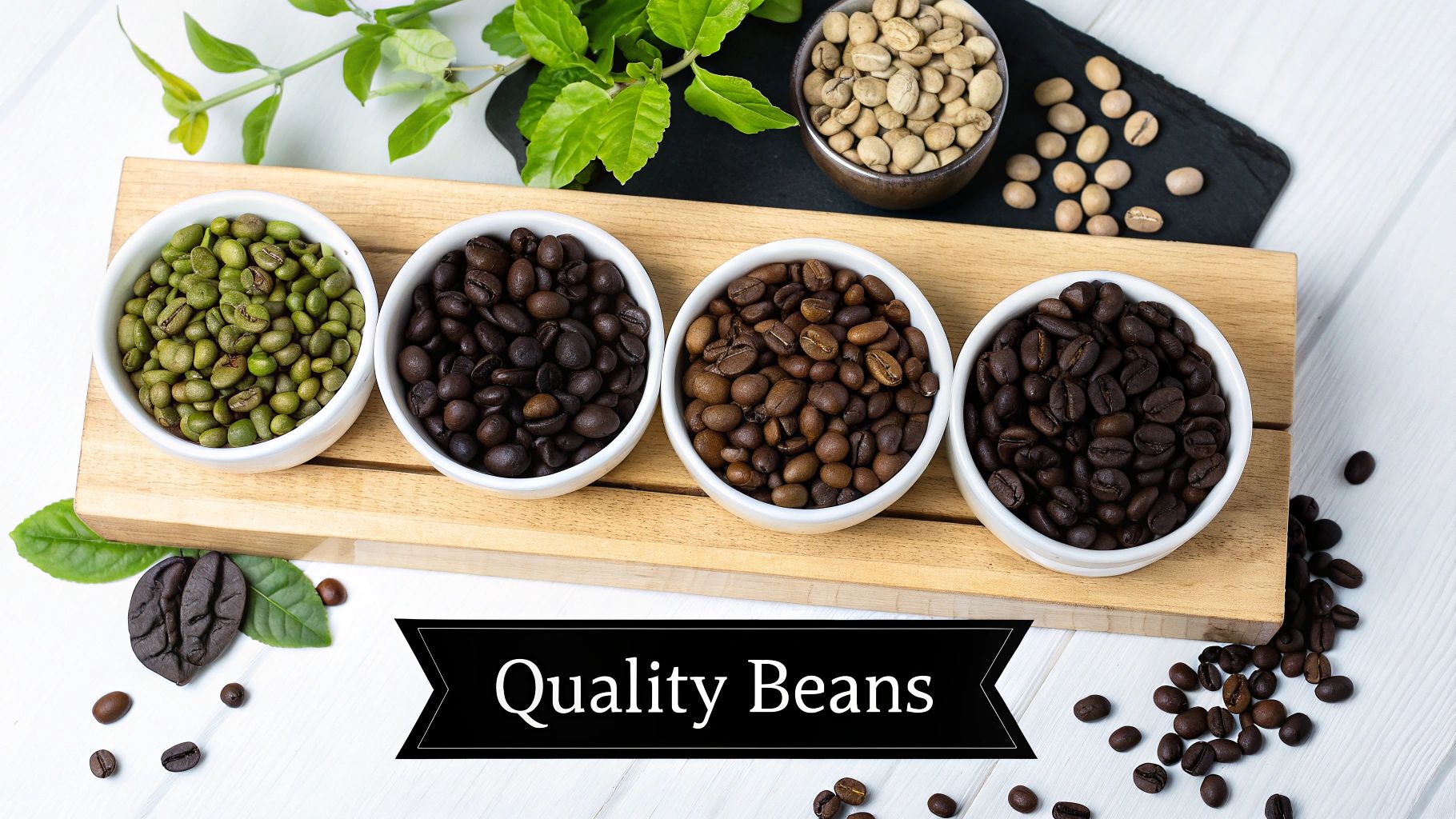
Your journey to a genuinely stronger coffee starts long before you even think about grinding or brewing. It all begins with the beans. Choosing a coffee with an inherently powerful profile is the foundation for everything else, and luckily, the UK’s incredible speciality coffee scene gives you a world of options.
One of the biggest myths is that a darker roast automatically equals a stronger brew. It's not quite that simple. A dark roast certainly delivers a bold, roasty, and often smoky flavour, but the intense heat actually burns off a tiny bit of caffeine. So, if your only goal is a caffeine hit, a very light roast technically has more.
But for most of us, "stronger" really means a richer, fuller-bodied taste that feels substantial in the cup. This is where learning to read the tasting notes on a bag from your local roaster becomes your secret weapon.
Decoding the Tasting Notes
When you pick up a bag of speciality coffee, those descriptive phrases are your clues to its character. Don't let them intimidate you; they're a guide to finding the exact kind of intensity you're after.
Keep an eye out for descriptions that suggest weight and depth. Look for:
- Full-bodied or syrupy body: This points to a rich, heavy mouthfeel.
- Dark chocolate, cacao, or molasses: These notes signal deep, intense flavours, not the bright, acidic, fruity ones.
- Nutty or roasted almond: You’ll often find these in classic, crowd-pleasing profiles that just feel solid and strong.
By actively looking for these words, you’re far more likely to land on a coffee that delivers that powerful flavour you associate with a proper strong cup.
The most direct path to a stronger coffee is to choose a bean known for its intensity from the get-go. Start with the bean's inherent character, and every other step in your brewing process will simply build on that solid foundation.
Choosing Your Beans: Arabica vs. Robusta
Next up is getting to grips with the two main coffee species. The vast majority of speciality coffee you’ll find in the UK is 100% Arabica, celebrated for its complex, aromatic qualities. But when it comes to sheer, unapologetic power, you can’t beat Robusta.
Robusta beans pack a serious punch, containing almost double the caffeine of Arabica and producing a thick, long-lasting crema that’s a signature of classic espresso. While a 100% Robusta brew can be a bit harsh for some palates, a high-quality blend that includes a percentage of Robusta is a brilliant trick for boosting strength and intensity. Many of the Italian-style espresso blends you love from UK cafés use this very technique.
If you're dedicated to single-origin Arabica, look for beans from regions known for their bold character. Coffees from Sumatra, for instance, are famous for their earthy, full-bodied, and deeply satisfying profiles. Choosing the right bean is more than half the battle won.
Mastering Your Grind for Maximum Extraction
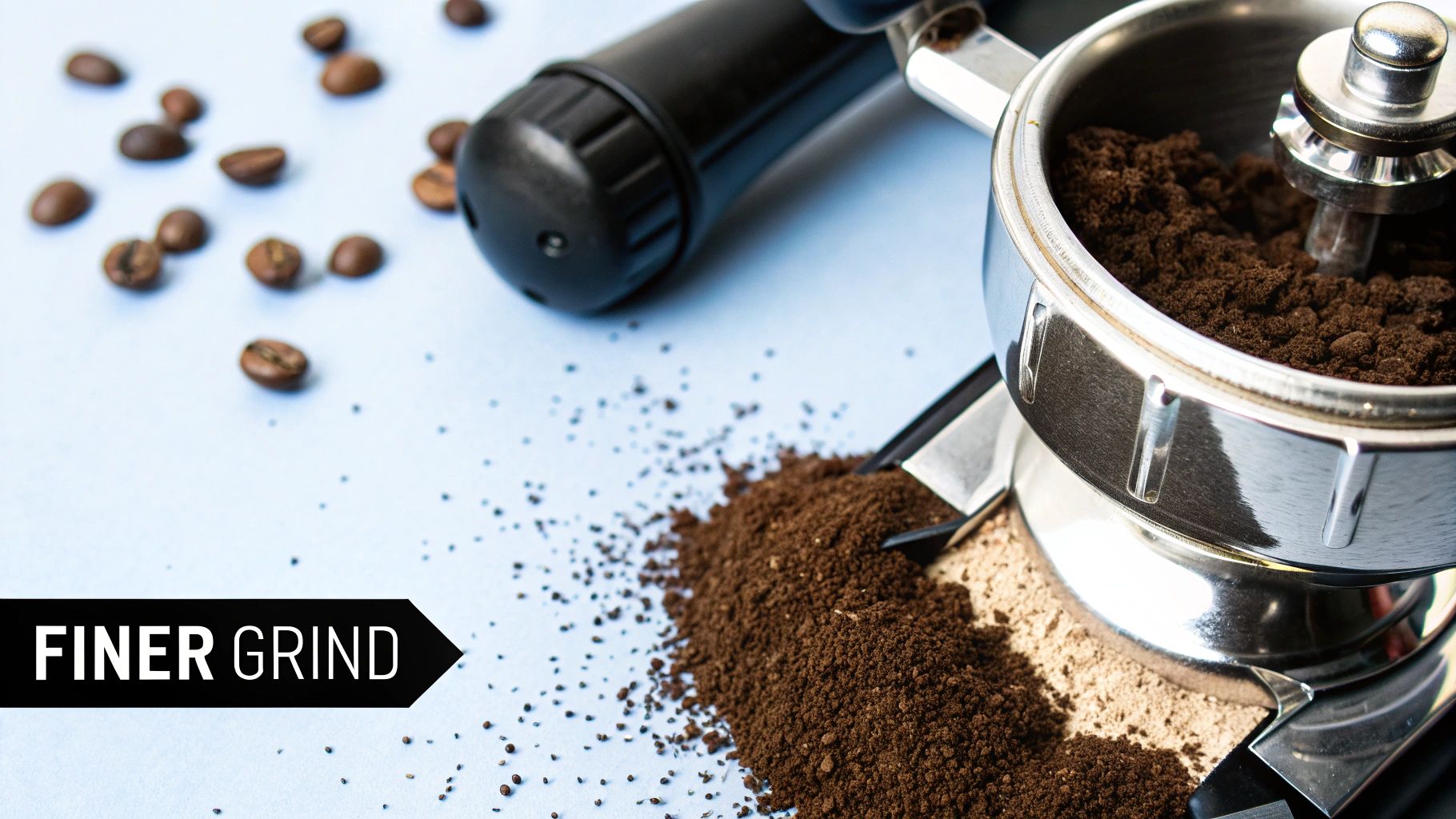
If choosing the right beans is laying the foundation, then getting the grind right is drawing up the architectural plan for your coffee’s flavour. This is, without a doubt, the single most powerful adjustment you can make in your mission to learn how to make coffee stronger. It's the unsung hero that decides just how much goodness you pull from those beans.
The logic behind it is beautifully simple. A finer grind massively increases the total surface area of your coffee. This gives the hot water far more to work with during the brew, letting it dissolve all those delicious oils, sugars, and acids more effectively. This whole process is called extraction, and learning to control it is your ticket to a much more potent cup.
This is exactly why so many home brewers in the UK find that upgrading from a basic blade grinder to a proper burr grinder is a complete game-changer. Blade grinders just hack beans into random, uneven chunks—a mix of boulders and dust. But a burr grinder mills the beans between two revolving surfaces, giving you a remarkably consistent and uniform particle size. That consistency is what allows for a balanced, even extraction every single time.
Finding the Grind Sweet Spot
Dialling in the perfect grind isn't a "set it and forget it" affair. It's about creating a perfect partnership between your grind size and your brewing method. A mismatch here is the quickest way to end up with a disappointing cup, whether it's weak and watery or harsh and bitter.
Here’s a rough guide to get you started:
- Espresso: This method needs a very fine, almost powder-like grind. The high pressure and short contact time demand maximum surface area to pull out that intense, concentrated flavour fast.
- Pour-Over (V60, Chemex): You're aiming for a medium-fine grind, something like the texture of table salt. This gives you a controlled flow, stopping the water from rushing through too quickly (which causes a weak brew) or getting stuck (which leads to bitterness).
- French Press: Go for a coarse grind, similar to rough sea salt. Because the grounds steep in the water for several minutes, a coarse grind slows the extraction right down, preventing a muddy, overly bitter result.
Think of your grinder less like an on/off switch and more like a precision dial for intensity. Moving the setting just one notch finer can radically alter the strength and body of your coffee.
It’s interesting to see how the need for stronger coffee maps onto our working lives. A recent UK survey revealed that journalists and media pros are the biggest coffee drinkers, putting away an average of 3.62 cups a day. For jobs that require that kind of sustained focus, a stronger brew—made possible by a finer grind or a higher dose—isn’t just a preference, it’s a necessity. You can read more about these trends in the latest UK consumption report.
So, it’s time to start experimenting. If your morning pour-over tastes a bit thin, try adjusting your grinder just one click finer. You'll notice the brew takes a little longer, and the coffee in your cup will have more depth and body. That’s you, taking control of your brew.
Dialling in Your Coffee to Water Ratio
Right, let's get into the numbers game—the blueprint that truly defines your brew's character. If you want to know how to make coffee stronger, the coffee-to-water ratio is the most direct and reliable dial you can turn. Once you get a handle on it, you’re in complete control of your coffee's final concentration and flavour intensity.
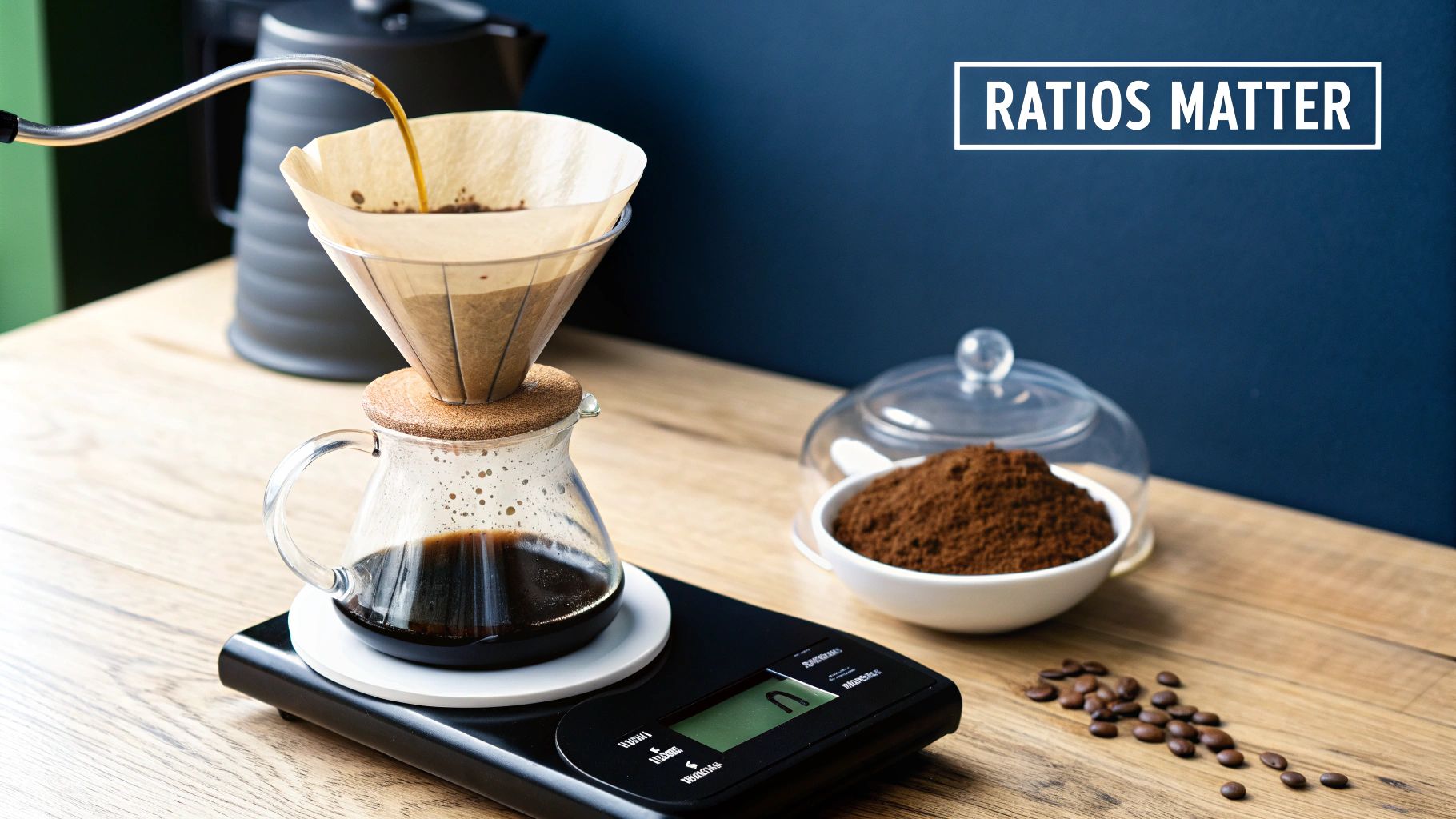
Many home brewers in the UK start somewhere around a 1:15 ratio. That’s one part coffee to fifteen parts water. Think of this not as a rigid rule, but as a brilliant starting point. From here, every little adjustment you make is a conscious step toward crafting your ideal cup. The secret is to change one thing at a time, and the ratio is by far the easiest to measure and tweak.
To get started, you’ll need a simple digital scale. Measuring by volume with scoops is notoriously all over the place; a scale gives you precision and, more importantly, lets you repeat your successes. Once you can brew a consistent cup, you can start experimenting with confidence.
Adjusting Your Ratio for More Punch
So, you’ve brewed a cup with that 1:15 ratio. It’s pleasant, but just not punchy enough. For a more robust and concentrated flavour, you simply need to reduce the amount of water relative to the coffee.
Try moving to a 1:14 or even a 1:13 ratio. It might not sound like much, but this small change makes a significant difference. You're forcing more of those lovely coffee solids to dissolve into less water, creating a brew that’s denser, richer, and far more satisfying.
- For a weekend French Press: You might be using 60g of coarse coffee with 900g of water (a classic 1:15). For more punch, try upping the coffee to 65g with the same amount of water. That shifts you closer to a 1:13.8 ratio.
- For a quick morning AeroPress: A common recipe is 15g of coffee to 240g of water (1:16). To really boost its strength, try using 18g of coffee instead. This brings you to a much more potent 1:13.3.
This methodical approach helps you understand exactly how your choices impact the final taste in the cup.
Your digital scale is the single most important tool for achieving a consistently strong brew. It removes all the guesswork and empowers you to replicate that perfect cup, day after day.
This push for stronger, more concentrated coffee at home really mirrors what we’ve seen happening in the UK’s incredible café culture. There are nearly 12,300 coffee shops across the country, and with the market set to hit £6.1 billion by 2025, there's a clear demand for quality and intensity—just think how double espresso shots have become the standard.
This desire for a more powerful flavour experience inevitably trickles down into how we brew in our own kitchens. You can dive deeper into these trends in this UK coffee market report. By controlling your ratio, you're essentially doing what the best baristas do to deliver that strength we’ve all come to expect.
Right then, let's look beyond the basics. If you're ready to truly master the art of a powerful brew, you'll be glad to know it doesn't require a brand-new, expensive setup. With just a few clever tweaks to your technique, you can unlock a level of intensity you might have thought was only possible in a high-street café. Your strongest, most satisfying coffee is just a few adjustments away.
Different brewing methods naturally offer different pathways to strength. Your trusty French press, for instance, can be pushed much further than you think, while an AeroPress holds the secret to a quick, concentrated shot. Even if you have an espresso machine, there are still a few tricks up your sleeve. It’s all about knowing which levers to pull.
Fine-Tuning Your French Press
The French press is a UK favourite for a reason—it’s fantastic at producing a full-bodied and robust cup. The simplest way to ramp up the strength is by extending the steep time. Most guides suggest a four-minute brew, but don't be afraid to push this to five or even six minutes. This gives the hot water more contact time to extract those deep, rich, and soluble flavours from the coarse grounds.
Of course, time is a powerful variable, and more isn't always better. The longer you let it brew, the more caffeine and flavour compounds you extract. This is great, up to a point.
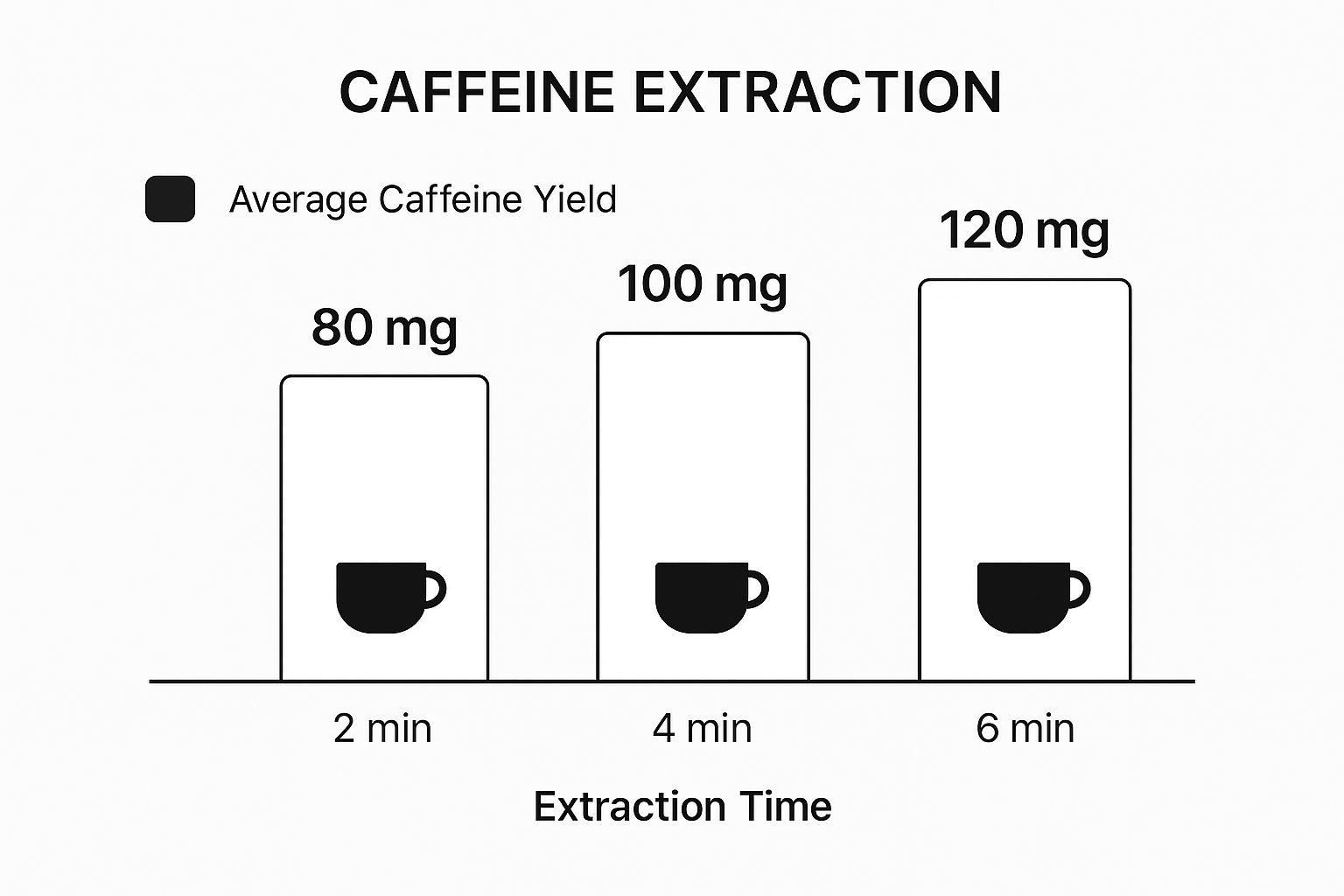
As you can see, simply extending your brew time from four to six minutes can bump up the caffeine by around 20%, giving you a noticeably stronger result. Just be careful not to push it too far, as over-extraction can start to pull out bitter, undesirable notes alongside all that goodness.
Exploring More Intense Brew Styles
Beyond tweaking your go-to method, some techniques are specifically designed for maximum impact. These are the ones to turn to when you need a truly potent and flavourful cup that really hits the spot.
A few of my favourites include:
-
The AeroPress "Espresso-Style" Shot: This versatile little brewer is absolutely brilliant for creating a short, highly concentrated coffee. By using a finer grind than you would for a filter coffee, adding your water, and then applying a quick, firm plunge, you can produce a "shot" that rivals an espresso in its intensity. It's perfect for making a punchy Americano or a café-quality flat white at home.
-
The Ristretto Shot: If you're lucky enough to own an espresso machine, pulling a 'ristretto' is the ultimate move for stronger flavour. A ristretto is essentially a "short" or "restricted" shot of espresso. You use the same amount of ground coffee as a normal shot but only about half the amount of water. The result? A sweeter, less bitter, and incredibly concentrated coffee experience.
-
The 'Double Brew' Method: Now, this one is for the truly bold. The double brew technique involves, well, exactly what it sounds like. You brew a batch of coffee as you normally would, but then you use that brewed coffee—instead of fresh water—to brew a second batch of grounds. It's an extreme method, for sure, but it guarantees an unforgettably strong and almost syrupy cup.
Your brewing method isn't just a set of instructions; it's a creative tool. Don't be afraid to push the boundaries of a recipe to find the strength and flavour profile that’s perfect for you.
By embracing these advanced methods, you're not just learning how to make coffee stronger; you're taking direct control over every aspect of your brew. You become the architect of your own perfect cup, transforming a simple daily routine into a moment of genuine craft and satisfaction.
Comparing Brewing Methods for Coffee Strength
Choosing the right tool for the job makes all the difference. While any method can be adjusted, some are inherently better suited for producing a powerful cup.
Here’s a quick comparison of how popular home brewing methods stack up when you’re aiming for strength.
| Brewing Method | Potential for Strength (1-5) | Key Adjustment for Strength | Best For |
|---|---|---|---|
| French Press | 4/5 | Increase steep time (5-7 minutes) and use a finer grind. | A full-bodied, rich, and heavy cup with a classic, robust flavour. |
| AeroPress | 5/5 | Use a fine grind and a 1:2 coffee-to-water ratio. | Quick, concentrated "espresso-style" shots perfect for milk drinks. |
| Espresso Machine | 5/5 | Pull a ristretto shot (same coffee, half the water). | The ultimate in concentrated flavour and syrupy texture. |
| Moka Pot | 4/5 | Ensure a full chamber of coffee and use a medium-fine grind. | A strong, intense, and slightly rustic brew that’s famously bold. |
| Pour-Over (V60/Kalita) | 3/5 | Use a finer grind and a slower, more controlled pour. | Highlighting flavour clarity, though can be made stronger with technique. |
Ultimately, the best method is the one that fits your taste and routine. Experiment with these adjustments, and you'll find that a café-quality strong coffee is easily within your reach right at home.
Crafting Your Strong Coffee Ritual
Your journey towards a bolder, more satisfying brew is about much more than a single tweak here or there. It's about creating a personal craft, a rewarding daily ritual that turns your morning routine into something you genuinely look forward to. Think of it as bringing beans, grind, water, and technique together in perfect harmony.
This is where everything you've learned comes into play. You now know that a truly exceptional cup of coffee is built on a foundation of deliberate choices—from picking out a full-bodied Sumatran bean to dialling in your grinder just one notch finer.
Embracing the Craft of Brewing
That perfect, powerful cup of coffee isn't some myth. It's entirely achievable right in your own kitchen. The secret is to fully embrace experimentation. Don't be afraid to adjust one variable at a time and take note of what happens.
What's the difference when you shift your French press ratio from 1:15 to 1:13? How does a six-minute steep time taste compared to the standard four? Each small adjustment is another step closer to a coffee that is uniquely yours, brewed exactly how you like it.
The ultimate goal here is to move from just making coffee to thoughtfully crafting it. Once you understand the fundamentals of extraction, you have all the tools you need to brew a cup that truly inspires you.
This process transforms coffee from a simple caffeine delivery system into a genuinely fulfilling hobby. You start to appreciate the subtle nuances in every bag of beans and realise the power you hold with your grinder and scales.
Your Path to the Perfect Cup
You now have the knowledge to diagnose and improve your brew on the fly. Is your coffee tasting a bit thin? Try a finer grind. Missing that deep, rich flavour? Go for a darker roast next time, or simply increase your coffee dose.
Consider these your essential takeaways—a personal toolkit for making stronger, better coffee:
- Start with the right beans: Look for flavour profiles that mention 'dark chocolate' or 'full-bodied' from quality UK speciality roasters.
- Master your grinder: A consistent, finer grind is your single most powerful tool for boosting extraction and strength.
- Control your ratio: Use a digital scale. It’s the only way to precisely adjust your coffee-to-water ratio for more concentration.
- Optimise your technique: Don't be afraid to extend steep times or explore methods like the AeroPress for a more intense, concentrated result.
Your journey starts now. Brew with purpose, experiment with joy, and create a strong coffee ritual that makes every single morning something to get excited about.
Your Strong Coffee Questions Answered
Even with the best brewing plan, a few questions always pop up on the quest for a more powerful cup. Let's tackle some of the most common myths and queries to make sure you have everything you need to master the art of stronger coffee.
Does Darker Roast Mean More Caffeine?
It’s one of the biggest myths in the UK coffee scene, but the answer is, surprisingly, no. While a dark roast certainly delivers that bold, intense, and often smoky flavour we associate with "strength," the roasting process itself actually burns off a tiny amount of caffeine.
Lighter roasts, which keep more of the bean’s original character, often pack a slightly higher caffeine punch. It's a crucial thing to remember: strong flavour and high caffeine content are not always the same thing.
Can I Make Coffee Stronger Without New Gear?
Absolutely. You don’t need to rush out and buy a load of expensive equipment just to get a more robust cup. The simplest, most effective change you can make costs nothing: adjusting your coffee-to-water ratio. Using more coffee grounds for the same amount of water is the most direct way to get a more concentrated brew.
Your digital scale is the single most important tool for achieving a consistently strong brew. It removes all the guesswork and empowers you to replicate that perfect cup, day after day.
Got an immersion brewer like a French Press? Try extending your brew time by a minute or two. This will increase extraction and, therefore, strength. If your grinder has different settings, making your grind a touch finer is another fantastic way to boost intensity without spending a penny.
Will Stronger Coffee Taste Bitter?
Not necessarily, and this is a vital distinction to get right. 'Strong' refers to the concentration of dissolved coffee solids in your cup, which is what creates that rich, full-bodied flavour. 'Bitter', on the other hand, is the taste of over-extraction.
Bitterness happens when you pull too many of the wrong, undesirable compounds from the coffee. This is often the result of grinding your beans too fine or brewing for far too long. To avoid this, focus on adjusting your coffee-to-water ratio first. It’s the safest path to building strength without accidentally tipping your brew into bitter territory.
Ready to put this knowledge into practice with beans crafted for exceptional flavour? Explore the full range of speciality coffees at Ue Coffee Roasters and find the perfect foundation for your next bold brew. Discover our collection at https://www.uecoffeeroasters.com.