

Your Guide to Coffee Bar Equipment
So, you're ready to move beyond just a morning cup and create a space that truly celebrates the art of coffee. This guide is your starting point for building out that perfect little corner, whether it's in your kitchen or for a new café venture. The right coffee bar equipment is what turns a simple routine into a ritual, unlocking amazing flavour and transforming your counter into a hub of creativity.
Building Your Perfect Coffee Experience
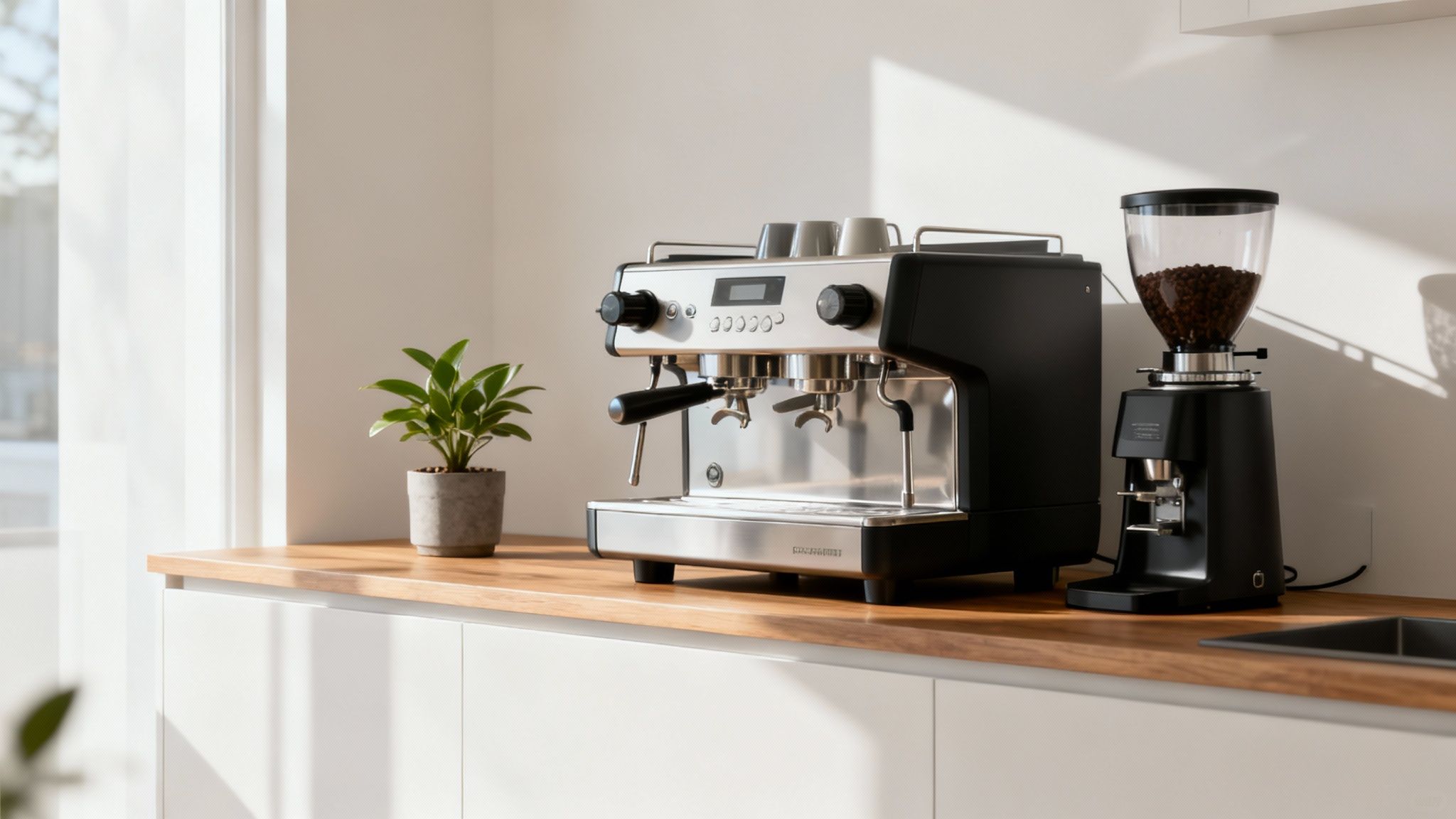
Setting out to create your ideal coffee space is an exciting journey. It’s about so much more than just buying a few appliances; it’s about curating a collection of tools that will help you craft the perfect brew, day in and day out. Think of this less as a shopping list and more as the foundation for a deeply rewarding coffee ritual.
Whether you're an aspiring home barista or a café owner ready to open your doors, the equipment you choose will directly shape the quality of your coffee and the joy you get from making it. From the satisfying whir of the grinder to the first pour of perfectly steamed milk, every single piece plays a crucial part in the final masterpiece.
Laying the Foundation for Quality
The passion for truly great coffee has never been stronger here in the UK. You can see this growing appreciation reflected in the market itself, which is on track to hit around $1,020 billion USD by 2035. It's a clear sign that people are investing in quality gear to elevate their coffee game, both at home and in commercial settings. You can dive deeper into the growth of the UK coffee machine market if you're curious.
This guide is here to help you make smart, informed choices that bring your unique vision to life. We’ll walk through all the essentials, from the core machinery down to the small but mighty accessories that make all the difference.
Your coffee bar is a personal expression of your taste and dedication to the craft. The equipment you choose is the set of brushes you'll use to paint your masterpiece in every cup.
Commercial versus Home Setups
While the passion behind the brew is the same, the practical needs of a commercial setup versus a home bar are worlds apart. A commercial coffee station is all about speed, durability, and consistency, designed to serve dozens of customers an hour without breaking a sweat. For a really thorough look at what that entails, it's worth exploring guides on sourcing restaurant equipment.
A home coffee bar, on the other hand, is built around personal preference and the pure joy of the process. It's your personal lab for experimentation and for mastering your favourite drinks, turning a corner of your kitchen into a sanctuary of flavour.
Mastering the Fundamentals of Great Coffee
Before you even start dreaming about that shiny new espresso machine, we need to talk about the two things that will make or break every single cup you brew: the grind and the water. It’s a classic bit of wisdom you’ll hear from any seasoned barista: your grinder is the single most important piece of kit you will ever own. This isn’t just an opinion; it's the bedrock of good coffee extraction.
A quality grinder is all about creating coffee particles of a uniform size. Think of it like cooking potatoes. If you toss a mix of tiny bits and huge chunks into a pan, the small ones will burn before the big ones are even cooked through. It’s exactly the same with coffee. An inconsistent grind gives you a muddled, disappointing cup, pulling bitter notes from the tiny, over-extracted particles and sour flavours from the chunky, under-extracted ones.
Why You Absolutely Need a Burr Grinder
This is why a burr grinder is a non-negotiable investment for anyone who's serious about their coffee. Forget blade grinders—they just violently smash beans into a chaotic mess of dust and boulders. Burr grinders, on the other hand, use two revolving abrasive surfaces to gently crush beans into a consistent size. That consistency is the real secret to a clean, delicious, and repeatable brew, time after time.
You’ll generally come across two main types:
- Flat Burrs: These are the gold standard for espresso lovers. They produce an incredibly uniform grind that creates a fluffy, even bed of coffee, which is perfect for high-pressure extraction.
- Conical Burrs: Often quieter and producing less heat (which is great for protecting the delicate oils in your coffee), these are fantastic all-rounders. They're versatile enough to handle everything from a coarse French press grind to a fine pour-over.
Choosing your grinder is the first real decision you'll make when setting up your coffee bar, and it directly dictates the potential of every single bean you buy.
The Unsung Hero: Your Water
Right, let’s talk about the unsung hero of every great brew: water. A finished cup of coffee is over 98% water, so its chemical makeup has a massive impact on the final taste. If your water is too soft—lacking minerals like calcium and magnesium—you’ll end up with a flat, lifeless cup. On the flip side, water that's too hard will cause over-extraction and can lead to a damaging build-up of scale inside your expensive machines.
The sweet spot for brewing water is a mineral content somewhere around 50–150 parts per million (PPM). This ideal range has just enough mineral content to bond with and pull out all the desirable flavour compounds from the grounds, creating a vibrant, balanced cup.
You don't need a chemistry degree to get this right. Simple, cheap test strips can give you a quick reading of your tap water's hardness. From there, you can figure out the best filtration solution. For a home setup, a good activated carbon filter pitcher can do a brilliant job of removing chlorine and balancing out the minerals.
For a commercial spot or for the truly dedicated home enthusiast, it’s worth looking into an in-line water filtration system designed specifically for coffee. It’s a smart move that not only elevates your coffee's flavour but also protects your coffee bar equipment from long-term damage, making sure your investment lasts for years to come.
Choosing Your Ideal Brewing Machine
This is where the magic really happens. The brewing machine is the heart of your coffee bar, the centrepiece that turns carefully selected beans into something sublime. Picking the right one is a deeply personal choice, a balance between your skill level, your daily routine, and the kind of coffee experience you're trying to create. It’s not just another appliance; it’s an extension of your passion for coffee.
The journey starts with understanding the main families of espresso machines. Think of them as different paths to the same delicious destination, each offering a unique level of control and involvement.
Finding Your Espresso Machine Style
The world of espresso can feel complicated, but it really boils down to how much of the process you want to handle yourself.
- Manual Machines: For the true traditionalist. These lever-operated machines give you complete control over every single variable, from pre-infusion to pressure. They demand skill and patience, but they reward you with an unparalleled connection to the craft.
- Semi-Automatic Machines: This is the sweet spot for most serious home baristas and commercial cafés. You control the grind, tamp, and shot duration, while the machine handles water temperature and pressure. It’s the perfect blend of hands-on artistry and reliable consistency.
- Super-Automatic Machines: Ideal for busy environments or anyone who values convenience above all else. At the touch of a button, these machines grind, tamp, and brew. Many even froth milk automatically. You get a consistent cup every time with almost zero effort.
This infographic breaks down the core principles of a great extraction—a process that’s absolutely central to getting the most from whichever machine you choose.
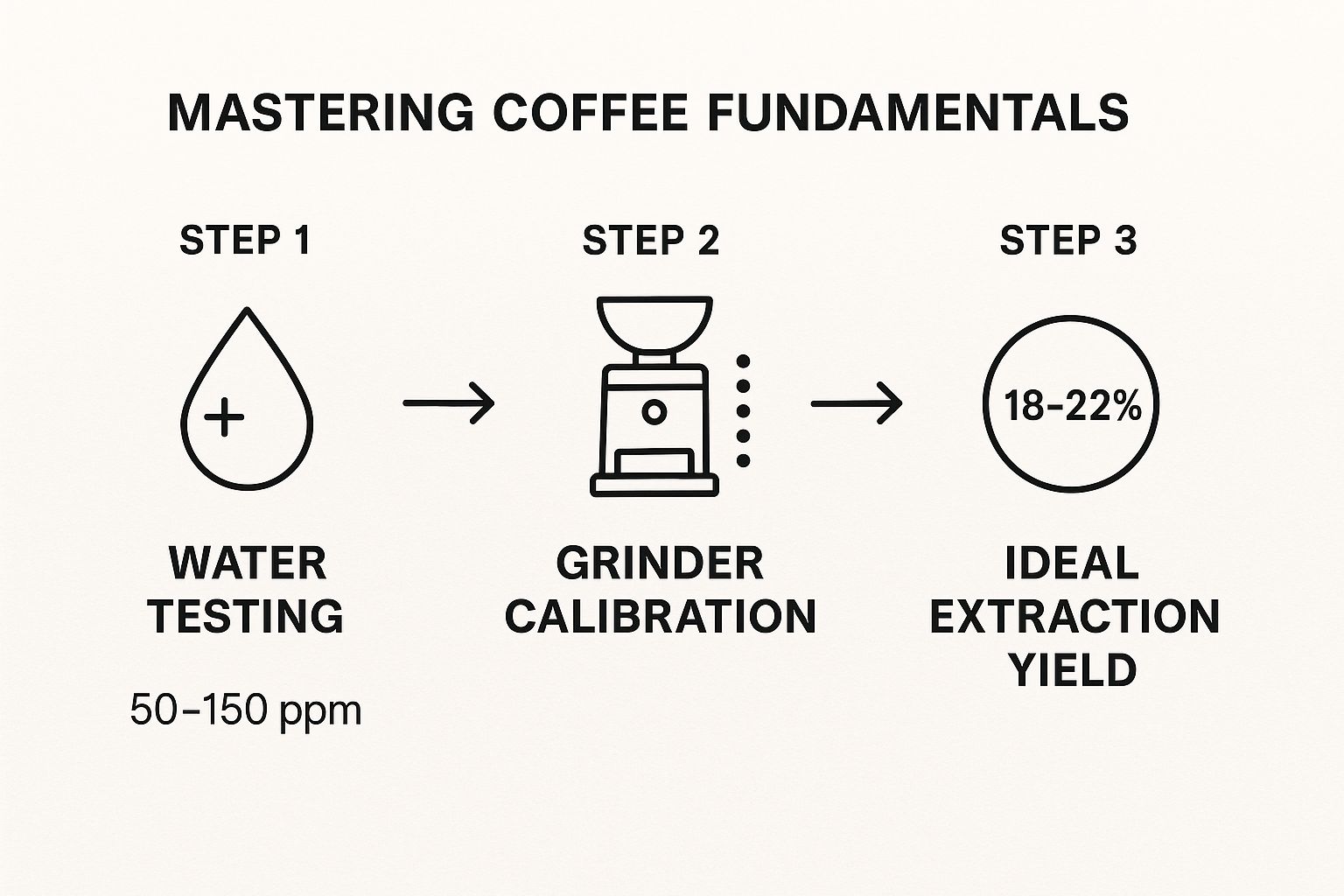
Nailing these fundamentals—your water quality, grind precision, and extraction targets—is how you unlock your machine's full potential. It’s what ensures every single shot is balanced and full of flavour.
To make things a bit clearer, here’s a quick comparison of the main machine types you'll encounter.
Choosing Your Brewing Machine
| Machine Type | Best For | Level of Control | Typical Setting |
|---|---|---|---|
| Manual Espresso | The purist who loves the ritual and wants total control over every shot. | Total. Every variable, from pressure to flow, is in your hands. | Home enthusiast setups, niche specialty cafés. |
| Semi-Automatic | Home baristas and professionals looking for consistency with hands-on artistry. | High. You manage the grind, dose, and shot time; the machine manages pressure. | Home coffee bars, most specialty coffee shops. |
| Super-Automatic | Busy households, offices, or anyone who prizes speed and convenience. | Low. Bean-to-cup at the press of a button. | Offices, high-volume commercial settings, homes. |
| Batch Brewer | Serving large groups quickly with consistent, high-quality filter coffee. | Medium. Set the recipe, and the machine handles the rest perfectly. | Offices, event spaces, cafés with high demand. |
| Pour-Over Station | The coffee connoisseur who enjoys a meditative, hands-on brewing process. | Total. You control water temperature, pour speed, and saturation. | Home kitchens, specialty brew bars. |
| Cold Brew System | Creating smooth, low-acidity coffee for warmer weather or iced drinks. | Varies. From simple immersion jars to complex nitro tap systems. | Homes, cafés, restaurants. |
Ultimately, your choice comes down to what kind of coffee experience you want to create for yourself or your customers.
Beyond the Espresso Shot
While espresso often steals the spotlight, your ideal setup might look completely different. Your coffee bar equipment should reflect the full spectrum of your tastes and the demands of your space.
For instance, in an office or café, a high-volume batch brewer is an indispensable workhorse. These machines are engineered for consistency and speed, churning out litres of delicious filter coffee that can be held at the perfect temperature for hours. They are the true unsung heroes of many busy mornings.
In the UK's bustling coffee shop sector, the choice of equipment is a critical decision that directly impacts a shop's efficiency and quality. Projections for 2025 point to the rapid expansion of coffee chains, all of which rely on significant investments in reliable espresso machines and grinders to maintain high standards as they grow. You can discover more about the coffee machine market dynamics to see where the trends are headed.
Exploring Artisanal and Modern Methods
For those who savour the ritual, an artisanal pour-over station can be a beautiful and engaging centrepiece. This hands-on method gives you absolute control over the brewing process, letting you highlight the delicate, nuanced flavours of single-origin beans. It really does turn coffee making into a mindful, almost meditative practice.
Your brewing machine should inspire you. It’s the tool that bridges the gap between raw ingredient and final creation. Choose the one that makes you excited to wake up and start brewing.
On the other end of the spectrum, modern cold brew systems have completely changed how we enjoy coffee in warmer weather. From simple immersion brewers for home use to sophisticated nitrogen-infused tap systems for commercial bars, cold brew offers a smooth, low-acidity alternative that’s now a staple on modern menus.
The best brewing machine is the one that fits seamlessly into your life and empowers you to create the coffee you love, day after day.
Assembling Your Barista Toolkit
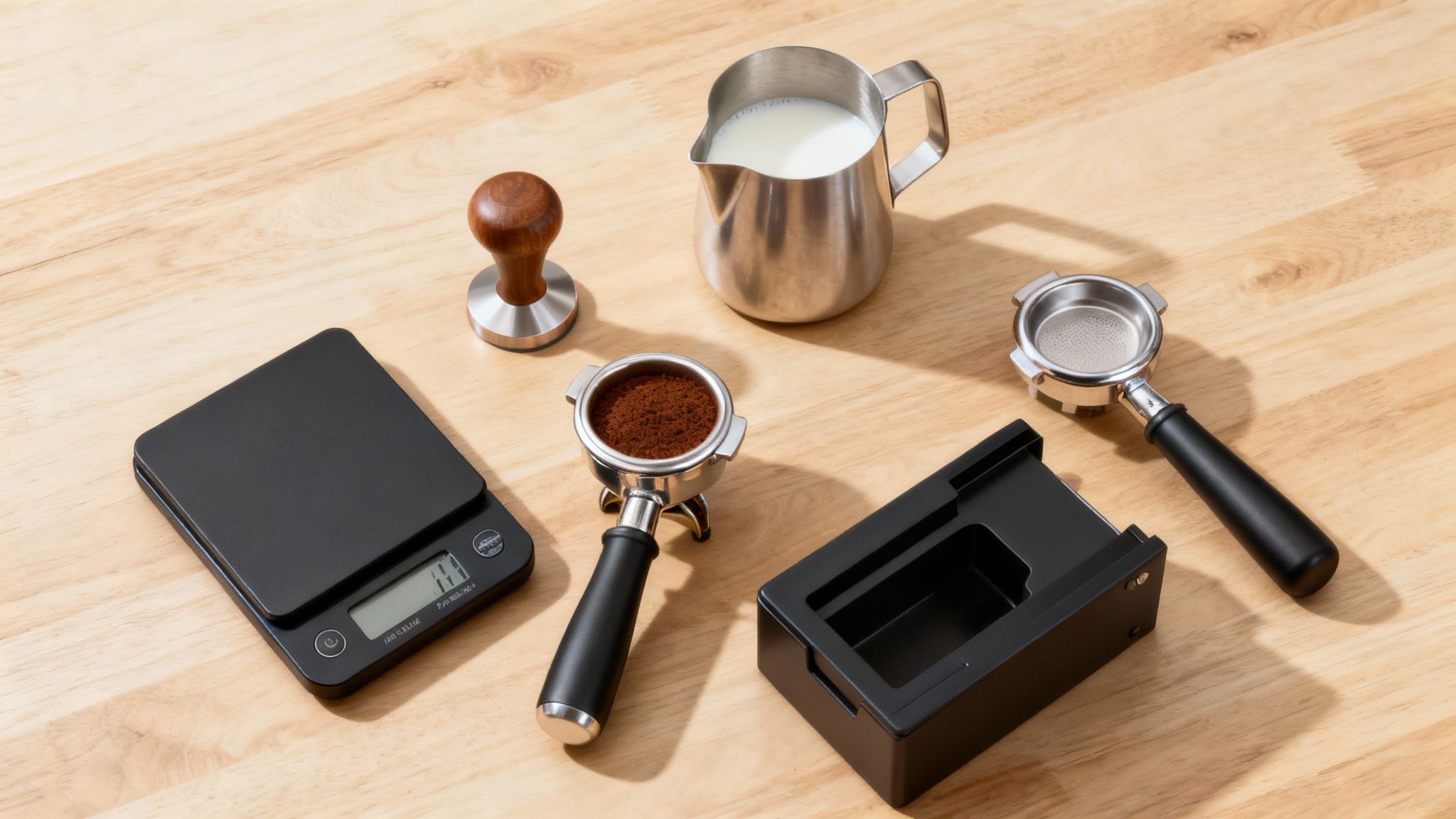
A magnificent brewing machine might be the centrepiece, but it’s only half the story. The small, essential tools you gather around it are what elevate a perfectly good cup of coffee into an exceptional one. This is your deep dive into the barista’s toolkit—a closer look at the accessories that grant you precision, consistency, and control over every single shot.
Think of these tools not as optional extras, but as vital instruments that let you conduct your coffee symphony. Each piece of your coffee bar equipment plays a specific role, helping you refine your technique and unlock deeper, more complex flavours. This is where the real craft begins.
The Holy Trinity of Espresso Precision
For anyone serious about espresso, three tools form a non-negotiable foundation for quality. These aren’t just nice-to-haves; they are absolute game-changers that bring repeatability to your routine and take the guesswork out of the equation.
First up is the precision scale. Weighing your coffee grounds (your 'dose') and the resulting espresso (your 'yield') is the only way to truly know what’s happening during extraction. A scale accurate to 0.1 grams gives you the data needed to make tiny adjustments that have a massive impact on taste.
Next, you need a quality tamper. Its job is simple but crucial: to create a perfectly level and evenly compacted puck of coffee grounds. This ensures water flows through the coffee bed uniformly, preventing 'channelling'—where water finds weak spots and under-extracts the coffee, leading to a sour, thin shot.
Finally, a distribution tool takes your puck preparation to the next level. Before you even think about tamping, this gadget evenly distributes the grounds in the portafilter, breaking up clumps and eliminating air pockets. It's one of the biggest secrets to achieving consistent, delicious espresso every single time.
Streamlining Your Workflow and Perfecting Your Craft
Beyond the core precision tools, a few other items are essential for a smooth, efficient, and enjoyable workflow. These pieces of coffee bar equipment are designed to make your process cleaner, faster, and more intuitive.
- Milk Frothing Pitchers: The shape and spout design of a good pitcher are vital for creating silky microfoam and pouring detailed latte art. It’s worth having a couple of different sizes on hand for various drink orders.
- Knock Box: A simple but incredibly satisfying tool. It’s a sturdy container with a bar across it for knocking out used coffee pucks, keeping your workspace clean and tidy in the middle of a busy service.
- Digital Thermometer: Consistency in milk temperature is the key to achieving a sweet, creamy flavour without scalding it. A clip-on thermometer gives you an instant, accurate reading every time.
A bottomless portafilter is one of the greatest teachers a barista can have. By exposing the basket, it gives you a direct, unfiltered view of your extraction in real-time. Any flaws in your technique are immediately visible, offering invaluable feedback to help you perfect your craft with every shot you pull.
Investing in these small but mighty tools is an investment in your own skill. They empower you to move beyond simply making coffee and into the art of crafting it with real intention. This is how you transform your coffee corner into a true barista's station.
Designing an Efficient Coffee Workspace
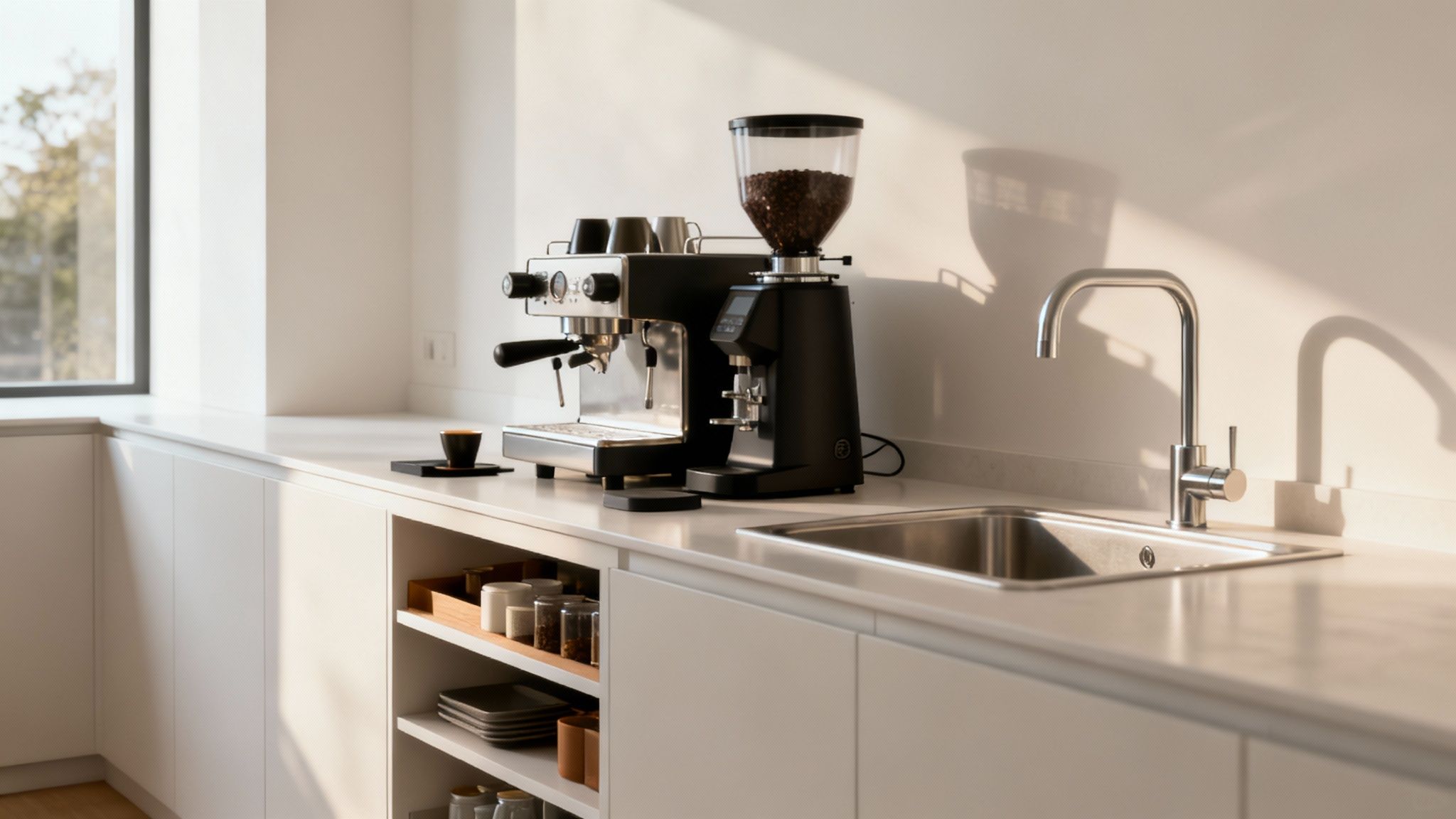
Having all the best coffee bar equipment is one thing, but how you arrange it is what truly makes or breaks the experience. A thoughtfully designed space is all about creating a smooth, intuitive workflow that lets you focus purely on the joy of making a great coffee. It's not just about looking good; it's about building a personal sanctuary for your daily ritual.
For the home brewer, this means carving out a dedicated coffee nook that feels both functional and inspiring. You don't need a massive amount of space, either. A small bit of countertop, a well-organised trolley, or even a dedicated cabinet can be transformed into a brilliant brewing station.
The secret is to think logically about the journey of your drink. Your beans, grinder, and scales should live together. Next in line is your machine, with your tamper, distribution tool, and other gadgets all within easy reach. And finally, your cups, milk pitcher, and syrups should be ready to go for those finishing touches.
Creating an Ergonomic Bar Flow
In a café, this idea of workflow is even more vital. An ergonomic bar layout can be the difference between a frantic, stressful shift and a calm, efficient one. The entire goal is to minimise how much your baristas have to move, cutting out wasted motion so they can produce consistently fantastic drinks, even at speed.
This principle of efficiency is also catching on in modern offices. Office coffee machine usage is a huge part of the UK's equipment market, which tells you a lot about the shift in workplace culture. While simple drip coffee makers are still popular—expected to hold about 33.1% of the market by 2025—convenient pod systems are gaining ground fast. You can read the full analysis on UK workplace coffee trends to see how these patterns are evolving.
A great workspace allows for a state of flow, where your movements are so natural you don’t have to think about them. This is where the true artistry of coffee making comes alive, free from distraction and clutter.
Practical Layout Principles
Whether you're setting up at home, in an office, or a coffee shop, a few core ideas always apply. Think in terms of the "coffee triangle"—the relationship between your grinder, espresso machine, and milk fridge. These three core pieces of your coffee bar equipment should form a tight, comfortable triangle to stop you from running back and forth.
Likewise, easy access to a water source and a knock box for spent grounds is essential. Placing your sink and bin strategically makes cleaning portafilters and rinsing pitchers a quick, seamless action, not a trek across the room that breaks your rhythm.
By thinking through every single step of the process, you can build a workspace that truly works for you, not against you. It's this thoughtful design that helps you find your groove and really master your craft.
Got Questions About Coffee Gear? We've Got Answers
Diving into the world of coffee is exciting, but it’s natural to have a few questions swirling around. Let's tackle some of the most common ones we hear, cutting through the noise to give you clear, confident answers.
Think of this as a quick chat to clear up any confusion. Our goal is to get you set up with the right coffee bar equipment so you can start turning those coffee dreams into a delicious reality.
What Is the Most Important Piece of Coffee Bar Equipment?
It's tempting to fixate on the shiny espresso machine, but ask any seasoned barista, and they'll tell you the same thing: the high-quality burr grinder is the most critical investment you can make.
Your grinder is where great flavour begins. It dictates the consistency of your coffee grounds, and without consistency, you're sunk. A cheap blade grinder creates a chaotic mix of boulders and dust, leading to a muddled cup that’s somehow both bitter and sour at the same time.
A fantastic grinder paired with a decent espresso machine will always, always outperform a top-of-the-line machine that’s handicapped by a poor grinder. Start your budget here; you won't regret it.
A great grinder provides the foundation for great coffee. It's the one piece of equipment where spending a little more delivers a massive return in the quality of every single cup you brew.
How Much Should I Budget for a Home Coffee Bar?
This is a classic "how long is a piece of string?" question, but we can definitely give you some solid goalposts. A home coffee bar budget can range from modest to extravagant, depending on your ambitions.
For a setup that will produce genuinely excellent espresso, here’s a rough guide:
- Entry-Level Enthusiast: Plan to spend somewhere between £600 and £1,000. This will get you a quality burr grinder and a very capable entry-level espresso machine.
- Advanced Home Barista: If you’re eyeing more advanced features like dual boilers or flow control profiling, your budget will likely climb into the £1,500-£3,000+ range.
- Essential Accessories: Don't forget the small stuff! Set aside an extra £100-£200 for the tools that make all the difference, like a precision scale, a good tamper, and a milk pitcher.
Do I Really Need a Water Filter for My Coffee?
Yes. Absolutely. This is a non-negotiable, both for flavour and for the health of your equipment.
Remember, a finished cup of coffee is over 98% water. If your water tastes off, your coffee will too. Tap water often contains chlorine and other minerals that can introduce weird flavours.
More importantly, that mineral content can cause damaging scale buildup inside your expensive machines, leading to costly repairs. For home use, a simple activated carbon filter pitcher will make a huge difference. For serious home setups or commercial use, a dedicated filtration system that properly manages mineral content is one of the smartest investments you can make.
At Ue Coffee Roasters, we know that exceptional coffee in the workplace is more than just a perk—it’s a cornerstone of a thriving company culture. We bring speciality coffee and premium refreshments directly to your office, powered by best-in-class bean-to-cup machines. Explore our office coffee solutions and see how you can elevate your team's daily experience.