

Master Your Coffee Brewing Temperature
Let's talk about one of the most powerful, yet frequently overlooked, variables in making a truly exceptional cup of coffee: water temperature.
Imagine you've sourced the perfect beans and have the best grinder, but your coffee still tastes a bit... off. It could be flat and sour, or perhaps harsh and bitter. The culprit is often hiding in plain sight in your kettle.
The Secret Dial to Unlocking Coffee Flavour
Think of brewing as a simple act of extraction. When hot water hits your coffee grounds, it starts dissolving the wonderful compounds inside—the sugars, acids, and oils that create the flavours we love. Temperature is the master control for this entire process.
Get it wrong, and you're either not pulling out enough of the good stuff (under-extraction) or you're pulling out too much of the bad stuff (over-extraction). Get it right, and you unlock a world of flavour.
Here in the UK speciality coffee scene, there’s a widely accepted sweet spot. Most baristas and roasters will tell you to aim for a water temperature between 90°C and 96°C (195°F and 205°F). This isn't just a random number; it's a carefully honed range that consistently delivers fantastic results. You can read more about this expert recommendation from UK coffee specialists.
So, what does dialling in this temperature actually do for your brew?
- Balanced Sweetness: This is where you extract the lovely, pleasant sugars that give coffee its satisfying, rounded character.
- Bright Acidity: The right heat lets those vibrant, fruity acids come to the party, adding a sparkle to the cup.
- Rich Body: Temperature helps dissolve the oils responsible for that lovely, mouth-filling texture and weight.
The most rewarding part of focusing on your coffee brewing temperature is realising you have direct control over the final taste. A change of just one or two degrees can completely transform your cup from sour to sweet, or from bitter to beautifully balanced.
By the time we're done, you'll see temperature not as a rigid rule, but as a creative tool. You'll be able to confidently nudge the flavour of your coffee in any direction you choose, moving beyond simply following a recipe to truly understanding the craft.
The Science of Flavour Extraction
Brewing coffee is a beautiful bit of chemistry, and water temperature is the director of the whole show. Think of your coffee beans as tiny treasure chests, each packed with a whole spectrum of flavour compounds—bright acids, sweet sugars, and rich oils. The temperature of your water is the key that decides which of these treasures get unlocked and end up in your cup.
This whole process is called extraction. It’s the journey those flavours take from the solid coffee grounds into your liquid brew. It's a bit like making a pot of tea; the hot water dissolves the goodness from the leaves. Coffee is no different, except its various compounds dissolve at different rates and, crucially, at different temperatures.
The Balancing Act of Extraction
Getting a truly delicious cup of coffee is all about striking the right balance. If your water is too cool, it won’t have the energy to properly dissolve the desirable sugars and oils. This is what we call under-extraction. The water only manages to grab the easiest compounds—the sour-tasting acids—leaving you with a brew that’s thin, weak, and disappointingly sharp.
On the flip side, water that’s too hot is just plain aggressive. It strips everything out of the grounds, including the unpleasant, bitter compounds that are much better left behind. This is over-extraction, and it’s the culprit behind that harsh, astringent, and sometimes burnt taste. You’ve pulled out all the good stuff, and then kept going.
By understanding this fundamental process, you are no longer just following a recipe. You are consciously conducting a symphony of flavours, making deliberate choices to highlight the very best characteristics your coffee has to offer.
This is the real 'why' behind all the numbers and guides. Once you get a feel for the science of flavour extraction, you gain the confidence to take proper control of your brew. You can finally move beyond guesswork and start crafting coffee with purpose, unlocking the incredible potential hidden inside every single bean.
Adjusting Temperature for Your Roast Profile
This is where the real craft of a home barista comes into play. Not all coffees are the same, and the roast profile of your beans should dictate your brewing temperature. It’s all about moving beyond a one-size-fits-all number and learning to honour the unique character of each bag of coffee you buy.
Think of it like cooking. You wouldn't use the same high heat for a delicate piece of fish as you would for a hearty steak, right? The same logic applies directly to your coffee. A simple tweak to your water temperature is one of the most powerful tools you have to unlock the flavours the roaster worked so hard to create.
Matching Temperature to Light Roasts
Lighter roasts, which are a cornerstone of the UK’s speciality coffee scene, are much denser and less porous than their darker counterparts. Because of this, they need a bit more energy to persuade them to give up their complex, hidden flavours. Without enough heat, you just won't properly penetrate the bean's cellular structure.
- Recommended Range: Start somewhere between 94°C and 96°C. This is the sweet spot for most light roasts.
- Why It Works: That extra heat provides the energy needed to dissolve the delicate, bright, and often fruity or floral compounds locked inside.
- The Result: You’re rewarded with a vibrant, clean, and aromatic cup that truly sings with the bean’s origin notes.
Get this wrong, and you’ll know it immediately. Water that’s too cool will leave you with a disappointingly sour, thin, and underdeveloped brew.
Nurturing Darker Roasts with Cooler Water
On the other end of the spectrum, we have dark roasts. These beans have spent much more time in the roaster, making them more brittle, porous, and far more soluble. Their flavours are practically waiting to jump out of the grounds, which means they are incredibly easy to over-extract. Using water that’s too hot is a fast track to a harsh, bitter cup.
The secret to a great dark roast is finesse. By lowering your water temperature slightly, you can gently extract those deep, rich notes of chocolate and nuts without scorching the coffee and pulling out all the nasty, bitter stuff.
For these bolder beans, a cooler, gentler approach always wins.
- Recommended Range: Aim for a temperature between 90°C and 92°C.
- Why It Works: Cooler water is less aggressive. It allows for a more balanced extraction that focuses on sweetness and body instead of bitterness.
- The Result: A beautifully smooth, full-bodied cup with a rich character and a pleasant, lingering finish.
Finding the Right Tools for Temperature Control
If there's one secret to brewing consistently brilliant coffee, it's this: nail your water temperature. Thankfully, getting it right is easier than ever, and you don’t need a science lab to do it. Just a little know-how and the right tools for the job.
For any home barista chasing that perfect, repeatable brew, a temperature-controlled gooseneck kettle is a total game-changer. These have become a staple in the UK speciality coffee scene for a reason. You can dial in the exact temperature you want, taking all the guesswork out of the equation. This kind of precision is your ticket to a balanced, delicious extraction, every single time. You can learn more about the critical role of temperature in coffee brewing in our other guides.
But hold on, you don't need to rush out and buy fancy gear to see a massive improvement in your coffee. A simple digital thermometer, which you can find in most UK homeware shops, paired with your trusty standard kettle, is a fantastic and budget-friendly way to start.
Low-Tech, High-Impact Methods
What if you don't have a thermometer handy? No problem. The "boil and wait" method is a simple, effective trick to get your water right into that ideal brewing sweet spot.
The goal is to find a practical solution that fits your routine and budget. Whether you invest in a precision kettle or simply use your watch, taking control of your temperature will immediately elevate your daily coffee experience.
Here’s how easy it is:
- Boil Your Kettle: Just let your kettle run its course until it clicks off at a full boil (100°C).
- Wait and Cool: Once it's boiled, pop the lid off and let it stand for about 30 to 60 seconds.
- Ready to Brew: This short pause is all it takes to bring the water temperature down into that perfect 93-96°C range. It’s a beautifully simple hack for a much better brew.
Tailoring Temperature to Your Brewing Method
Your choice of brewing device is more than just a preference; it’s a decision that profoundly shapes how heat and water work together to create flavour. Each method has its own unique relationship with temperature. Learning to tailor your approach is what separates a good coffee from a truly memorable one.
Think of it this way: the brew time is your guide. Methods where water and coffee sit together for a while, like immersion brewing, need a gentler touch.
For a French Press, where the grounds steep for several minutes, starting with a slightly cooler water temperature of around 93°C is ideal. This stops the extraction from becoming harsh and bitter over time, resulting in a much smoother, more balanced cup.
On the other hand, methods with a quicker, continuous flow of water need a bit more heat to get the job done efficiently.
Pour-Over, AeroPress, and Espresso Nuances
For pour-over methods, which are incredibly popular across the UK’s speciality coffee shops and homes, holding onto that heat is critical. Starting with a higher temperature, often around 96°C, compensates for the heat that’s naturally lost as the water flows through the grounds and the brewer itself. This ensures a full and vibrant extraction from start to finish.
The AeroPress, however, is a world of its own. Its famous versatility means there’s no single "correct" temperature. Enthusiasts across the UK use a massive range, from a low 80°C for sweet, concentrated shots to a hotter 95°C for a more traditional, fuller-bodied cup. With this brilliant brewer, experimentation is everything.
Finally, we have espresso. With this method, temperature stability is non-negotiable. The optimal range is narrow and rigorously guarded by coffee professionals, lying between 91°C and 95°C. As many UK coffee specialists will tell you, starting with water around 93°C is often recommended for home espresso machines as it powerfully influences the balance between acidity and bitterness. You can discover more insights about espresso temperature on pumphreys-coffee.co.uk.
To help you get a sense of how these popular methods stack up, here’s a quick comparison.
Brewing Method Temperature Comparison
This table offers a snapshot of the ideal temperature ranges and key considerations for some of the most common coffee brewing methods you’ll find in homes and cafés today.
| Brewing Method | Ideal Temperature (°C) | Key Consideration |
|---|---|---|
| Pour-Over (V60, Kalita) | 92°C – 96°C | Heat loss is significant, so start hotter. |
| French Press | 90°C – 94°C | Lower temp prevents over-extraction during long steep time. |
| AeroPress | 80°C – 95°C | Highly versatile; lower temps for sweetness, higher for body. |
| Espresso | 91°C – 95°C | Stability is crucial; tiny changes have a big impact on flavour. |
| Cold Brew | Room temp or below | Time replaces heat; requires 12-24 hours of steeping. |
As you can see, there’s no single magic number. The best temperature always comes back to the specific tool you’re using and the final taste you’re aiming for in the cup.
The following chart compares common tools you can use to measure your brewing temperature.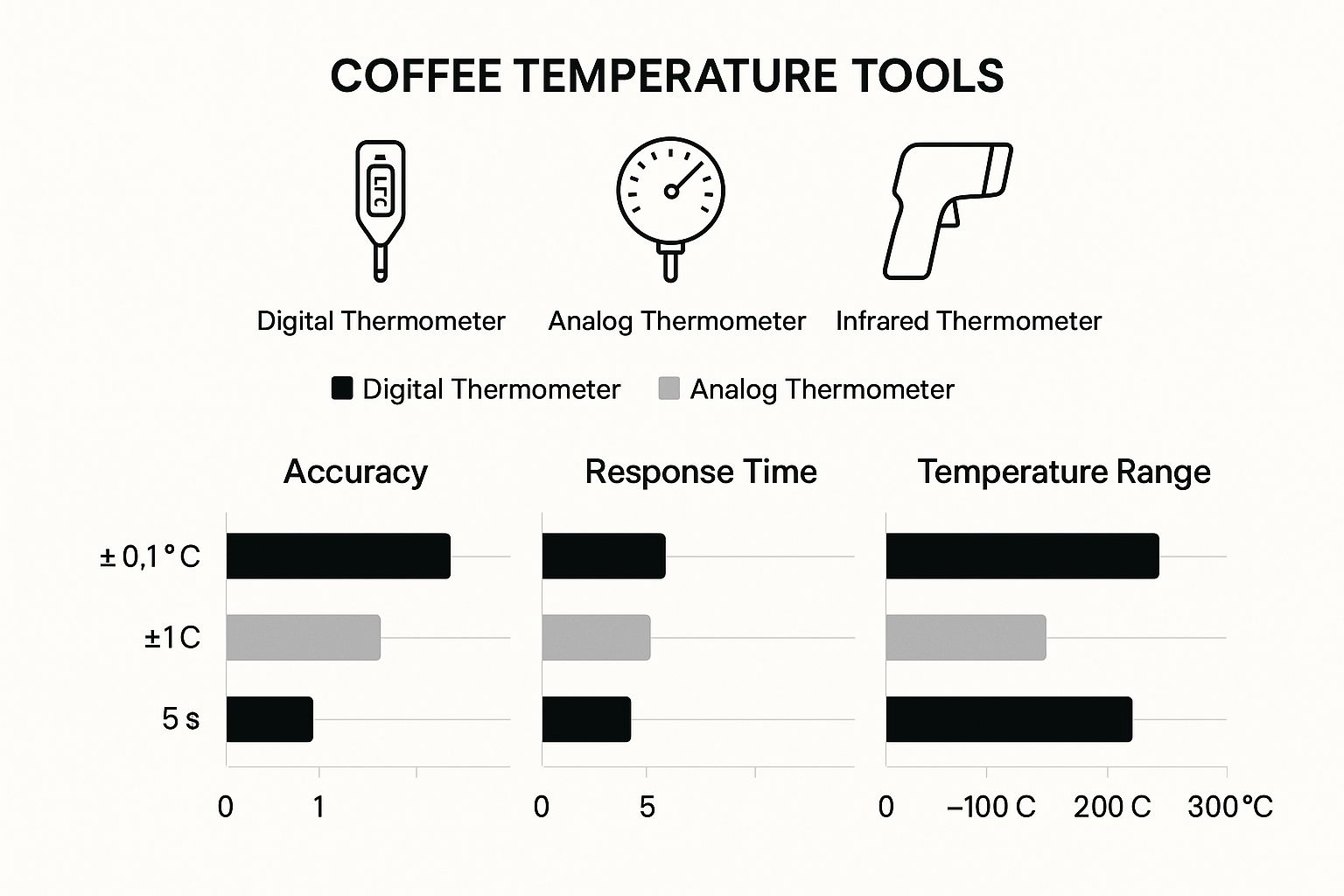
This visualisation shows that while a digital thermometer offers the best blend of accuracy and speed for most home brewers, each tool has its place depending on your specific needs.
Where Do You Go From Here?
You now have the key to unlocking a whole new world of flavour. If there’s one thing to take away, it's that getting a handle on your brewing temperature is one of the most powerful—and easiest—skills you can learn to make your daily coffee truly exceptional. Think of our recommendations as a reliable starting point, but don't be afraid to wander off the beaten path.
This is where the real fun begins: experimentation. Try nudging the temperature up or down by a single degree and pay close attention to the result. Does it bring out more caramel sweetness? Has it softened the bright, fruity acidity? This is exactly how you train your palate and start to figure out what you love.
Your own palate is the only judge that matters. What tastes best to you is the perfect cup of coffee. There are no right or wrong answers here, only delicious discoveries waiting to be made.
Let this knowledge turn your daily coffee ritual from a mindless routine into an exciting, ongoing journey. Have fun with it, stay curious, and prepare to be amazed by the incredible range of tastes hiding in your favourite beans. Your adventure into better flavour starts right now, with you at the controls.
Your Brewing Questions, Answered
Got a question that’s been bugging you? You’re not the only one. Here are the answers to some of the most common queries we get about brewing temperature. Let's clear things up so you can brew with complete confidence.
Does UK Altitude Affect Brewing Temperature?
While it’s true that altitude changes the boiling point of water, the variations across the UK are so minimal they make virtually no difference to your coffee's final flavour.
The golden rule of 90-96°C holds firm. Unless you fancy setting up an espresso bar on the summit of Ben Nevis, you really don't need to worry about adjusting for altitude.
How Can I Get the Right Temperature Without a Thermometer?
This is where the classic "boil and wait" trick comes in handy. Once your kettle hits a rolling boil (100°C), just click it off, take the lid off, and let it sit for 30 to 60 seconds.
That simple pause is all it takes for the water to cool down into that perfect 93-96°C sweet spot. It's a beautifully simple, low-tech way to get a consistently delicious brew every time.
Should I Use a Different Temperature for Decaf Coffee?
Nope, you can treat your decaf beans just like any other speciality coffee. The thing that really dictates your water temperature isn't the caffeine content, it's the roast level.
Whether your decaf is a light, medium, or dark roast is what matters most. Base your temperature on that, and you'll bring out the best flavours it has to offer.
Is It Better to Start Hotter or Cooler if I'm Unsure?
If you're not sure where to start, our advice is to err on the hotter side, around 95-96°C. This is especially true for the lighter, more delicate speciality roasts that are so popular in the UK right now.
It’s much easier to taste the tell-tale bitterness of over-extraction (from water that’s too hot) and simply dial it back, than it is to diagnose the sour, underdeveloped flavour of under-extraction (from water that’s too cool).
Ready to put all this into practice? Ue Coffee Roasters has an incredible selection of speciality beans and the precision brewing gear you need to nail your temperature and unlock amazing flavour. Explore the collection and taste the difference for yourself.