

A Guide to Amazing Decaf Coffee Beans
Decaf coffee isn't about giving something up. It’s about enjoying all the rich, complex flavour of a brilliant cup of coffee, just without the caffeine. Think of it as opening up a whole new world of taste, free from the jitters.
Welcome to the Decaf Coffee Renaissance
If you still think "decaf" is a dirty word, it’s time for a rethink. The old myth that decaf coffee is dull and flavourless is being completely dismantled, one specialty bag at a time. Today’s decaf is celebrated for its vibrant, nuanced profiles that can easily go toe-to-toe with their caffeinated cousins. This isn't just coffee with something missing; it's a premium choice in its own right.
What we're seeing is a real shift in how we approach our daily brew. It’s a move towards savouring the ritual, the aroma, and the pure flavour of the coffee itself, separate from its stimulating effects. For a growing number of us, it’s simply about enjoying a warm, comforting cup in the evening without it costing a good night's sleep.
A Movement Gaining Momentum
This growing love for decaf is more than just a feeling; the numbers back it up. In the UK, decaf has gone from a niche afterthought to a mainstream staple, with one in five coffee drinkers now regularly choosing it. This surge is being led by a more wellness-conscious generation that wants balance and choice.
The market is responding, too. The UK's decaffeinated products market is projected to grow at a compound annual rate of 7.72%. That's a powerful, sustained trend. You can find more insights on this shift from the British Coffee Association.
This guide is your invitation to join the movement. We'll dive into the incredible world of decaf coffee beans, helping you find a brew that doesn't just replace your regular coffee but completely elevates your experience.
Decaf is no longer an afterthought. It's a conscious decision to prioritise flavour and well-being, proving that a great cup of coffee is defined by its taste, not its caffeine content.
The journey into specialty decaf is all about discovery. It’s about tasting the difference that high-quality beans and meticulous decaffeination processes make. You’ll learn to appreciate the subtle notes of chocolate, fruit, and caramel that shine through in a well-crafted cup. Prepare to be inspired—and to find a decaf that becomes your new favourite.
How Coffee Beans Become Decaffeinated
Ever held a green, unroasted coffee bean and marvelled at the journey it's about to take? The process of turning it into one of your favourite decaf coffee beans is even more remarkable. It’s not about stripping something away; it’s a delicate art, gently persuading the caffeine to leave while ensuring all the complex, wonderful flavours stay right where they belong.
Think about it: a single green bean contains over a thousand natural compounds that create the aromas and tastes we adore. Caffeine is just one of them. The real challenge is to pinpoint and remove that single element without upsetting the bean's intricate chemical balance. It's a craft that demands precision and a deep respect for the coffee itself.
The ultimate goal is always the same: to produce a decaf that’s indistinguishable in flavour from its caffeinated twin. This ambition has led to some truly ingenious methods, each with its own philosophy and impact on the final cup.
This infographic gives you a glimpse of how decaf is being reimagined—less as a compromise and more as a conscious choice for flavour and wellbeing.
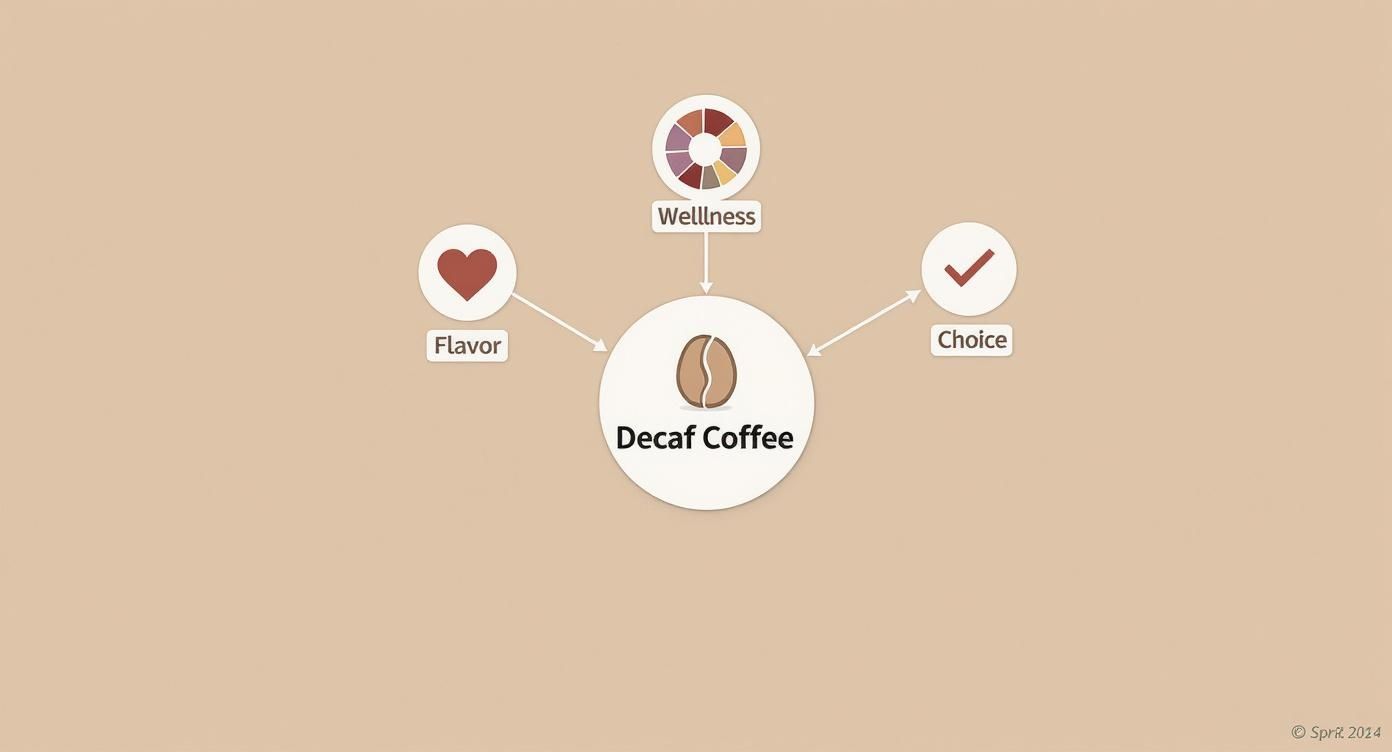
As you can see, modern decaf has moved far beyond being a simple substitute. It’s now celebrated for its unique taste profiles and health-conscious appeal.
The Swiss Water Process: A Spa Day for Beans
Imagine sending coffee beans to a luxury spa where they’re pampered with nothing but pure, fresh water. That’s the heart of the Swiss Water Process, a beautifully simple and 100% chemical-free method that’s won over a new generation of decaf drinkers.
It all starts by soaking a batch of green coffee beans in hot water. This dissolves both the caffeine and the flavour compounds, creating a solution called Green Coffee Extract (GCE). The beans from this first step have done their job and are discarded.
Now for the magic. This flavour-rich GCE is passed through special carbon filters designed to trap only the larger caffeine molecules, letting all the smaller, precious flavour molecules pass straight through.
- The Result: You’re left with a caffeine-free, flavour-charged liquid.
- The Process: A fresh batch of green coffee beans is then introduced to this GCE. Because the water is already saturated with the coffee's flavour solids, these elements can't dissolve out of the new beans.
- The Genius: Only the caffeine migrates from the beans into the water, driven by a natural tendency to create equilibrium.
This cycle continues until the beans are 99.9% caffeine-free. They’re then dried and ready for roasting, with their original flavour profile wonderfully intact. It’s a perfect example of how nature’s simplest solvent—water—can achieve extraordinary results with a bit of scientific precision.
"The Swiss Water Process is a beautiful example of how decaffeination can be a process of preservation, not removal. It honours the bean by focusing on what to keep, rather than just what to take away."
The CO2 Method: Harnessing Natural Elements
Another brilliant, solvent-free approach is the CO2 Process. This method uses carbon dioxide—the very same gas that puts the fizz in sparkling water—in a remarkable state known as "supercritical." When CO2 is heated and highly pressurised, it cleverly behaves like both a gas and a liquid at the same time.
In this supercritical state, CO2 becomes an incredibly selective solvent for caffeine.
- Preparation: First, the green coffee beans are soaked in water to expand their cellular structure, making the caffeine easier to get to.
- Extraction: The beans are then placed in a chamber filled with supercritical CO2. As the CO2 flows through the beans, it bonds with and dissolves the caffeine molecules while leaving the larger flavour compounds completely untouched.
- Separation: The caffeine-rich CO2 is then moved to another chamber. Here, the pressure is reduced, causing the CO2 to turn back into a gas and leave the caffeine behind as a fine powder. The pure CO2 can then be recaptured and used all over again.
This clean, environmentally sound method is celebrated for its efficiency and its amazing ability to preserve the coffee’s inherent character, making it particularly effective for large batches.
A Look at Decaffeination Methods
While water and CO2 methods have set a new standard for chemical-free decaffeination, they aren't the only options. To give you a clearer picture, here’s how the main techniques stack up against each other.
| Method | Process Overview | Flavour Impact | Chemicals Used |
|---|---|---|---|
| Swiss Water Process | Beans are soaked in a flavour-charged, caffeine-free Green Coffee Extract. Caffeine naturally leaches out. | Excellent preservation of original flavour and body. | None (only water). |
| CO2 Process | Supercritical carbon dioxide is used as a solvent to selectively remove caffeine from soaked beans. | Very high flavour retention; maintains the coffee’s unique character. | None (only CO₂ and water). |
| Solvent-Based (Direct) | Beans are steamed and then rinsed repeatedly with a solvent (methylene chloride or ethyl acetate). | Can sometimes slightly alter the flavour profile, though modern methods are very refined. | Methylene Chloride or Ethyl Acetate. |
| Solvent-Based (Indirect) | Caffeine is removed from the water the beans were soaked in, and the now decaffeinated water is returned to the beans. | Generally good flavour preservation, as the beans don't directly touch the solvent. | Methylene Chloride or Ethyl Acetate. |
Each method has its place, but it's clear why processes like Swiss Water and CO2 have gained such a loyal following among coffee lovers who prioritise purity and flavour integrity.
Other Decaffeination Techniques
Solvent-based processes have been around for over a century and remain common. In these methods, the beans are typically steamed to open their pores and then rinsed repeatedly with a solvent that binds to the caffeine.
The two main solvents used are methylene chloride and ethyl acetate. Ethyl acetate is an organic compound found naturally in fruits like bananas and apples. When it's derived from fermenting sugarcane, the method is sometimes marketed as the "Sugarcane Process."
After the caffeine is washed away, the beans are steamed and rinsed again to remove any residual solvent. Regulatory standards for these processes are incredibly strict, ensuring any remaining traces are exceptionally low and considered safe. Even so, the rise of methods like Swiss Water and CO2 reflects a growing desire for processes that rely solely on natural elements, celebrating the pure, unadulterated essence of the coffee bean.
Finding the Flavour Notes in Decaf Coffee
Let's get one thing straight: the old myth that decaf is bland, one-dimensional coffee needs to be put to rest. High-quality decaf coffee beans aren't defined by what they're missing, but by the incredible spectrum of flavour they hold onto. A truly great cup of decaf offers a rich tapestry of taste, woven from the threads of its origin, the bean variety, and the careful decaffeination method used.

It’s all about approaching decaf with the same curiosity you’d give any speciality coffee. It’s about learning to tune in and savour the subtle, complex notes that make each brew a unique experience. This isn't about compromise; it's a celebration of pure coffee flavour.
The Decisive Role of Decaffeination
As we've touched on, how the caffeine is removed is much more than a technicality—it’s a critical step that profoundly shapes the bean's final flavour profile. Chemical-free processes, in particular, are celebrated for their ability to preserve the bean's inherent character.
Take the Swiss Water Process. By using a flavour-charged solution, it gently coaxes the caffeine out while ensuring the delicate compounds responsible for taste and aroma stay locked inside the bean. This is why a Swiss Water processed Ethiopian bean still sings with its signature bright, floral, and citrusy notes. The process honours the bean's origin.
Similarly, the CO2 Process is prized for its precision. It acts like a key that unlocks and removes only the caffeine molecule, leaving the rest of the bean's complex chemistry untouched. A Sumatran bean processed this way will hold onto its deep, earthy body and rich notes of dark chocolate and spice. It's proof of how science can work in harmony with nature to protect flavour.
How Origin Shapes the Taste
The concept of terroir—the idea that a region's soil, climate, and altitude impart unique characteristics—is just as vital for decaf as it is for any other coffee. The place where a bean is grown is the first and most important author of its flavour story.
A bean's origin gives you powerful clues about what to expect in your cup:
- Latin American Beans: Coffees from places like Colombia, Peru, or Brazil often deliver balanced, clean, and classic coffee flavours. Think milk chocolate, caramel, nuts, and a gentle, pleasing acidity.
- African Beans: Beans from Ethiopia or Kenya are famous for their vibrant and complex profiles. Here you'll find bright, fruity, and floral notes—berries, citrus, jasmine, and an almost wine-like acidity.
- Indonesian Beans: Coffees from Sumatra or Java are known for their full body and deep, earthy character. They often have bold flavours of dark chocolate, tobacco, and rich spices with very low acidity.
Approaching decaf is like exploring a world map of taste. Each region offers a distinct dialect of flavour, and the best decaffeination methods ensure that dialect is spoken clearly and beautifully in your cup.
Reading the Language of Flavour
When you see tasting notes like "maraschino cherry" or "toasted almond" on a bag of decaf, these aren't artificial flavourings. They are descriptors used by professional tasters to describe the subtle, natural characteristics of the coffee itself. Learning to pick out these notes is a skill that deepens your appreciation with every sip.
Start by focusing on three main areas:
- Aroma: What do you smell as soon as you open the bag or pour hot water over the grounds? Is it nutty, fruity, or floral?
- Taste: As you take your first sip, what flavours come to mind? Is it sweet like caramel, bright like a lemon, or rich like cocoa?
- Body: How does the coffee feel in your mouth? Is it light and tea-like, or is it heavy, creamy, and full?
By paying attention to these elements, you start to build your own flavour vocabulary. You’ll quickly realise that a great decaf isn't just "coffee-flavoured"—it’s a complex and delightful experience just waiting to be discovered.
How to Choose Your Perfect Decaf Beans
Walking down the coffee aisle can feel a bit overwhelming, but picking the right decaf coffee beans shouldn’t be a lottery. Your perfect cup starts long before you even think about brewing—it begins with knowing what to look for on the bag.
Think of yourself as a coffee detective. Every piece of information on the packaging, from the origin to the roast date, is a clue. These clues tell the story of the coffee in your hands and hint at the flavour journey ahead.
Start with the Roast Date
Before you get lost in tasting notes or origin stories, your first job is to find the roast date. This is, without a doubt, the most critical piece of information on any bag of coffee, decaf or not.
Coffee is a fresh product. Its best, most vibrant flavours start to fade just a few weeks after it's been roasted. Look for a specific date, not a vague "best before" window that could be months away. A clear roast date signals a roaster who cares about quality and has nothing to hide. For the best experience, grab a bag that was roasted within the last few weeks.
Whole Beans Versus Pre-Ground
Next up: always, always go for whole beans if you can.
Pre-ground coffee is handy, of course, but it goes stale much faster because more surface area is exposed to oxygen. Grinding your beans just moments before you brew is a simple step that makes a world of difference to the final taste. It’s what keeps all those delicate oils and aromatic compounds locked in until the last second.
It’s like cooking with fresh herbs versus dried ones from a jar—the fresh version always wins on flavour and aroma. A simple burr grinder is one of the best investments you can make for your coffee setup.
Understanding the Label
Once you've checked for freshness, it's time to dig into the details that give the coffee its character. Learning to read the label transforms shopping from guesswork into a fun, intentional exploration.
-
Single Origin vs. Blend: A single-origin coffee comes from one specific farm or region, letting you taste the unique terroir of that place—think of the bright, floral notes of an Ethiopian bean. Blends, on the other hand, are a roaster’s creation, combining beans from different places to hit a specific, balanced flavour profile, like a smooth, chocolatey espresso blend.
-
Decaffeination Method: Check how the caffeine was removed. As we've covered, processes like the Swiss Water and CO2 Method are chemical-free and do a fantastic job of preserving the bean’s original flavours. Seeing one of these on the bag is usually a sign of a high-quality decaf.
-
Tasting Notes: These aren't added flavourings! They’re the roaster's way of describing the coffee's natural taste. Words like "caramel," "citrus," or "dark chocolate" are your best guide to finding something you'll genuinely enjoy.
Choosing your decaf beans is an act of intention. By learning to read the language of the label, you empower yourself to move beyond generic options and discover the incredible diversity the world of speciality decaf has to offer.
This shift towards quality is reshaping the entire market. The UK decaf coffee scene isn't just growing; it's getting more sophisticated, with more people than ever happy to invest in premium beans. The market is forecasted to grow at a CAGR of 7.72%, driven by a culture that prioritises wellness and amazing flavour.
London, in particular, has become a real hub for this, with speciality shops offering a brilliant range of high-end decaf options. You can find more insights into the UK's decaffeinated market growth and see just how much the decaf world is changing.
Brewing Your Best Cup of Decaf Coffee
So, you’ve brought home a truly special bag of decaf coffee beans. You’ve admired the roast, learned its origin story, and you're imagining the flavours locked inside. Now for the best part: brewing a cup that makes you pause and appreciate every single sip.
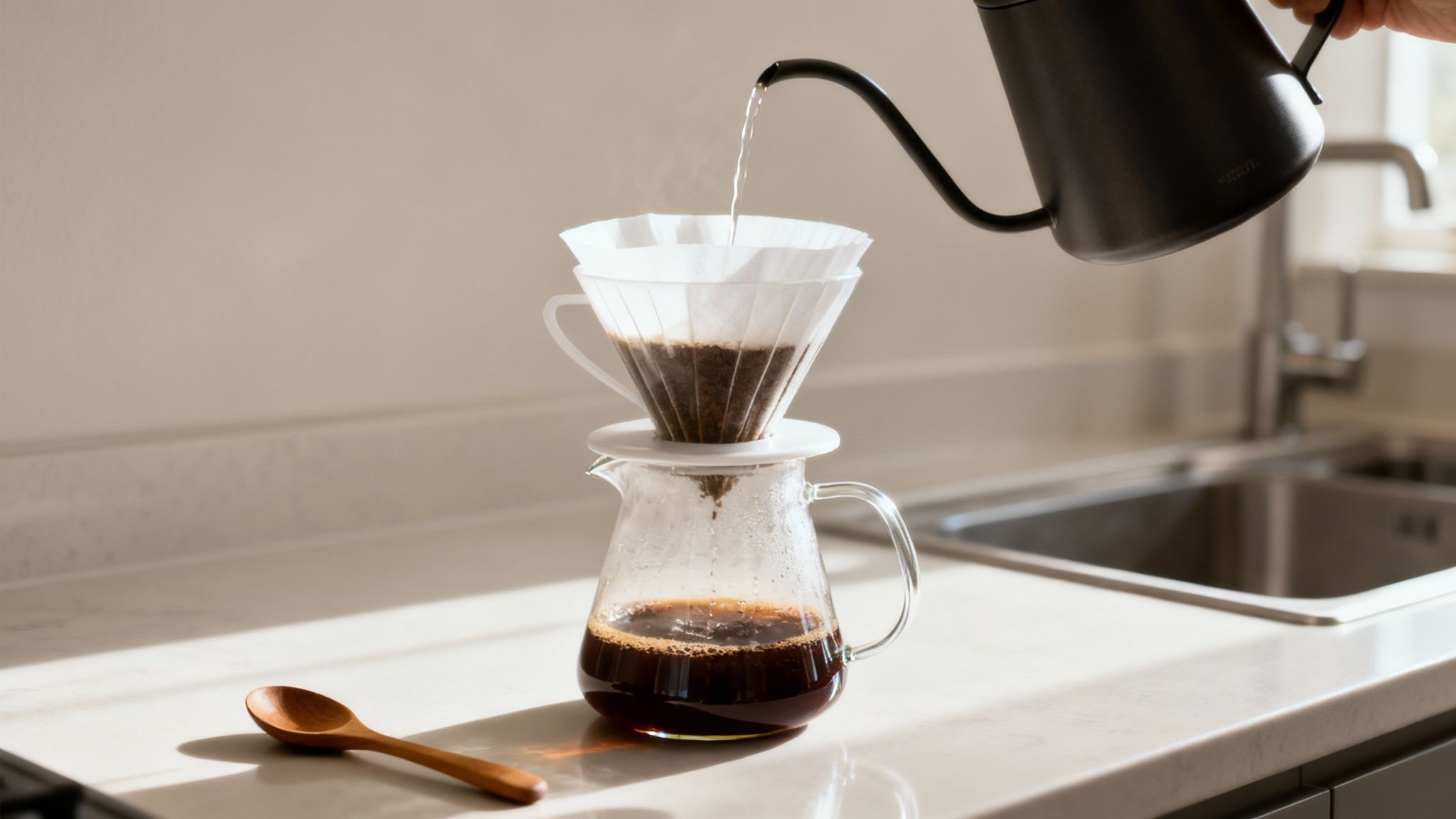
Brewing decaf is more of an art form than a simple routine. Because the decaffeination process can make the beans slightly more porous and a little less dense, they can behave differently in the brewer. But with a few thoughtful adjustments, you can coax out a truly magnificent and satisfying brew.
Perfecting the Grind and Water Ratio
Your journey to a better cup starts with two fundamentals: the grind of your beans and the ratio of coffee to water. Think of these as the foundation upon which all that great flavour is built.
First up, the grind. Decaf beans can be a little softer, meaning they sometimes extract more quickly than their caffeinated cousins. A great starting point is to try a slightly coarser grind than you would normally use for your brew method. This small tweak can prevent over-extraction, which is the main culprit behind any bitter or hollow tastes.
Next is your coffee-to-water ratio. While the golden rule is often cited as 1:16 (one part coffee to sixteen parts water), don’t be afraid to play around. For decaf, starting with a slightly stronger ratio—say, 1:15—can really help accentuate the coffee’s body and flavour. It just means using a little more coffee for the same amount of water, giving those nuanced notes a chance to properly shine.
Mastering Temperature and Time
The final variables in your brewing equation are water temperature and extraction time. Getting these right is like conducting an orchestra; it brings all the elements together in perfect harmony.
Water temperature is crucial. If it’s too hot, it can scald the grounds and pull out harsh, unpleasant flavours. You want to aim for water that is just off the boil, ideally between 90-96°C. If you don't have a temperature-controlled kettle, no problem—just let it sit for about 30-45 seconds after it clicks off.
Brewing time is your final control. This varies wildly between methods, but the principle is always the same: you want to give the water just enough time to extract all the sweet, delicious compounds, without it lingering long enough to start pulling out the bitter ones.
Think of brewing decaf not as a rigid set of rules, but as an invitation to experiment. Your palate is your best guide. Every adjustment you make teaches you more about the coffee and brings you closer to your perfect cup.
Tips for Popular Brewing Methods
Let’s apply these principles to a few popular home-brewing methods. These aren’t strict instructions, but more like inspiring starting points for your own delicious experiments.
-
French Press: For a rich, full-bodied cup, use a coarse grind that looks a bit like sea salt. Try that 1:15 ratio and steep for 4 minutes. Plunge slowly and evenly to avoid kicking up the grounds at the end.
-
Pour-Over (e.g., V60/Chemex): This method is all about highlighting clarity and nuance. Start with a medium-coarse grind and aim for a total brew time of around 3 to 4 minutes, pouring your water in slow, controlled circles for an even extraction.
-
AeroPress: The AeroPress is wonderfully forgiving and versatile. For a clean, espresso-like shot, use a finer grind and a quick press time of around 30 seconds. If you fancy a longer brew, a coarser grind with a 2-minute steep before pressing works beautifully.
Your ideal cup of decaf is just waiting to be discovered. Embrace the process, trust your taste buds, and enjoy the simple, profound pleasure of a coffee brewed with a bit of care and intention.
A Look at the UK's Growing Decaf Scene
The buzz around exceptional decaf coffee beans isn't just a fleeting trend; it's a real cultural shift brewing across the UK. It’s a brilliant blend of our booming speciality coffee scene, a greater focus on personal wellness, and a collective decision to never settle for a sub-par brew. Think of it as a quiet revolution, proving that a fantastic cup of coffee is all about the taste, not just the caffeine kick.
More than ever, coffee drinkers are looking for balance, a moment of mindfulness, and the simple joy of a delicious drink, no matter what time it is. This change is showing up in our daily routines.
A New Daily Ritual
Recent numbers really highlight how decaf has woven itself into our lives. A survey of coffee lovers found that over 66% now drink decaf several times a week, and almost 40% enjoy it daily. This shows decaf has moved beyond being a second choice to become a go-to staple. Even more telling, over 53% of these drinkers only started their decaf journey within the last three years, pointing to a recent and powerful surge in its popularity. You can dive deeper into these findings about the rise of decaf here.
By understanding the bean’s journey, appreciating its different flavours, and learning to brew it with a bit of care, you're already part of this exciting movement.
You're now ready to continue your decaf journey with confidence. Go on, explore some new beans, fine-tune your brewing, and savour the pure, simple pleasure of a truly brilliant cup of coffee, whenever you fancy it.
Your Questions About Decaf Coffee, Answered
If you're just dipping your toes into the world of decaf coffee beans, you've probably got a few questions. From caffeine levels to health benefits, let's clear up the common curiosities so you can sip with complete confidence.
First things first, it's a common myth that "decaf" means "caffeine-free". It doesn't. The term actually means decaffeinated.
In the UK and Europe, for a coffee to earn that decaf label, it must have had at least 99.9% of its caffeine removed. This means an incredibly tiny trace amount might still be present.
How Much Caffeine Is Actually in Decaf Coffee?
So, what does that 99.9% figure really mean for your cup? An average mug of regular coffee contains around 95 mg of caffeine. A cup of decaf? Typically, it's only about 2-5 mg.
This amount is so small it's considered negligible. It’s highly unlikely to give you the jitters or keep you staring at the ceiling at 2 a.m. That makes it the perfect choice for enjoying the ritual and flavour of coffee in the evening.
Choosing decaf is about embracing the coffee experience on your own terms. It’s for those who love the taste, the aroma, and the warmth of a great brew, without the caffeine commitment.
Is Decaf Coffee a Healthy Choice?
Absolutely, as long as you choose wisely. When coffee is decaffeinated using natural, chemical-free methods like the Swiss Water or CO2 processes, it holds onto most of the beneficial antioxidants found in regular coffee.
These powerful antioxidants are known to support overall wellness, making a cup of high-quality decaf a genuinely positive part of your daily routine. The key is to look for beans that have been processed with care.
This way, you get all the rich, satisfying flavour you love while making a choice that aligns with your well-being goals.
Can Decaf Coffee Keep You Awake at Night?
For the vast majority of people, the answer is a firm no. The tiny amount of caffeine in a standard cup of decaf is simply too low to mess with your sleep cycle.
If anything, the effect is more psychological than physiological. The ritual of making and drinking coffee is often associated with waking up, which might make you feel more alert, but the chemical impact is insignificant. It’s an ideal way to unwind with a warm, comforting drink before bed without counting sheep later on.
At Ue Coffee Roasters, we believe everyone deserves an exceptional coffee experience, any time of day. Explore our premium decaf selections and discover how we bring high-street quality coffee directly to your workplace. Learn more at https://www.uecoffeeroasters.com.