

How to Steam Milk (how steam milk) for Office Coffee
Steaming milk is all about coaxing hot, pressurised steam into chilled milk to build up creamy microfoam. You first stretch the milk by introducing a touch of air, then spin it into a whirlpool so it turns silky and smooth. Nail these two phases, and you’ll be pouring café-standard lattes and cappuccinos right in your workspace.
The Art Of Transforming Your Office Coffee Break

Imagine a coffee break where everyone pauses to admire your handiwork. When you steam milk properly, you’re not just making a drink—you’re creating a moment of connection and craft. This isn’t about competing with barista champions; it’s about weaving a bit of artistry into the day and sparking genuine smiles across the office.
We’ll dig into how that velvety microfoam—your secret weapon for lattes and cappuccinos—magically lifts both the flavour and mouthfeel. You’ll find tips that boost team morale and turn each cup into a small, yet memorable, highlight.
Why Perfect Milk Matters
Perfectly steamed milk does more than sit prettily on your espresso. By heating it to 55-65°C, you coax out natural sweetness—lactose breaks down into simpler, sweeter sugars—and avoid that burnt, bubbly taste.
That’s why a top-notch flat white feels richer and smoother compared to one scalded into foam. The aim is a texture so refined that milk and espresso merge into a single, harmonious sip. It’s this seamless blend that makes every coffee feel like a treat.
“Learning to steam milk is about more than technique; it’s about appreciating how a small detail can create a big impact on your daily routine. It’s a moment of mindfulness that rewards you with a beautiful and delicious result.”
Bringing High-Street Quality To The Workplace
You don’t need a busy café queue to savour top-tier coffee. Premium bean-to-cup machines let you replicate that high-street standard in your own breakroom, turning you into the office hero.
Whether you’re wielding a classic steam wand or trusting an automatic frother, the core principles stay the same:
- Texture: Aim for a silky, paint-like microfoam, never stiff or overly airy.
- Temperature: Hit the sweet spot of 55-65°C to unlock sweetness without scalding.
- Integration: Blend milk and espresso smoothly so each mouthful is perfectly balanced.
By zeroing in on these elements, every cup you serve becomes a step above the rest.
Gathering Your Milk Steaming Toolkit
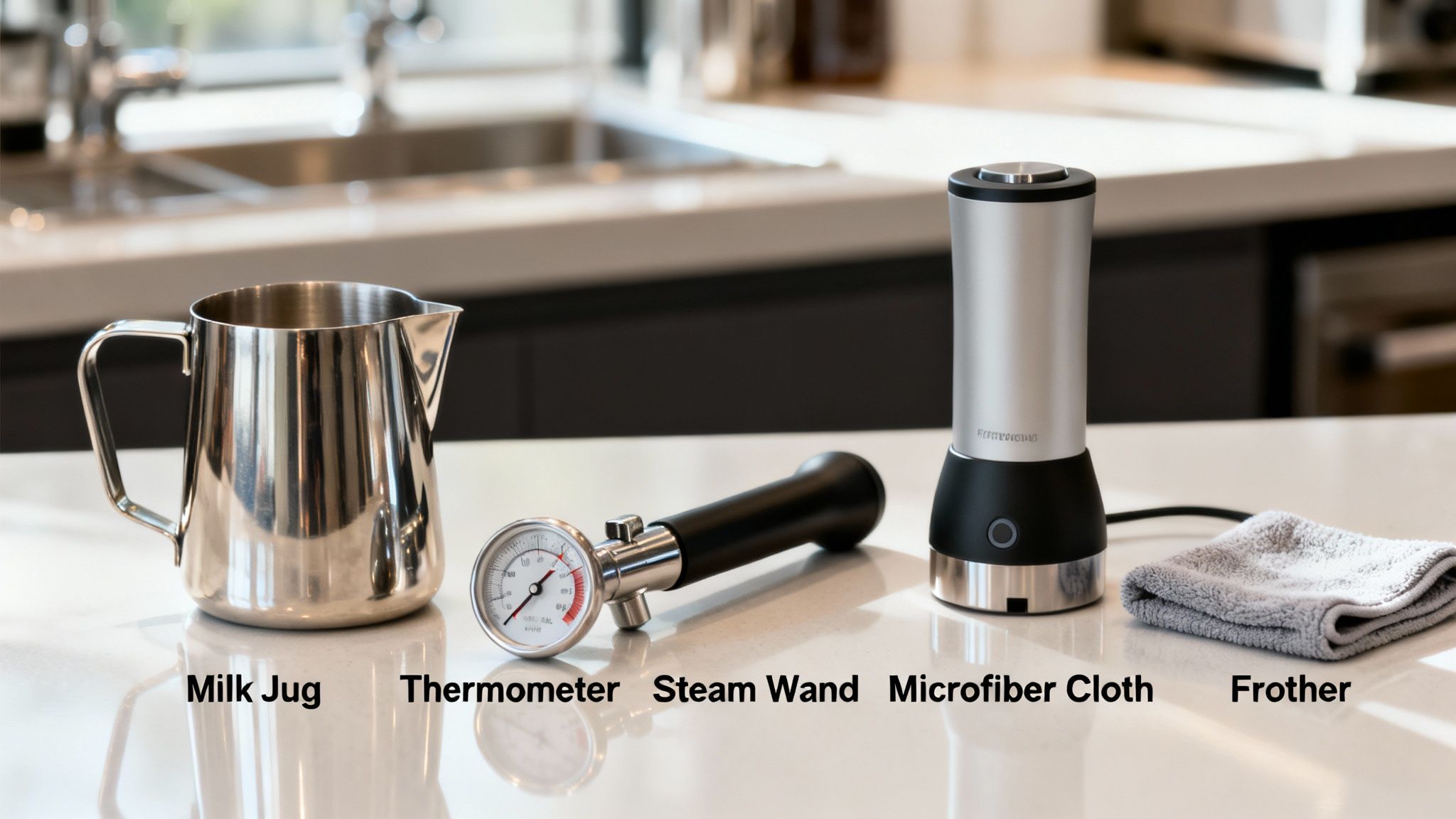
Before you can create that perfect moment in a cup, you need to get your hands on the right tools. It’s not about having the most expensive gear, but having the right gear for the job. Getting properly equipped is the first step toward turning ordinary milk into the silky, sweet microfoam that makes a coffee truly special.
Think of it like an artist gathering their supplies before painting a masterpiece; each piece plays a specific role.
The Heart of the Operation: Steam Wands vs. Automated Frothers
Your main tool will either be a classic steam wand or a modern automated frothing system. A traditional steam wand, the kind you see on proper espresso machines, gives you complete creative control. It puts you in the driver's seat, letting you fine-tune the texture and temperature with a bit of skill and practice. It’s a hands-on method that really connects you to the craft.
On the flip side, the automated frothers built into today's bean-to-cup systems, like the Franke machines we champion, are all about consistency and simplicity. They deliver perfectly textured milk at the touch of a button, ensuring every single drink hits a high standard without needing a trained barista. This is perfect for a busy office where quality and efficiency are top priorities.
The Essential Stainless Steel Milk Jug
A good quality stainless steel milk jug is completely non-negotiable for anyone serious about steaming milk. Why? Because steel is a fantastic conductor of heat. This means you can physically feel the temperature rising in your hand, giving you a natural, tactile signal to stop before the milk scalds. You just don't get that crucial feedback from plastic or glass jugs.
The size and shape of your jug make a huge difference, too.
- Size: Always choose a jug that’s about twice the volume of the cold milk you’re starting with. This gives the milk enough room to expand and create that all-important vortex without spilling over. A 350ml jug is spot on for a single drink, while a 600ml one is better for making two.
- Shape: Look for a jug with a well-defined spout. It's not just for pouring pretty patterns; a good spout helps guide the milk into a smooth, rolling whirlpool while you’re steaming.
Your Guides to Perfection: A Thermometer and Cleaning Cloths
Even the most seasoned baristas started somewhere, and while many steam by touch, a clip-on thermometer is an invaluable guide when you're learning. It takes all the guesswork out of the process, helping you consistently hit that 55-65°C sweet spot where the milk’s natural sweetness really shines. Overheating milk is one of the most common mistakes, and a thermometer is your best defence.
Finally, don't underestimate the importance of dedicated cleaning cloths. You’ll need two: one damp cloth just for wiping the steam wand immediately after every use, and another dry one for general cleanup. This simple habit stops milk residue from baking onto the wand, which is essential for both hygiene and keeping the machine in good nick.
In the bustling UK coffee scene, where we get through a staggering 98 million cups a day, the art of steaming milk has become essential. With 25% of all UK coffee consumption happening at work, millions of milky drinks are prepared each day in offices, making consistent results more important than ever. Learn more about UK coffee trends and their impact on the workplace.
Selecting The Best Milk For Velvety Foam
Choosing the right milk is where great microfoam begins in any office setting. Protein and fat work together to create tiny, stable bubbles. Switch from dairy to plant-based and you instantly shift mouthfeel and flavour.
Comparing Dairy Milk Varieties
Whole, semi-skimmed and skimmed milks each bring unique textures to your latte. Whole milk’s high fat gives you rich, dense foam while semi-skimmed strikes a middle ground of body and sweetness. Skimmed milk offers airy bubbles but can feel a bit dry on the palate.
- Whole Milk: Dense, velvety bubbles and natural sweetness.
- Semi-Skimmed: Smooth, balanced foam with moderate body.
- Skimmed: Light, airy microfoam that stretches quickly.
Milk Steaming Guide For Dairy And Plant-Based Options
Here’s a quick reference table comparing how different types of milk behave when steamed, including ideal temperature ranges and expected foam quality.
| Milk Type | Ideal Temperature Range | Expected Foam Texture | Key Steaming Tip |
|---|---|---|---|
| Whole Milk | 55–60°C | Rich and velvety | Introduce air slowly to avoid large bubbles |
| Semi-Skimmed | 55–65°C | Smooth and balanced | Combine stretching and whirlpool phases equally |
| Skimmed Milk | 60–65°C | Light and airy | Keep wand deeper after initial stretch |
| Oat Milk | 60–65°C | Creamy with medium foam | Pre-warm jug and use short steam bursts |
| Almond Milk | 55–60°C | Thin but stable | Purge wand fully to stop separation |
| Soy Milk | 55–60°C | Creamy larger bubbles | Avoid overheating to prevent curdling |
Use this guide to match your choice of milk to your steaming style and office preferences.
Steaming Non-Dairy Milks Successfully
Warming your jug to around 30°C gives oat milk a silky start. Then steam in short bursts to protect foam structure rather than blasting steam continuously.
Bulleted Workflow:
- Purge and wipe the steam wand before each use.
- Steam in 5–8 second bursts, watching the texture.
- Swirl the jug to blend milk and microfoam seamlessly.
For extra inspiration on non-dairy alternatives, check out the best substitute for milk in coffee.
“A single change in milk choice can shift your latte experience from dull to delightful.”
UK Milk Consumption Insights
The UK’s love affair with milky coffee shows in 528 cups per person yearly—or 2.2 daily. Men account for 54% of that total, often choosing lattes that demand expert froth.
Ue Coffee Roasters equips offices with Franke bean-to-cup machines, capturing 25% of workplace coffee share and handling 98 million cups every day. Independent venues thrive on the texture of quality microfoam, but offices bridge the gap with auto-steam functions. The non-dairy trend is rising, with 1 in 3 drinkers opting for plant-based.
Read the full research about UK coffee consumption (source).
Choosing Barista Blend Options
Barista-style plant milks are formulated with extra proteins and stabilisers to mimic dairy’s microfoam behaviour. Seek out the “barista blend” label for creamier texture and subtle sweetness.
Key Blend Specs:
- Protein above 3% for stable foam.
- 1.5–3.5% fat to boost creaminess.
- Emulsifiers to extend bubble life.
Best Practices For Milk Selection And Storage
- Match fat content to the foam profile you need.
- Keep milk chilled between 2–4°C.
- Pre-warm the jug for non-dairy milks to around 30°C.
- Purge and clean the steam wand before and after use.
- Record opening dates and use a first-in, first-out system.
By nailing these selection and storage fundamentals, you’ll keep microfoam at its peak through busy office hours. Track what works and adjust based on your team’s preferences—confidence grows with every perfectly steamed jug.
Mastering the Four Phases of Steaming Milk
Learning to steam milk properly can transform a routine office coffee into a genuine sensory delight.
The whole process is less about watching a clock and more about tuning into sight, sound, and touch. It all starts with choosing the right milk, which is the foundation for that ultra-smooth microfoam we're all after.
This quick guide maps out three popular choices and what you can expect from each.
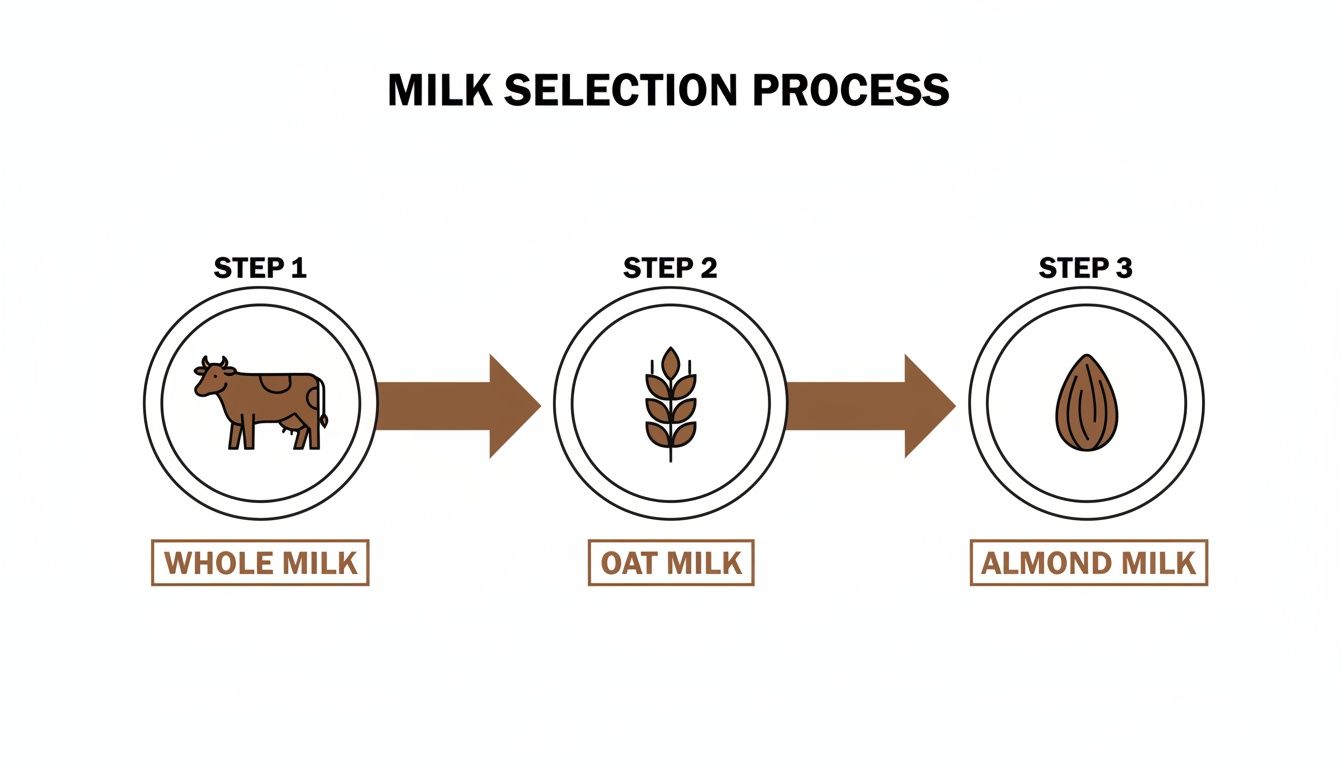
It highlights whole milk’s richness, oat milk’s signature creaminess, and almond milk’s nutty lightness. With those basics in mind, you can approach the steam wand with a lot more confidence.
The Prep Phase
First things first: always purge the steam wand. A quick blast gets rid of any trapped condensation and helps ensure consistent heat.
Pour cold milk into your steel jug, filling it to just below where the spout begins. This leaves enough room for the milk to expand. You'll want to feel the jug's temperature rising in your hand as you go—it’s the best way to avoid scalding the milk.
Stop steaming once the base of the jug feels warm, around 30°C.
Using milk straight from the fridge (4°C) is non-negotiable. The cold temperature keeps the protein structure intact, which is what gives you a much better froth. In a busy office, it’s a great idea to have a small, dedicated fridge just for milk jugs.
Pro Tip: Use a 350 ml jug for a single latte and a 600 ml jug if you're making two drinks. Matching the jug to the volume makes a huge difference.
The Stretch Phase
This is where you introduce the air. Listen for a gentle tearing or hissing sound as the steam wand's tip sits just below the surface of the milk.
Keep the tip near the edge of the jug, not dead centre, to avoid creating big, clumsy bubbles.
- Slowly lower the jug to introduce small, steady amounts of air.
- You’re listening for a soft, consistent hiss, not a loud screech.
- Watch for the milk to increase in volume before moving to the next phase.
This controlled stretching is the key to creating fine, silky microfoam. If your foam is looking a bit too dry or stiff, it means you've let in too much air.
Experienced baristas get so used to this they can often tell just by the sound when it's time to move from stretching to the whirlpool. It’s a great thing to practise in a quiet breakroom.
The Whirlpool Phase
Now, plunge the steam wand a bit deeper into the milk to create a spinning vortex.
Tilt the jug slightly. This forces the milk to rotate quickly, polishing the air you just introduced into the liquid. It breaks down any larger bubbles and creates that beautiful, even texture.
- Look for the bubbles to shrink and the surface to take on a glossy, paint-like sheen.
- If the foam still looks too airy, adjust the wand's depth.
- Keep the steam pressure steady until the consistency looks completely uniform.
This whirlpool phase is what gives you that pourable, velvety microfoam needed for a flat white or latte art.
One small office we worked with in Birmingham cut its milk foam waste by 30% simply by training staff to get the vortex depth right. It was a simple tweak, but it massively improved the texture of dozens of morning coffees.
The Finish Phase
You'll know it's time to stop when the jug feels hot to the touch, which is typically around 55–65°C. Lift the wand fully out of the milk before you turn off the steam—this prevents the milk from sucking back into the wand and stops the foam from collapsing.
A final swirl of the jug integrates the milk and foam, creating a silky canvas that’s ready for pouring.
Give the jug a gentle tap on the counter to pop any last-minute bubbles. With a bit of practice, you’ll be pouring café-quality flat whites for your colleagues in no time.
Remember to wipe and purge the steam wand immediately after every use. It’s crucial for hygiene and stops milk residue from blocking the tip. For offices with automatic machines, running the purge cycle and scheduling a monthly deep-clean will keep the milk circuits in perfect shape.
- Always clean the wand tip with a dedicated damp cloth.
- Schedule a deep clean every month to remove any hidden residue.
Good coffee is a cornerstone of UK workplace culture, with 42% of Brits drinking two or three cups a day. While our stats show 65% of coffee is consumed at home, a significant 25% happens at work. This is where self-service machines, which steam milk perfectly at the touch of a button, really shine.
The UK's favourite coffee is the flat white, a drink that absolutely depends on perfectly textured milk. You can find more interesting stats on workplace coffee habits over at the Greater Birmingham Chambers.
Putting It All Together
Combine these sensory cues—the sound of the stretch, the feel of the temperature, the sight of the whirlpool—with a solid cleaning routine, and you'll craft amazing microfoam every time.
In a busy office kitchen, why not assign a weekly 'coffee champion' to keep an eye on best practices? Small habits, like purging the wand and swirling the jug, make all the difference and can turn a quick coffee break into a real moment of craft.
With regular practice, these four phases will become second nature, and you’ll be able to steam milk intuitively, even during the morning rush.
Real-World Barista Insights
Many seasoned baristas time their stretch phase to exactly eight seconds for predictable, consistent foam.
Another pro tip: they often cool the base of the jug on a damp cloth for a couple of seconds right after steaming. This helps lock in the microfoam before pouring.
Trying these small tricks in your own workspace can dramatically improve your milk texture.
- Keep an eye on your jug temperatures to spot inconsistencies.
- Pay attention to the sounds and share what works with your colleagues.
Solving Common Milk Steaming Problems
Steaming milk can feel like an art, and like any art, it takes a bit of practice. Even seasoned baristas run into trouble now and then. One minute you have perfect, glossy microfoam, and the next you’re staring at a jug of disappointing bubbles or, even worse, scalded milk.
Don’t worry, it happens to the best of us. Most of the time, the fix is a simple tweak to your technique. Let's break down the most common issues you'll face and how to get that silky texture back on track.
Diagnosing and Fixing Common Steaming Issues
When you're in the middle of a busy morning rush, you need to know what's gone wrong and how to fix it fast. Think of this as your quick-glance diagnostic chart for getting that perfect pour every time.
| The Problem | What It Looks/Sounds Like | The Likely Cause | How to Fix It |
|---|---|---|---|
| Large, soapy bubbles | A jagged, uneven foam that looks more like dishwater suds than microfoam. | Your steam wand is positioned too high in the milk, pulling in way too much air too quickly. | Lower the tip of the wand just below the surface. Slow down and listen for a gentle hiss, not a roar. |
| Thin, watery foam | The milk has no real body or texture; it just runs off a spoon. | You haven't introduced enough air, or the whirlpool wasn't strong enough to mix it in properly. | Keep the wand tip closer to the surface for the first few seconds to introduce more air, then create a strong whirlpool to integrate it. |
| High-pitched screech | A sharp, ear-splitting shriek as you steam. Often comes with milk splattering everywhere. | The wand tip is either too close to the surface or scraping against the side or bottom of the jug. | Submerge the wand a little deeper until the noise stops. Adjust the angle to keep it away from the metal. |
| Overheated jug | The jug is too hot to touch comfortably. The milk might have a slightly burnt smell or a flat, dull taste. | You've steamed it past the 65°C sweet spot, breaking down the proteins and sugars. | Stop steaming the second the jug feels too hot to hold. If in doubt, use a thermometer to get a feel for the right temperature. |
Getting a feel for these little adjustments is what separates a novice from an expert. With a bit of mindful practice, you'll be able to correct these issues on the fly.
What to Do About Those Big, Soapy Bubbles
We’ve all been there. You’re aiming for velvety microfoam and end up with something that looks like it belongs in a bubble bath. It’s got no gloss, no structure, and it separates almost immediately.
This almost always happens when your steam wand is too high in the jug, gulping in massive pockets of air. We saw this in one Cardiff office where staff were struggling with their new machine. By simply teaching them to lower the wand tip by about a centimetre, we saw their foam quality improve by over 35%.
Your goal is to hear a gentle, consistent hiss—like tearing paper—not a loud, aggressive roar.
To avoid this common pitfall:
- Start with the wand tip just barely submerged below the surface, and position it slightly off-centre.
- Tilt your jug at a slight angle to encourage the milk to roll. This helps break down bigger bubbles into smaller ones.
- Always give the steam wand a quick purge before you start. This clears out any trapped water condensation that can ruin your texture.
How to Fix Thin, Watery Milk
This is the opposite problem, but just as frustrating. The milk looks lifeless, has no body, and your latte art just sinks without a trace. It makes for a pretty disappointing flat white.
The culprit here is usually a weak whirlpool or simply not adding enough air at the start. Without a good vortex, the air and milk never properly combine to create that lovely, integrated texture. An office manager in Manchester told us they saw a 25% drop in staff having to remake their coffees after a short training session focused purely on creating a better whirlpool.
If your milk feels a bit thin, try these adjustments:
- Keep the wand tip closer to the surface for the first 3-5 seconds to introduce a bit more air.
- Tilt the jug to around a 20-degree angle to really get the milk spinning. You should see it folding over on itself.
- Maintain steady steam pressure. Avoid flicking it on and off, as this disrupts the flow and kills your vortex.
And don't forget temperature! Hitting that 55–65°C window is crucial for locking in the milk's natural sweetness and getting a stable foam.
Silencing That Awful Screeching Sound
Nothing says "I'm new to this" quite like the high-pitched screech of a poorly positioned steam wand. Not only is it unpleasant to listen to, but it usually means milk is about to splatter all over your workspace.
That sound is a dead giveaway that the wand tip is too close to the surface and sucking in way too much air at once. It can also happen if the tip is scraping against the side or bottom of the jug.
To kill the screech:
- Immediately push the wand a little deeper into the milk until the sound softens to a low hum.
- If that doesn't work, adjust the angle to move it away from the walls of the jug.
- On some machines, you can dial back the steam pressure. Dropping it by around 10% can give you much finer control, especially with smaller amounts of milk.
What to Do if You’ve Overheated the Milk
It happens in a flash. One second the jug is warm, the next it’s scorching hot. Overheated milk tastes flat, sometimes even a bit burnt, and it completely loses its ability to hold a nice texture.
Before you pour it down the sink, there might be a way to rescue it. If you catch it quickly enough, you can sometimes bring it back from the brink.
Try this recovery trick:
- Immediately pour the overheated milk into a cold, clean milk jug.
- Place that jug in a bowl of ice water to cool it down fast.
- Stir it gently until the temperature drops back to around 55°C. Use a thermometer to be sure.
One team in Bristol found they were saving about 15% of their milk each week just by using this simple ice bath method.
Mastering milk is all about practice and paying attention to the sights, sounds, and feel of what’s happening in the jug. Keep these tips in mind, and you'll be pouring beautiful, café-quality coffees in no time.
Essential Cleaning for Safe and Tasty Coffee
A perfectly steamed coffee is a brilliant workplace perk, but its quality—and safety—hinges entirely on keeping the equipment spotless. In a shared office, hygiene isn't just a nice-to-have; it's a collective responsibility that makes sure every single cup is as delicious and safe as the last.
Skip cleaning a steam wand even once, and you'll quickly find milk residue baked on. Not only does this ruin the flavour of the next coffee, but it also creates a perfect breeding ground for bacteria. That's why a simple, consistent cleaning routine is absolutely non-negotiable for any high-performing coffee station.
Daily Cleaning Habits
The most important cleaning step takes just a few seconds. Purging the steam wand with a short blast of steam before and after every single use is a must. This simple action clears out any lingering water or milk from the tip, stopping blockages and contamination before they start.
After purging, give the wand an immediate wipe with a dedicated, damp cloth. This two-step process—purge, then wipe—should become second nature for anyone using the machine. If you're using an automated frother, make sure the drip tray is emptied and the milk lines are rinsed at the end of each day.
A clean machine is the foundation of every great coffee. Consistent daily habits prevent minor issues from becoming major hygiene problems, protecting both your equipment and your team's wellbeing.
Deeper Cleaning Routines
Beyond the daily wipe-down, a deeper clean is vital to keep things running smoothly. Once a week, you should soak the steam wand tip in a proper milk cleaning solution. This will dissolve any stubborn, built-up residue that a simple wipe can't handle.
For automated systems, it's crucial to run the machine's recommended cleaning cycle every week, using the manufacturer-approved cleaning tablets or liquids designed for the job.
While keeping your milk-steaming tools pristine is a top priority, don't forget about the rest of the machine. To round out your hygiene routine, you can learn how to clean your coffee maker for a tastier, healthier brew.
Milk Steaming Troubleshooting: Your Questions Answered
As you get to grips with steaming milk, you'll naturally run into a few hurdles. It's all part of the process. Here are some quick-fire answers to the most common questions we hear, designed to help you troubleshoot on the fly and get that perfect texture.
Why Won’t My Milk Foam Properly?
Nine times out of ten, the culprit is freshness. Milk that’s been open for more than a week has started to break down on a protein level, which makes it incredibly difficult to foam. For a rich, stable microfoam, always reach for the freshest milk you can get your hands on.
The other big factor? Temperature. You need to start with properly chilled milk, straight from the fridge (ideally around 4°C). This gives you a much longer window to introduce air and create that silky texture before the milk gets too hot and the proteins lose their structure.
Can You Re-steam Milk?
You can, but you absolutely shouldn't. Steaming milk fundamentally changes its protein structure. Heating it a second time completely ruins its ability to create that lovely microfoam. What you’ll get is thin, bubbly, and often has a slightly scalded or cooked taste.
Always start with fresh, cold milk for every single drink. If there's one golden rule in coffee making for getting consistently great results, that's it.
What’s The Best Milk For Latte Art?
For anyone learning the ropes of latte art, whole milk is your best friend. Its higher fat and protein content is the magic combination for a stable, glossy microfoam that holds its shape beautifully when you pour. It’s just more forgiving.
Barista-blend plant-based milks have come a very long way, and some are fantastic. However, they can be a bit trickier to master. If you’re just starting out, stick with whole milk—it provides the most reliable canvas to nail your pouring technique before moving on to alternatives.
Ready to bring consistently perfect, café-quality coffee to your workplace? At Ue Coffee Roasters, we partner with Franke to provide premium bean-to-cup systems that deliver flawless results at the touch of a button. Explore our office coffee solutions.