

How to Improve Employee Productivity and Boost Your Business
Improving employee productivity isn’t about working harder; it’s about working smarter. It all comes down to creating a supportive environment, giving your team the right tools, and actually understanding the core challenges that drain their energy day in and day out. Get that right, and you'll see huge gains in focus, motivation, and output.
Understanding the UK Productivity Puzzle
Before we dive into solutions, let’s get real about what productivity actually looks like in the United Kingdom. Too many businesses chase surface-level fixes without grasping the deep-seated issues holding their teams back. The challenge isn't just about tracking hours; it’s about acknowledging the massive gap between the time people spend at work and the actual, valuable output they produce.
And that gap is wider than most leaders realise.
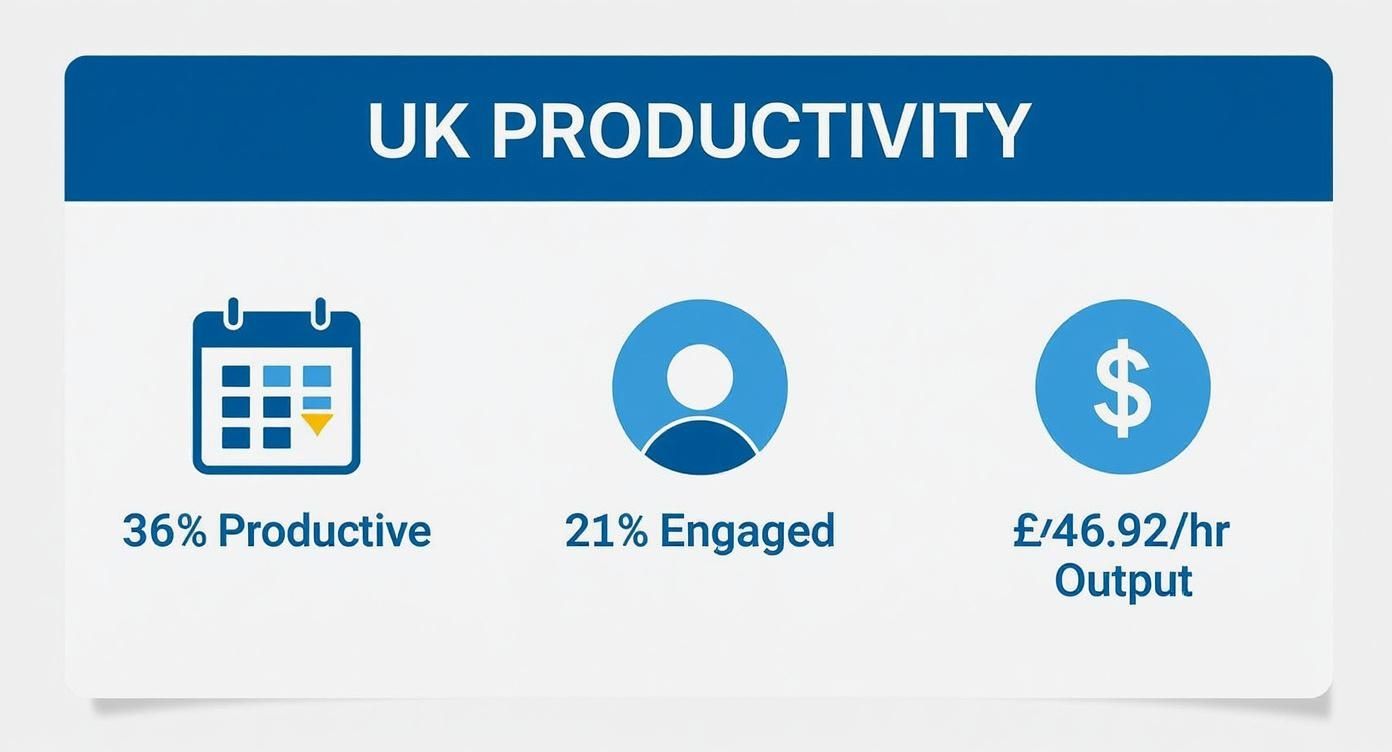
Recent data is pretty eye-opening. In the UK, the average employee works an 8-hour day but is only genuinely productive for about 2 hours and 53 minutes. That means less than 36% of paid work time results in anything tangible. To add to that, only 21% of employees feel they are consistently productive all day.
With the UK's output per hour sitting at around £46.92—noticeably behind peers like France and Germany—it's crystal clear that the old ways aren't working. You can discover more insights about UK workplace productivity statistics and see exactly how these figures stack up.
This infographic really brings those core metrics to life, showing the split between productive time, employee engagement, and economic output.
These numbers don’t just point to an efficiency problem. They tell a story about engagement, motivation, and workplace wellbeing.
To get a clearer picture of the landscape, let's break down the key challenges and their impact on UK businesses.
The UK Productivity Snapshot: Key Factors at a Glance
| Challenge Area | Key Statistic | Primary Impact on Productivity |
|---|---|---|
| Time vs. Output | Only 2 hours & 53 minutes of an 8-hour day are productive. | A significant portion of the workday is lost to distractions, administrative tasks, and low-value activities. |
| Employee Engagement | Just 21% of employees feel consistently productive. | Disengaged staff lack the motivation and focus needed to perform at their best, leading to missed goals. |
| Economic Competitiveness | UK output is £46.92/hour, trailing other major economies. | Lower national productivity affects business growth, innovation, and the ability to compete globally. |
These figures highlight that simply demanding more from employees is not the answer. The real opportunity lies in creating an environment where they can thrive.
Beyond the Numbers: The Human Element
If you really want to improve productivity, you have to look beyond the spreadsheets and timesheets. At its heart, the "productivity puzzle" is a human puzzle. What’s happening in your team's lives outside the office walls often has the biggest impact on their performance within them.
Think about the daily pressures your people are facing:
- Financial Stress: Worrying about bills doesn't just stay at home. It follows them into the office, eating up mental energy that could be spent on complex problem-solving or creative thinking.
- Mental Wellbeing: The rise in burnout and anxiety is directly linked to a drop in focus and motivation. When someone’s mental battery is low, their ability to engage, collaborate, and innovate is seriously compromised.
- Physical Health: A bad night’s sleep, poor nutrition, or no physical activity leads to fatigue and brain fog. You can't expect someone who is physically drained to perform at their mental peak.
These aren't just private issues; they are critical business hurdles. Ignoring them is like trying to run a high-performance engine on contaminated fuel—it simply won't work for long.
Redefining What Productivity Means
The old-school view of productivity—measured only by output per hour—is becoming obsolete. A much more effective approach sees it as the natural result of a healthy, supportive, and engaging work environment. When people feel secure, valued, and cared for, they are far more likely to invest their best efforts.
A truly productive workplace isn't one where everyone is busy all the time. It's one where people have the clarity, energy, and support to focus on the work that matters most.
This shift in perspective is the first real step toward meaningful improvement. It means that things often written off as "soft perks," like promoting mental health resources or creating comfortable break areas with quality coffee, are actually strategic investments in your company's most valuable asset: its people.
By addressing the whole person, not just the employee, you create the conditions for sustainable high performance. The journey to boost productivity doesn’t start with a new tool or process. It starts with a genuine commitment to understanding and supporting your team.
Building a Culture That Breeds Productivity
Great tools and clever strategies are only one part of the puzzle. True, sustainable productivity blossoms from something much deeper: a strong, supportive company culture.
It’s the invisible force that dictates whether people show up feeling motivated and connected, or simply go through the motions. When your team feels valued, trusted, and aligned with a shared mission, their best work just naturally follows.
This isn’t about feel-good platitudes; it’s about building a practical framework where focus and engagement can thrive. Let's move beyond generic advice and get into the specific cultural shifts that reclaim lost time and unlock your team's full potential.

Foster Psychological Safety and Trust
Productivity plummets in an atmosphere of fear. It’s that simple.
When employees are afraid to ask questions, admit mistakes, or propose unconventional ideas, they retreat into a safe, passive mode. Innovation dies, and collaboration grinds to a halt. Building psychological safety means creating an environment where team members feel secure enough to take risks without fear of blame or ridicule.
This has to start with leadership. When managers model vulnerability—by admitting their own mistakes and openly asking for help—it signals that it’s safe for others to do the same. This trust is the absolute bedrock of a high-performing team, encouraging open dialogue and proactive problem-solving.
A culture of trust isn't just a nice-to-have; it's a direct driver of efficiency. When people trust their leaders and colleagues, they spend less time navigating office politics and more time focusing on impactful work.
Define Roles and Set Clear Expectations
Ambiguity is the enemy of productivity. When roles are poorly defined and expectations are vague, people waste precious energy just trying to figure out what they’re supposed to be doing. This confusion leads to duplicated work, missed deadlines, and a real sense of frustration.
To fix this, make sure every team member has a crystal-clear understanding of their responsibilities and how their work contributes to the bigger picture. This involves:
- Clearly defined role descriptions: Go beyond a simple list of tasks. Outline key responsibilities and what success actually looks like.
- Structured project kick-offs: Ensure everyone involved in a project knows the goals, their specific role, and the expected outcomes from day one.
- Regular check-ins: Use one-on-one meetings not just for status updates, but to clarify priorities and remove any roadblocks.
This level of clarity eliminates guesswork, empowering your team to work with confidence and autonomy.
Empower Managers to Be Coaches, Not Just Overseers
The traditional, top-down management style is outdated and, frankly, ineffective for boosting productivity. Today’s most productive teams are led by managers who act as coaches, guiding and supporting their people rather than simply delegating tasks and monitoring progress.
A coaching mindset involves asking powerful questions, actively listening, and helping employees develop their own problem-solving skills. Instead of providing all the answers, a great manager-coach empowers their team to find solutions independently. This doesn't just boost performance on current tasks; it builds long-term capability and confidence within the team.
The impact of strong management is huge. In the UK, a staggering 68% of employees report a lack of clarity from their managers about workloads, which directly stifles output. This managerial gap, coupled with disengagement, is estimated to cost UK employers an immense £438 billion in lost productivity. Clearly, investing in management training is a direct investment in your bottom line. You can explore more statistics on employee productivity to understand the full picture.
Celebrate Progress and Recognise Effort
Waiting for a project to be fully completed before acknowledging hard work is a massive missed opportunity.
Celebrating small wins and recognising consistent effort along the way builds momentum and reinforces positive behaviours. Recognition doesn’t always need to be a grand gesture; a simple, specific "thank you" in a team meeting or a public shout-out can have a huge impact on morale.
When employees feel their contributions are seen and valued, they are far more likely to stay engaged and motivated. This culture of appreciation creates a positive feedback loop, inspiring everyone to consistently bring their A-game and fostering a workplace where people genuinely want to do their best work.
Designing a Smarter Work Environment
Your workspace is so much more than just a place to get things done. Whether it’s a bustling office, a dedicated home setup, or a mix of both, the environment itself can either energise your team or slowly drain their focus. Designing a smarter space means making deliberate choices that support concentration, collaboration, and wellbeing.
It’s about turning your physical space into a catalyst for higher productivity, moving beyond simple aesthetics to deliver real, measurable improvements in how your team feels and performs. Thoughtful upgrades can smooth over the little bumps in the day, giving your people back precious time and mental energy.

Reducing Friction with Intentional Design
Think about all the little moments that chip away at a productive day. An employee having to leave the building for a decent coffee. A struggle to find a quiet corner for a complex task. A meeting room that lacks the right tech. These minor frustrations really add up.
A well-designed environment anticipates these needs before they become problems. By providing the right tools and spaces, you minimise the constant context-switching and help your team stay in a state of flow. The goal is simple: make the path of least resistance the most productive one.
This kind of intentional design shows a deep respect for your team's time and focus—a message that resonates far more than any motivational poster ever could.
The Surprising ROI of Quality Amenities
Investing in premium on-site amenities, like a high-quality coffee and refreshment station, is often seen as just a "perk." In reality, the return on that investment is tangible and directly hits your bottom line.
Just consider the time lost when employees pop out for their daily coffee. A 15-minute trip each day quickly adds up to over 60 hours per employee every year. Now, multiply that by your team's size and average hourly wage. The lost productivity cost is staggering.
By bringing a café-quality experience in-house with a premium bean-to-cup machine, you don’t just offer coffee; you create a central hub for informal connection while reclaiming thousands of hours of productive time. That daily time-sink is suddenly transformed into an opportunity for spontaneous collaboration and a much-needed mental reset.
Creating Zones for Different Work Modes
These days, a single open-plan layout just doesn’t cut it. Modern productivity demands a more sophisticated approach, with distinct zones designed for different kinds of work. This method, often called activity-based working, empowers people to choose the environment that best fits the task at hand.
To put this into practice, think about creating:
- Focus Zones: Quiet, library-like areas with single desks, free from chatter and distractions. They’re perfect for deep work like coding, writing, or analysing data.
- Collaboration Hubs: Dynamic, open spaces kitted out with whiteboards, large screens, and comfy seating to encourage brainstorming and team problem-solving.
- Social Spaces: A welcoming kitchen or break area, often centred around a quality coffee station, designed for casual chats, recharging, and building relationships.
This variety acknowledges that productivity isn't a one-size-fits-all concept. Giving your team the autonomy to choose where and how they work builds trust and enables them to perform at their absolute best.
A workspace should be an ecosystem, not a factory floor. By providing a variety of environments, you empower your team to match their space to their task, unlocking a more natural and sustainable form of productivity.
Impact of Workplace Enhancements on Productivity
To truly see how to improve employee productivity through environmental design, it helps to compare how different strategies deliver specific benefits. The right changes can have a direct and positive effect on focus, retention, and overall output.
| Enhancement Strategy | Primary Benefit | Implementation Example |
|---|---|---|
| Zoned Office Layout | Improved Deep Work | Designating "quiet zones" where conversation is disallowed, allowing for uninterrupted concentration on complex tasks. |
| Premium On-Site Refreshments | Reduced Disruptions | Installing a high-quality bean-to-cup coffee machine to eliminate the need for employees to leave the office for breaks. |
| Biophilic Design Elements | Enhanced Wellbeing | Incorporating natural light, plants, and natural materials like wood to reduce stress and improve cognitive function. |
Each of these strategies does more than just make the office look better. They are functional upgrades that solve common productivity roadblocks, from constant interruptions to mental fatigue. By thoughtfully designing your work environment, you create a space that doesn't just house your team—it actively helps them succeed.
Using Technology to Amplify Human Talent
Let's be honest: technology should be a launchpad for your team's talent, not another source of frustration. The goal here is to be strategic, using tools that liberate your people from the repetitive, soul-crushing work that kills creativity. It's about making technology a genuine partner in productivity, not just piling more software onto the stack.
When you get it right, automation and intelligent tools can take on the administrative grind that chips away at your team's day. Imagine your sharpest minds spending less time on data entry and scheduling, and more time on the big-picture problems they were hired to solve. This isn't some far-off dream; it's a practical strategy you can implement today.

Automating the Administrative Burden
Every business has them—those necessary but mind-numbing tasks that eat up precious hours. I'm talking about manual data entry, pulling together reports, or wrestling with schedules. They're essential, sure, but they rarely move the needle on growth or innovation. This is exactly where automation can be a complete game-changer.
By bringing in tools that handle these routines, you give your team back their most valuable resource: time. Suddenly, they can redirect their energy towards strategic work that needs human ingenuity and critical thinking.
Technology’s true power isn’t in replacing people, but in freeing them up to be brilliant. When you automate the mundane, you create the space for creativity to thrive.
Take a sales team, for example. Instead of manually logging every single client interaction into a CRM, an automated system could capture that data straight from emails and calls. That reclaimed time is then reinvested into what really matters: building stronger relationships with clients—a job no software can truly do.
Choosing Tools That Empower, Not Overwhelm
Buying new software isn't a strategy; it's an expense. To genuinely boost productivity, you need to choose tech that slots neatly into your existing workflows and actually solves a real problem. A cluttered tech stack with confusing, overlapping tools just creates more friction.
Before you invest, get on the ground and ask your team:
- What are your biggest time-sinks? Find out which specific, repetitive tasks drive them mad.
- Where are the bottlenecks in our process? Pinpoint exactly where work gets stuck or needs manual intervention.
- What information do you struggle to find? Look for ways to centralise knowledge so it’s easy for everyone to access.
Their answers are your roadmap. They will lead you to solutions your people will actually want to use because they make their day-to-day work easier.
Fostering Adoption Through Training and Support
The most powerful tool in the world is useless if no one knows how to use it properly. A quick memo about a new platform is a surefire recipe for failure. Real adoption comes from clear communication and solid training that makes your team feel confident and supported.
The research backs this up. While technology is a massive productivity driver, its potential is unlocked through proper support. For instance, companies that go all-in on artificial intelligence (AI) report productivity improvements in 72% of cases and better job satisfaction in 59%. What’s more, 75% of knowledge workers say AI helps them save time and focus better.
The catch? The current uptake of AI training among UK workers is worryingly low—only 27% feel they get enough support from their organisation. You can explore detailed statistics about employee productivity and AI adoption to see the full picture.
To bridge that gap, create a structured rollout plan. This means hands-on training sessions, easy-to-find help guides, and appointing a few "super-users" in each team who can offer peer support. When you invest in your team’s ability to use new tools, you’re investing in the ROI of the tech itself. This is how a simple software purchase becomes a meaningful leap forward in how to improve employee productivity across the board.
Making Productivity Gains Stick for Good
Getting a temporary spike in output is one thing. But making it last? That’s the real challenge.
Embedding continuous improvement into your company's DNA isn’t about one-off initiatives or short-term fixes. It’s about building a resilient system that supports growth for the long haul. Here’s how to make sure the positive changes you implement today become the bedrock of a more productive and innovative future.
True progress starts when you stop obsessing over simplistic metrics like task completion rates. To genuinely understand what’s working, you need to look deeper at the health of your team's workflow, their engagement levels, and their overall wellbeing. That’s where the real story is.
Measure What Actually Matters
To build a sustainable model, your measurement approach has to evolve. Stop asking, "how much did we do?" and start asking, "how effectively are we working?" and "are our people actually thriving?". This shift in perspective is what helps you spot underlying issues before they snowball into major roadblocks.
You need a blend of qualitative and quantitative metrics to get the full picture:
- Project Cycle Times: How long does it really take to get a project from an idea to "done"? Shorter cycles are a great indicator of smooth collaboration and fewer bottlenecks.
- Employee Net Promoter Score (eNPS): It’s a simple question: "How likely are you to recommend our company as a great place to work?". The answer is a powerful gauge of morale and engagement.
- Tool Adoption Rates: Are those new technologies you invested in actually being used, or are they just creating more friction? If adoption is low, it’s a red flag that you need better training or maybe even a different solution.
This balanced view gives you a much richer understanding of your operational health. It helps you make smarter, more empathetic decisions that support your team for the long run.
Create a Powerful Feedback Loop
Data tells you what is happening, but only your people can tell you why. You absolutely must create a culture where honest feedback is actively sought out and valued. The people on the ground have the best insights into process snags and daily frustrations—the things a spreadsheet will never show you.
Anonymous surveys are a decent starting point, but they’re not enough. You need to foster real dialogue through regular, informal check-ins and even dedicated brainstorming sessions focused on making things better. When your team sees their suggestions being put into action, it builds incredible trust and empowers them to take ownership of productivity.
The most powerful insights for sustainable productivity won't come from a dashboard. They'll come from a conversation with an employee who feels safe enough to tell you what's really slowing them down.
Recent UK labour productivity trends show just how hard it is to create lasting change. While output per hour worked has crept up by 1.5% compared to pre-pandemic levels, these gains are gradual and demand sustained effort. It's a clear sign that real improvement comes from deep structural and behavioural shifts, not quick fixes.
Iterate and Adapt Your Strategy
Think of your productivity strategy as a living document, not a static plan set in stone. The workplace is constantly changing, and your approach has to be flexible enough to keep up. Use the data you gather and the feedback you receive to constantly review and refine what you’re doing.
For a deeper dive into actionable methods, explore these proven ways to increase employee productivity that can be applied in almost any work environment.
What worked six months ago might be completely ineffective today. Maybe a new software update has created an unforeseen workflow issue, or a shift to a hybrid model demands a totally different communication style.
By treating productivity as an ongoing experiment, you build a mindset of constant learning and adaptation. That's how you ensure your team is always equipped to perform at its best, no matter what challenges come next.
Got Questions? We’ve Got Answers
You've explored the strategies, from nurturing a great culture to designing a smarter workspace. But as with any big change, it’s the practical details that often come up last. Let’s tackle some of the most common questions business leaders ask when they’re ready to get serious about productivity.
How Quickly Will We Actually See Results?
While some changes bring an almost instant lift, true, sustainable improvement is more of a slow burn.
You’ll likely feel a quick morale boost from something like a new premium coffee station—it immediately cuts out daily hassles and gets people talking. But the deeper cultural shifts, like building genuine psychological safety or rethinking management styles, take a bit longer to take root.
A good rule of thumb is to look for early indicators within the first three months, like more engaged meetings or positive chatter in the hallways. You should expect to see significant, measurable shifts in output and efficiency within six to twelve months, as these new habits become the default way of working.
Is Investing in Office Amenities Really Worth the Money?
Absolutely, but only when those amenities solve a real problem. Think of high-quality, on-site refreshments not as a perk, but as a direct investment in winning back lost time.
A 15-minute coffee run each day might not sound like much, but for one employee, that adds up to over 60 hours of lost productivity a year. Multiply that across your team, and the numbers become impossible to ignore. Providing a fantastic alternative in-house plugs that leak instantly.
Beyond the time savings, it sends a clear signal that you care about your team's wellbeing. A great cup of coffee or a comfortable spot to recharge improves the daily work experience, which is directly linked to better morale and sharper focus. It’s a strategic move with a clear, positive return.
What’s the Best First Step to Take?
The most powerful place to start is by removing daily friction. Before you map out a huge new initiative, just ask your team a simple question: "What's the most frustrating part of your day?"
Their answers are your roadmap to high-impact, low-effort wins.
More often than not, it’s the small, consistent annoyances that are the biggest productivity killers. It might be slow software, a clunky approval process, or even just the lack of a decent cup of coffee without having to leave the building. Tackling these immediate pain points shows you're listening and builds the momentum you’ll need for the bigger changes down the line.
The quickest way to boost productivity isn't a grand, top-down strategy. It's identifying and eliminating the small, daily frustrations that drain your team's energy and focus. Start there, and you'll build the trust needed for bigger transformations.
This ground-up approach ensures your efforts are focused where they’ll make the most difference, creating a workplace that’s not just more efficient, but genuinely better for everyone.
Ready to transform your workplace environment and reclaim lost productivity? At Ue Coffee Roasters, we provide premium office coffee and refreshment solutions that energise your team and create a culture of appreciation. Discover how our speciality coffee and Franke bean-to-cup machines can make your office the best place to be. Learn more about our office coffee solutions.