

What is Coffee Cupping? A UK Guide to Tasting Like a Pro
Ever wondered what makes one coffee extraordinary and another just… forgettable? The answer almost always comes down to coffee cupping – the standardised ritual professionals use to taste, evaluate, and get to the heart of a coffee's character. Think of this as your invitation into that world, right here in the UK.
Your Journey into Coffee Cupping Starts Here
Picture a wine tasting, but for coffee. At its core, coffee cupping is a sensory evaluation method. It’s a shared language used across the UK's vibrant speciality coffee scene to score quality and pinpoint unique flavour profiles.
The whole process is designed to strip away variables like your brewing method or a fancy machine. By doing this, the coffee's true, unadulterated character gets to shine through.
This isn’t just some academic exercise; it's the very bedrock of quality for everyone involved in your daily brew. From the roasters in London fine-tuning a new single origin to the baristas in Manchester choosing a guest espresso, cupping provides a consistent, objective way to measure a coffee’s merits. It turns a vague "I like this" into a detailed analysis of why you like it.
More Than Just a Taste Test
Unlike your daily flat white, cupping is about careful dissection and discovery. The goal is to break down the entire sensory experience into its core components, ensuring fairness and repeatability whether you're in a Cotswolds roastery or a Bristol café.
So what are the main objectives of a proper cupping session?
- Pinpointing Flavour Notes: Is that a hint of blueberry, a touch of lemon, or a deep, dark chocolate note? Cupping helps identify these specific tastes and aromas.
- Assessing Overall Quality: Coffees are scored based on universally accepted criteria to determine their grade and value.
- Ensuring Consistency: It’s a crucial quality control step to make sure a batch of roasted coffee hits the desired flavour profile every single time.
- Guiding Purchasing Decisions: This is how UK coffee buyers and roasters decide which green beans to select from farms all over the world.
Let's break down the key components and their roles in a typical session.
The Core Elements of Coffee Cupping
| Element | Its Purpose in Cupping |
|---|---|
| Fragrance/Aroma | Evaluating the smell of the dry grounds (fragrance) and the wet grounds (aroma). |
| Flavour & Aftertaste | Identifying the primary taste characteristics and how they linger on the palate. |
| Acidity | Assessing the "brightness" or "liveliness" of the coffee—not sourness, but a pleasant tang. |
| Body | Describing the texture or "mouthfeel" of the coffee, from light and tea-like to rich and heavy. |
| Balance | How well all the different sensory elements work together in harmony. |
| Overall Score | A final quality score based on a comprehensive evaluation of all attributes. |
Each of these elements helps build a complete picture of the coffee, moving far beyond a simple thumbs-up or thumbs-down.
The Standard for UK Coffee Excellence
In the UK, coffee cupping is a highly specialised skill. It allows industry professionals to assess and classify coffees with incredible precision, noting everything from aroma and acidity to body and aftertaste. This practice is absolutely essential for UK coffee roasters and buyers to maintain quality and grade their offerings. To get a better sense of the market, you can delve deeper into the trends shaping the UK coffee scene in the Project Café UK 2025 report.
By creating a level playing field, cupping allows a coffee from Ethiopia to be evaluated against one from Colombia using the exact same metrics. It’s this universal standard that drives quality and innovation in the UK industry.
Ultimately, getting to grips with what coffee cupping is all about will give you a new perspective on your daily brew. It’s the first step toward transforming how you taste, appreciate, and truly connect with every single cup.
The Evolution of Coffee Tasting in the UK
Coffee cupping in the UK didn't start in the trendy, minimalist roasteries we know today. Its origins are far more gritty, born not from a love of nuanced flavour but from the cold, hard reality of colonial-era trade.
Picture the docks of London or Liverpool, centuries ago. Huge shipments of green coffee beans are arriving, and buyers need a quick, no-nonsense way to check the quality. This was the first form of cupping: a blunt instrument for risk management. It was all about spotting defects, ensuring consistency, and making sure you weren't paying good money for bad beans. A purely functional, industry-only affair.
For a long time, that’s all it was. A behind-the-scenes quality check for importers and roasters, designed to weed out undesirable traits like mould or taints from poor storage. The goal wasn’t to uncover notes of jasmine or bergamot; it was to avoid disaster.
The Speciality Coffee Shift
Everything started to change in the early 2000s. A new wave of coffee culture began to wash over the UK, and drinkers started to demand more. They were tired of generic, dark-roasted blends and began seeking out unique flavours, traceable origins, and the stories behind their beans.
This new appetite for quality coffee meant the old way of tasting just wasn't cutting it anymore. Simply checking for faults was no longer enough. The UK industry needed a new language, a better system to identify and celebrate what made a particular coffee truly special.
This is where the structured, almost scientific approach to cupping we see now came into its own. It transformed from a simple quality check into a sophisticated method for uncovering a coffee's complex flavour profile. The focus flipped entirely, moving from defect detection to flavour discovery.
Cupping became the bridge connecting the coffee farm to the flat white. It created a universal language that allowed a roaster in Edinburgh to understand and communicate the exact qualities of a coffee grown thousands of miles away in Kenya.
This systematic approach became the engine driving the UK's burgeoning coffee scene. As British coffee consumption grew—now standing at an incredible 98 million cups daily—so did the demand for better quality. The push towards speciality coffee, which really gathered steam after 2010, put cupping front and centre at trade shows, in roasteries, and at training events. It helped pull the market away from basic commodity beans towards an industry obsessed with intricate flavours, all evaluated through a standardised sensory process. You can find more insights into UK coffee consumption statistics on yorkemporium.co.uk.
From Industry Tool to Public Celebration
As the speciality scene blossomed, cupping started to step out from behind the curtain. Forward-thinking roasters and cafés across the UK realised it wasn't just a professional tool; it was a powerful way to connect with their customers and share their passion.
Public cupping sessions began popping up in cities like London, Manchester, and Bristol, inviting everyday coffee lovers to slurp and score alongside the pros. It was a game-changer. The process was demystified, turning an intimidating industry ritual into an accessible, fun, and educational experience.
Today, coffee cupping is a cornerstone of UK coffee culture. It stands as a testament to how far we've come—from a simple taste test on a shipping dock to a celebrated art form that connects us all more deeply with the coffee we love.
Mastering the Step-by-Step Cupping Ritual
Diving into coffee cupping is a bit like learning the sheet music to your favourite song; it reveals the structure and harmony you always knew was there but couldn't quite put your finger on. This ritual transforms tasting from a passive experience into an active exploration. Ready to get started? Let's walk through the professional process, breaking it down into clear steps anyone can follow, whether you're at home or in a local UK roastery.
The journey starts well before the first taste. The golden rule here is consistency, as it ensures the coffee itself is the star of the show, not the variables in your process.
Setting the Stage for Sensory Analysis
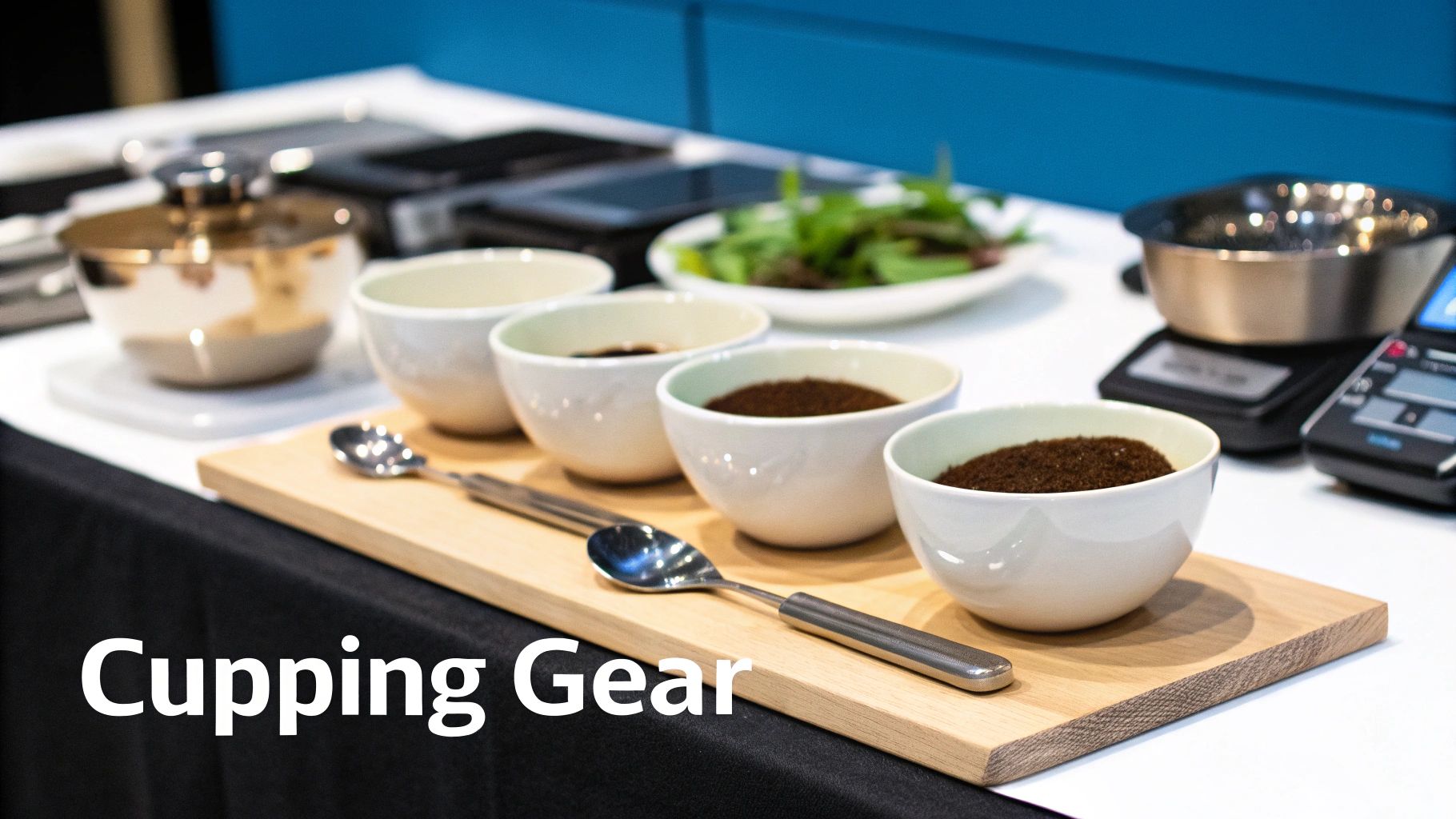
Before a single drop of water is poured, the first job is to prepare your space and equipment. Think of it like a chef meticulously organising their station before service—it guarantees a smooth, focused, and repeatable workflow. You don't need a high-tech lab, just a few key items.
- Identical Vessels: Grab a few identical bowls or glasses. This is crucial so that each coffee cools down at the same rate.
- A Grinder: A burr grinder is your best friend here, as it delivers a consistent particle size for an even extraction.
- A Kettle: One that lets you set a specific temperature is ideal. You’re aiming for around 93°C.
- Cupping Spoons: These are deeper and rounder than a normal soup spoon, specially designed for that signature slurp.
- Scales: Precision is everything. You'll need to weigh both your coffee and water accurately.
Once your kit is ready, it’s time to bring in your first sense: smell.
Step 1: Fragrance and Aroma Evaluation
This first stage is all about what you can smell, and it’s a two-part process. First up is the fragrance, which is the scent of the dry coffee grounds. Grind your beans slightly coarser than you would for a filter coffee and place a precise amount in each cup. Now, get your nose right down to the cup and take a good, deep sniff. What are you picking up? Is it nutty like almonds, sweet like chocolate, or floral like jasmine?
Next comes the aroma – the scent of the wet grounds. Start a timer and pour your hot water directly over the grounds, making sure they’re all saturated. You'll see a crust of coffee grounds form on the surface. Lean in close again, but don't stir just yet. Inhale. The aroma will be much more intense and complex than the dry fragrance. This is where you might start to detect fruity notes, like a hint of blackcurrant jam or zesty citrus.
The difference between fragrance (dry) and aroma (wet) is fundamental. It's like smelling a bouquet of fresh flowers versus smelling those same flowers after a light spring rain—the water unlocks and amplifies a whole new world of scents.
After letting the coffee steep for about four minutes, the real magic begins.
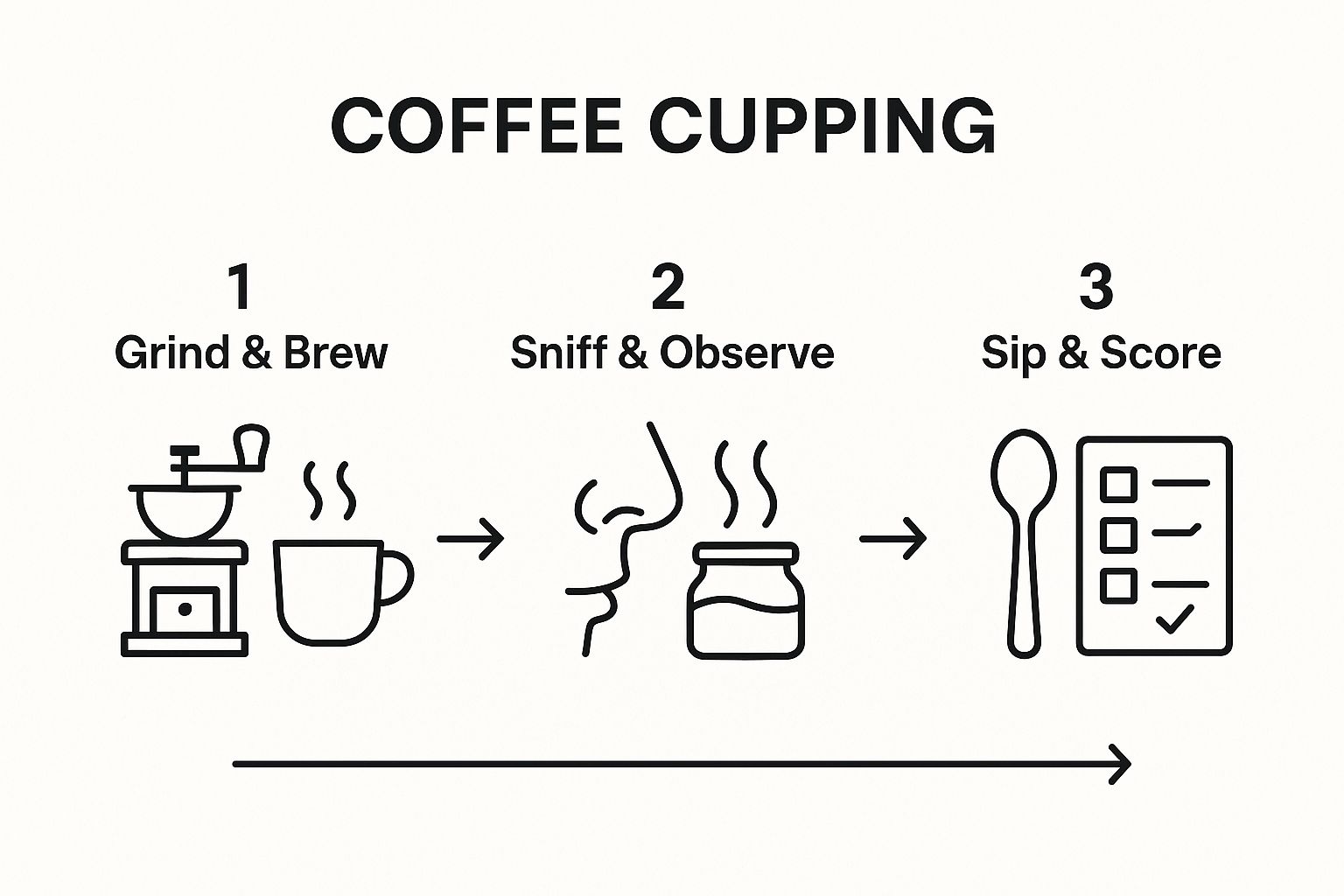
Each phase, from setting up to the final evaluation, is a deliberate step designed to systematically uncover the coffee's true character.
Step 2: Breaking the Crust and Skimming
This is probably the most iconic moment in the whole cupping ritual. At the four-minute mark, it’s time to "break the crust." Take your cupping spoon, push it just below the surface, and gently stir three times. As you do this, get your nose right over the cup to capture the intense burst of aromatic gases that are released. It’s one of the most vivid sensory snapshots you’ll get.
After breaking the crust on all your samples, you'll see some foam and grounds still floating on top. Using two spoons, carefully skim this layer off and get rid of it. This just cleans up the surface of the coffee, ensuring you only taste the pure liquid in the next step.
Step 3: The Slurp and Final Evaluation
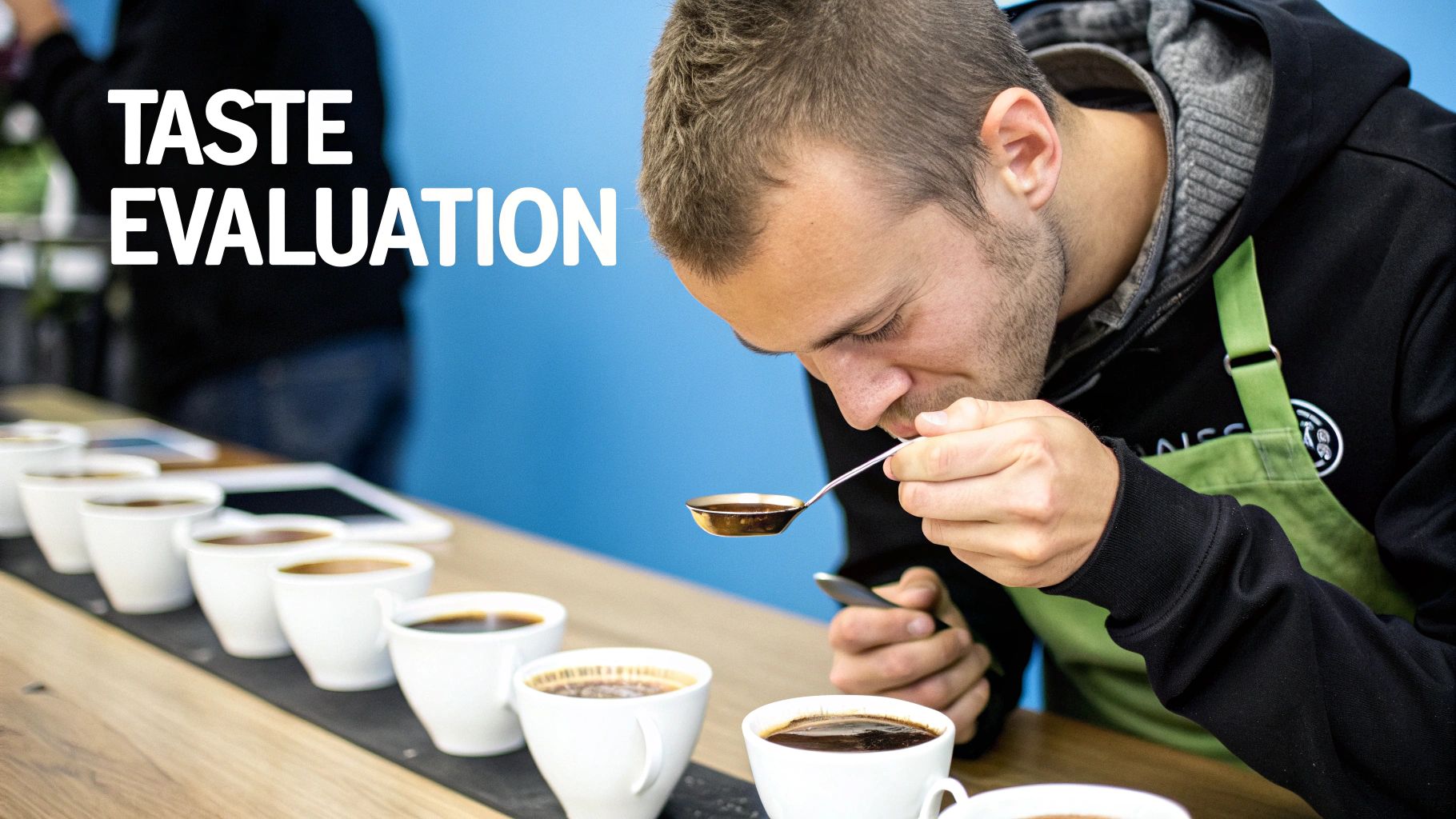
Now, we taste. But we don't just sip. The proper technique is a loud, deliberate slurp. It might feel a bit silly at first, but it has a very important job. By slurping forcefully, you spray the coffee across your entire palate, hitting all your taste buds at once. This action also aerates the liquid, carrying aromatic compounds up to your olfactory receptors at the back of your nose. It’s this marriage of taste and smell that unlocks the coffee's full flavour spectrum.
As you slurp from your spoon, think about these key qualities:
- Flavour and Aftertaste: What are the main tastes you’re getting? How do they evolve as the coffee cools down? What sensations are left lingering?
- Acidity: Is there a pleasant brightness, like the crispness of a British apple, or is it more muted?
- Body: How does the coffee feel in your mouth? Is it light and tea-like, or is it heavy, rich, and creamy?
- Balance: Do all the elements—the acidity, body, and flavour—work together in harmony, or does one shout louder than the others?
By following these steps, you’re creating a structured tasting that lets you fairly compare different coffees and start building your own sensory library. This ritual is the key to unlocking a deeper appreciation for the incredible complexity hidden inside every single coffee bean.
Learning the Language of Coffee Flavour
Tasting a great coffee is one thing. Finding the right words to describe what’s happening on your palate? That’s a whole different skill. This is where you move beyond simple descriptions like ‘strong’ or ‘nice’ and into the rich, detailed vocabulary that UK coffee professionals live and breathe.
Think of it as a shared language. It’s what allows a roaster in the Cotswolds to communicate the precise character of a bean to a barista in Manchester. It’s a toolkit that helps you pull apart every sensation and finally put a name to what you’re tasting.
Let’s dive into the six core terms that form the foundation of this language.
Decoding Aroma and Flavour
First up is Aroma. This is purely about the scent of the brewed coffee, your very first impression as the steam rises from the cup. It’s what hits you when you break the crust and what you smell just before your first sip. Aromas can be wonderfully varied—from delicate, floral notes of lavender to a deep, comforting sweetness like caramel.
Next comes Flavour. This is the main event—the combined sensation of what your tongue tastes and what your nose smells once the coffee is in your mouth. Flavour covers the entire spectrum, from bright, zesty citrus notes to the rich, nutty character of a toasted almond.
To help nail down these specific notes, professionals often use a flavour wheel. It’s like a compass for your taste buds. It starts with broad categories like 'fruity' or 'spicy' at the centre and branches out into incredibly specific descriptions on the outer edges, such as 'blackberry jam' or 'clove'.
Exploring Acidity and Body
Now for Acidity. In the world of speciality coffee, acidity isn’t a bad thing—it’s a prized quality. It refers to that bright, sparkling, lively sensation that makes a coffee feel vibrant and alive on your palate.
Think of it like this: acidity is the crisp, mouth-watering tartness of a perfectly ripe Cox's Orange Pippin apple. It’s a pleasant tang that adds dimension and structure, not the sourness of something that has gone off. A coffee without any acidity can often feel dull or flat.
Working alongside acidity is Body, which you’ll also hear called 'mouthfeel'. This has nothing to do with taste and everything to do with texture. It describes the weight and feel of the coffee in your mouth. Is it light and delicate, almost like tea? Or is it heavy and rich, coating your tongue like double cream? A coffee's body is a crucial part of its personality.
Understanding Aftertaste and Balance
What’s left behind after you swallow? That lingering sensation is the Aftertaste, or the ‘finish’. A high-quality coffee will leave you with a pleasant, clean aftertaste that might even evolve over time. You could find a sweet chocolate note that hangs around long after the cup is empty, or maybe a subtle hint of spice.
Finally, we have Balance. This is the big-picture term. It asks a simple question: how well do all the other elements—aroma, flavour, acidity, body, and aftertaste—work together? A well-balanced coffee is one where no single attribute shouts over the others.
Each component plays its part in perfect harmony, creating a complete and satisfying experience. Just like a great piece of music, every note contributes to the final masterpiece.
Essential Cupping Terms and Their Meanings
To bring it all together, this table breaks down the core sensory language with a few familiar UK analogies to help lock in the concepts.
| Term | What It Describes | Common UK Flavour Analogy |
|---|---|---|
| Aroma | The scent of the brewed coffee. | The smell of a freshly baked fruit cake. |
| Flavour | The combined taste and smell in your mouth. | The taste of rich blackberry jam on toast. |
| Acidity | The bright, lively quality of the coffee. | The crisp tartness of a Bramley apple. |
| Body | The texture and weight on your palate. | The difference between skimmed milk and full-fat cream. |
| Aftertaste | The lingering sensation after swallowing. | The pleasant finish of a dark chocolate digestive. |
| Balance | How all the elements work together in harmony. | A perfectly composed symphony orchestra. |
By getting comfortable with this language, you’re not just learning new words. You’re arming yourself with the tools to truly understand and appreciate the incredible complexity hidden inside every single coffee bean.
Why Cupping Drives the UK Coffee Scene
Coffee cupping is so much more than a simple tasting exercise; it's the engine that powers the UK’s entire speciality coffee industry. This single, disciplined practice is the critical link between a sack of green beans and a successful business, guiding every decision from a Cotswolds roastery to a bustling London café. Think of it as the compass that points the whole sector towards excellence.
For UK roasters, cupping is the ultimate decision-making tool. It’s a weekly, sometimes daily, ritual that dictates which expensive sacks of green coffee to buy. Imagine a roaster facing a choice between a dozen different Ethiopian coffees—cupping gives them the objective framework to assess each one’s potential, making sure they only invest in the most exceptional lots.
But its role doesn't stop there. Once the beans arrive, cupping becomes the roaster’s guide for perfecting the roast profile. By cupping multiple small batches roasted in slightly different ways, they can pinpoint the exact profile that makes a coffee’s inherent flavours sing. It’s how they turn raw potential into a delicious, marketable product.
The Secret Weapon for Independent Cafés
In the fiercely competitive UK coffee market, independent cafés need a distinct identity to stand out. Coffee cupping is their secret weapon. For a café owner in Manchester or Bristol, offering a unique guest coffee that customers can't find anywhere else is a powerful way to build a loyal following.
Cupping allows them to confidently select these unique coffees. It’s also an invaluable staff training tool, empowering baristas to talk about the coffee with genuine passion and knowledge. When a barista can describe a coffee's flavour notes with precision—explaining why it has a crisp apple acidity or a jammy body—it elevates the customer experience from a simple transaction to an engaging conversation.
This dedication to quality is what separates speciality coffee from the rest. Cupping is the guarantee that the premium price you pay for a flat white is justified by a truly exceptional, carefully selected, and masterfully roasted coffee.
The impact of this quality control is felt across the entire industry. Coffee cupping is a key reason the UK's branded coffee shop market has boomed to over 11,000 outlets. This growth is fuelled by a rise in consumer visits, with a large percentage of UK coffee drinkers now stopping by multiple times each week. This highlights just how essential quality control via cupping is to staying competitive in a crowded market. You can dig deeper into the UK's coffee market growth by exploring the latest foodservice insights on lumina-intelligence.com.
Upholding Standards and Fostering Innovation
Beyond individual businesses, cupping upholds the quality standards for the entire UK speciality coffee scene. It creates a common language and a universal benchmark for excellence, ensuring that a coffee scored highly in Edinburgh would receive a similar score in Cornwall.
This shared understanding fosters a culture of continuous improvement and innovation. Roasters are constantly cupping new and experimental coffee lots, pushing the boundaries of what coffee can taste like. They might discover a coffee processed using a novel anaerobic fermentation method, and cupping is the only way to truly understand and articulate its unique character.
Ultimately, coffee cupping is the unseen force that guarantees the cup you drink is the best it can be. It drives businesses to make smarter choices, empowers staff to become passionate advocates, and fuels the innovation that keeps the UK’s coffee scene at the forefront of the global stage. It’s a testament to the idea that true quality is never an accident; it’s the result of discipline, passion, and a shared commitment to excellence.
How to Join a Coffee Cupping in the UK
Feeling inspired to take your coffee journey to the next level? The great news is that the world of coffee cupping isn't some exclusive club. Far from it. Across the UK, passionate roasters and cafés are throwing open their doors, eager to share this sensory experience with anyone curious enough to join. This is your roadmap to experiencing it firsthand.
Your local speciality coffee roaster is always the best place to start. Many independent roasters in cities like London, Manchester, and Edinburgh host regular public cupping sessions. These are often free or low-cost events designed to introduce their latest single-origin coffees and simply connect with the local community. Check their websites or social media channels—that's usually where they'll announce upcoming dates.
Finding Events and Workshops
Beyond your neighbourhood roastery, the UK's thriving coffee scene offers plenty of other avenues for getting involved. Keep an eye out for these opportunities:
- Coffee Festivals: Major events in cities like London and Glasgow almost always feature dedicated cupping labs and sensory workshops. These are fantastic places to learn from industry experts in a lively, buzzing atmosphere.
- Independent Cafés: Many top-tier cafés that pride themselves on their coffee programme will host their own tasting events from time to time. Follow your favourites online to stay in the loop.
- Online Event Platforms: Websites like Eventbrite are brilliant resources for finding scheduled coffee tastings and workshops happening near you.
For those wanting to go a bit deeper, plenty of UK-based coffee schools and roasters offer introductory courses. These structured workshops provide a more in-depth look at sensory skills, often guided by certified professionals.
What to Expect at Your First Cupping
Walking into your first session might feel a little intimidating, but the atmosphere is almost always welcoming and educational. The whole point is to learn and explore together. To get the most out of it, just remember a few simple bits of etiquette.
The most important rule is to come with an open mind and be ready to have fun. Cupping is a shared discovery, not a test. There are no right or wrong answers, only your personal sensory experience.
Try to arrive with a neutral palate. This just means avoiding strong foods, chewing gum, or wearing heavy perfume or aftershave right before the event. These strong smells can interfere with your sense of taste and smell—and that of others around the table. Don't worry, the host will guide you through the whole process, from smelling the dry grounds to the final slurp.
Listen to the descriptions others share, as this can help you put a name to flavours you might not have noticed on your own. Most importantly, don't be afraid to share what you're tasting, even if it feels a bit strange. If you taste stewed rhubarb, say it! This collaborative discussion is what makes cupping such a rewarding and inspiring experience.
Common Questions About Coffee Cupping
Still got a few questions buzzing around about what coffee cupping is all about? Let's clear them up with some straightforward answers to the most common queries, so you can walk into your first tasting feeling like a pro.
Can I Cup Coffee at Home Without Special Gear?
You absolutely can. While professional UK roasteries rely on specific kit for consistency, you can easily get started with what’s already in your kitchen. The secret is keeping everything uniform—use identical bowls or mugs, a standard tablespoon for slurping, and a kitchen scale to be precise.
The aim of at-home cupping isn't about scoring coffee like a professional judge; it's about training your palate and learning to spot the differences between beans side-by-side. If you catch the bug and want to take it more seriously, many UK-based coffee suppliers offer affordable home cupping kits to get you going.
The real purpose of slurping, or aspiration, is to spray the coffee across your entire palate. This engages all your taste buds and simultaneously sends aromatic compounds up to your nasal passages, giving you a much fuller perception of the coffee's true flavour.
What Is the Point of Slurping So Loudly?
That signature slurp isn’t just for show—it’s a crucial technique! It’s called aspiration, and it has a very real, scientific purpose. When you slurp the coffee forcefully from the spoon, you're aerating the liquid and spraying it across your entire palate.
This one action does two things at once. First, it makes sure all your taste buds get involved at the same time. Second, it releases volatile aromatic compounds that travel up into your olfactory system. This gives you a complete picture of the coffee's flavour and aroma in a way that just sipping it never could.
How Do I Find Cupping Events in the UK?
Finding a local cupping session is probably easier than you think. Your best bet is to follow your favourite local speciality roasters and independent cafés on social media, as that's usually the first place they'll announce public events.
Beyond that, websites like Eventbrite are brilliant for tracking down scheduled coffee tastings in your area. And don't forget the major UK coffee festivals in cities like London, Manchester, and Glasgow—they almost always feature dedicated cupping labs and sensory workshops that are open to everyone.
Ready to start your own sensory journey? At Ue Coffee Roasters, we provide everything you need, from freshly roasted single-origin beans perfect for cupping to hands-on workshops at our Cotswolds roastery. Explore our world-class coffee and equipment to elevate your home brewing experience at https://www.uecoffeeroasters.com.