

What is employee wellbeing: Key insights for a thriving team
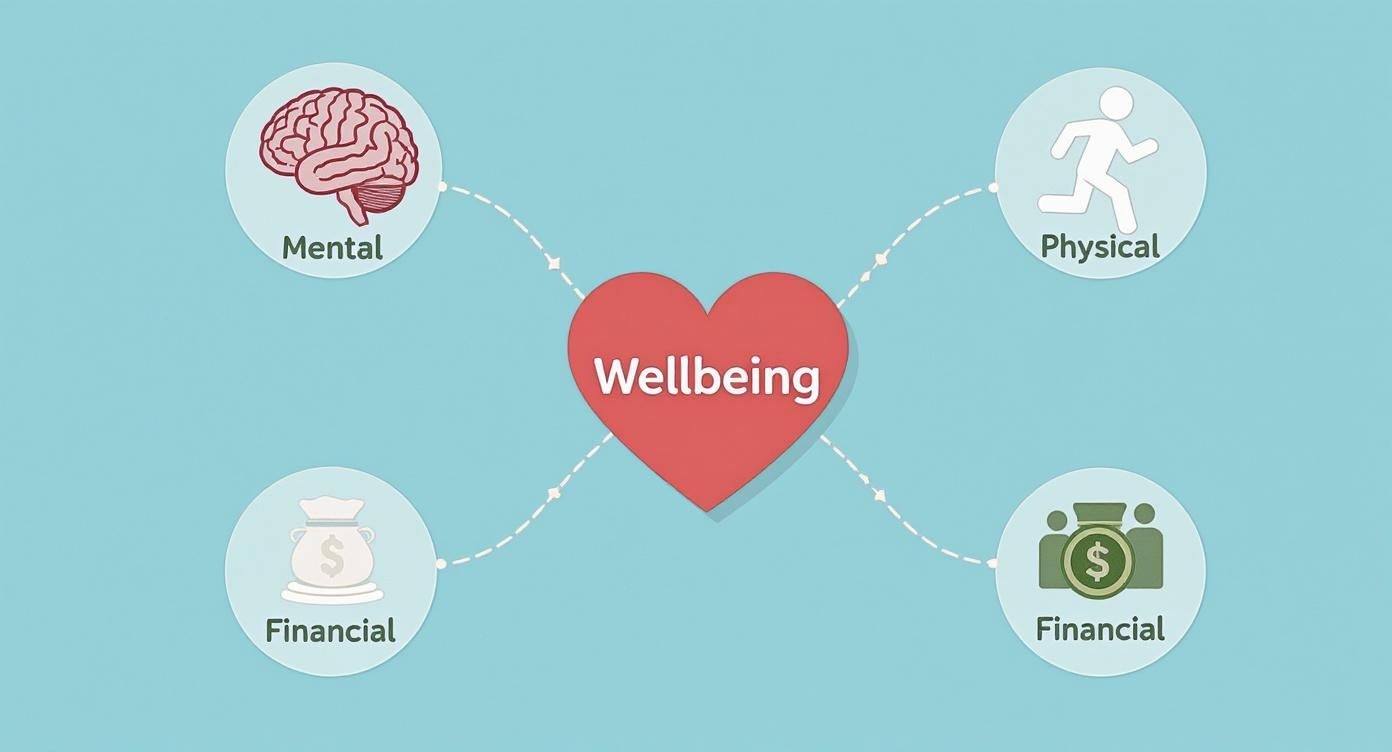
Employee wellbeing is the overall health of your workforce. It’s that powerful intersection of mental, physical, financial, and social wellness that ultimately determines how your people feel and perform every single day.
This isn’t about fleeting perks or superficial gestures. It’s about creating a sustainable environment where employees feel genuinely supported, valued, and empowered. This foundation is what allows them to bring their best, most authentic selves to work.
Defining Employee Wellbeing Beyond the Buzzwords
Think of employee wellbeing as a workplace ecosystem. Just like a garden, it needs consistent care across several interconnected areas to truly flourish. When you nurture each part, the entire system thrives, leading to a resilient and high-performing culture.
It’s the fundamental difference between a team that just survives the work week and one that is genuinely engaged and energised by what they do.
This kind of supportive environment is more critical than ever. According to the Health and Safety Executive (HSE), work-related ill health continues to be a major issue in the UK, with around 1.7 million workers suffering from such conditions in 2023/24. This led to a staggering 16.4 million working days being lost, shining a spotlight on the urgent need for organisations to build healthier workplace cultures.
More Than Just a Buzzword
So, what does employee wellbeing look like in practice? It moves past vague definitions to become the bedrock of a company's greatest competitive advantage. It's about fostering a culture where asking for help is seen as a sign of strength, and taking a proper break is encouraged, not frowned upon.
A genuine commitment to wellbeing is reflected in the daily experiences of your team. It's found in the small, consistent actions that show you care—from flexible work policies to creating spaces that encourage genuine connection and rest.
Ultimately, it’s about acknowledging that your employees are whole people with lives, challenges, and aspirations that extend far beyond their job titles. When a company invests in its team's overall health, it creates a powerful cycle of loyalty, motivation, and shared success.
For a deeper dive, this glossary entry offers a clear definition of employee well-being.
Core Components of Employee Wellbeing
To build a truly effective wellbeing strategy, it helps to break it down into its core pillars. Each one addresses a different aspect of an employee's life, and together, they form a complete support system.
| Component | Focus Area |
|---|---|
| Physical Wellbeing | Encouraging healthy habits like proper nutrition, regular movement, and adequate rest to maintain physical health and energy. |
| Mental Wellbeing | Supporting psychological health by managing stress, preventing burnout, and providing access to mental health resources. |
| Social Wellbeing | Fostering a sense of belonging, connection, and positive relationships among colleagues to build a strong community. |
| Financial Wellbeing | Providing resources and education to help employees manage their finances, reduce money-related stress, and plan for the future. |
| Professional Wellbeing | Supporting career growth, skill development, and a sense of purpose and satisfaction in one's work. |
When you address all five of these areas, you’re not just ticking boxes; you’re creating an environment where people can genuinely thrive, both personally and professionally.
The Five Pillars of a Thriving Workforce
When we talk about employee wellbeing, it’s tempting to think of it as a single concept. But in reality, it’s more like a structure built on five interconnected pillars. Each one represents a crucial part of an employee's life, and when they’re all strong, they create a solid foundation for a resilient, engaged person—and in turn, a thriving workforce.
These pillars don't stand in isolation; they’re deeply entwined. Financial stress can easily bleed into mental health, just as a lack of social connection can sap someone's physical energy. To truly support your people, you have to nurture all five. It's about looking after the whole person, not just the employee.
Physical Wellbeing
Physical wellbeing is about so much more than just hitting the gym. It’s about creating an environment where people have the energy and health to feel and perform at their best. This can be as practical as providing ergonomic workstations to prevent aches and pains, or as simple as championing restorative breaks away from the screen.
It also means encouraging healthy habits day-to-day. Think nutritious snacks in the kitchen or fostering a culture where taking a sick day to actually recover is seen as responsible, not a sign of weakness. When your team feels physically well, they bring a different level of focus and vitality to their work.
Mental Wellbeing
At its core, mental wellbeing is the ability to handle stress, navigate challenges, and maintain a generally positive outlook. In the workplace, this pillar is supported by building a culture of psychological safety—one where people feel secure enough to voice concerns, own up to mistakes, or ask for help without fear of being judged or penalised.
This goes way beyond just offering a mindfulness app. It's about training managers to spot the early signs of burnout, actively promoting a healthy work-life balance, and making sure workloads are realistic. A mentally healthy team is more creative, collaborative, and far more resilient when things get tough.
Social Wellbeing
We’re social creatures. A sense of belonging is fundamental to our happiness, and the workplace is no exception. Social wellbeing is all about fostering positive relationships and building a genuine sense of community among colleagues.
Meaningful connections at work are a powerful antidote to loneliness and disengagement. When employees feel they have genuine friendships and a supportive network, they are more likely to feel a deep sense of loyalty and belonging to the organisation.
This is something you nurture through collaborative projects, team-building days, and even just creating informal spaces where people can connect. Something as simple as a shared coffee break can become a vital ritual for building the bonds that make a company feel less like a workplace and more like a community.
Financial Wellbeing
Financial stress is a massive drain on a person's mental and physical health, and it absolutely impacts their ability to focus at work. Financial wellbeing means giving your employees the resources and support they need to feel secure and in control of their money. This starts with fair, competitive pay but can also include access to financial planning tools or educational workshops.
Professional Wellbeing
Finally, professional wellbeing boils down to an employee’s sense of purpose, growth, and satisfaction in their career. It’s that feeling of being aligned with the company’s mission, seeing a clear path for development, and knowing your contributions are genuinely valued. When people believe they are growing and making a meaningful impact, their overall sense of wellbeing skyrockets.
The Unmistakable Business Case for Wellbeing
Investing in your team's wellbeing isn't just a kind gesture anymore; it’s one of the sharpest strategic decisions a business can make. The idea that a company’s success is built on the health and happiness of its people is no longer a fluffy HR concept—it's a hard business reality with a clear, compelling return on investment.
When people feel genuinely supported, their entire contribution to the business changes. They stop just ticking off tasks and start actively driving innovation. That shift has a direct and powerful impact on the bottom line.
From Cost Centre to Profit Driver
Too many organisations still view wellbeing initiatives as a line item on an expense sheet. The data, however, tells a very different story. Neglecting wellbeing carries a far higher price tag, one that quietly drains resources through rising absenteeism, disengagement, and costly employee turnover.
Research consistently shows that burnout alone can cost a company 15-20% of its total payroll each year in voluntary turnover. Think about that for a second. The true cost of not investing in your people is immense, silently suffocating growth.
But a proactive approach completely flips this script, turning that potential loss into a significant gain. When employees feel their best, they do their best work. It’s a simple formula that creates a powerful cycle of productivity and profitability.
Skyrocketing Productivity and Creativity
A supported team is an energised team. When your people aren't bogged down by excessive stress or financial worries, they have more mental and emotional bandwidth to pour into their roles. This translates directly into higher productivity and a noticeable improvement in the quality of their work.
Better yet, a culture of wellbeing creates psychological safety—an environment where creative ideas can actually flourish. People are far more willing to take calculated risks, speak up, and collaborate openly when they feel secure and valued. This is where the breakthroughs happen, giving your business a genuine competitive edge.
When an organisation makes a strategic commitment to recognition and wellbeing, it can save millions in turnover costs annually. More importantly, it builds a culture where people feel seen, heard, and motivated to contribute their best ideas.
Becoming a Magnet for Top Talent
In today’s fiercely competitive job market, a good salary just isn’t enough to seal the deal. Top candidates are looking for something more; they're searching for a culture that values them as whole people. A genuine, demonstrated commitment to employee wellbeing has become a massive differentiator for any employer brand.
Companies that get a reputation for prioritising their people become talent magnets. They don't just attract the best candidates—they keep them for longer. This dramatically cuts recruitment costs and builds a more stable, experienced, and loyal workforce. It’s proof that when your people thrive, your business thrives right alongside them.
The Real-World Picture of UK Workplace Wellbeing
It’s one thing to talk about employee wellbeing in theory, but it’s another thing entirely to see how it plays out on the ground. For UK businesses, the landscape is in constant motion, reshaped by economic jitters and new working patterns that are stress-testing old-school support systems.
To build a wellbeing strategy that actually works, leaders first need to get honest about the modern workplace. It’s a messy, complex environment where hybrid work blurs the lines between our professional and personal lives, and financial uncertainty adds another layer of pressure for everyone. These aren’t abstract ideas; they’re the daily realities your team is grappling with.
Crucially, you have to realise that these pressures don't land equally. Different people across your organisation are facing their own unique set of challenges.
The Shifting Pressures on UK Employees
The data paints a clear—and sometimes surprising—picture. While overall wellbeing is still higher than it was before the pandemic, recent analysis shows it has dipped noticeably since its 2020 peak. A huge five-year study of over 300,000 UK employees reveals that this decline is hitting certain groups the hardest. You can dig into the specifics in the full workplace wellbeing report.
What this tells us is that a more nuanced, targeted approach to support is badly needed.
- Under-35s: Early-career professionals are often in a perfect storm, trying to build a career while juggling major life milestones and financial instability. It’s a recipe for burnout.
- Frontline Managers: These are the people caught in the middle, balancing expectations from leadership with the day-to-day needs of their teams. They carry a heavy emotional and operational load that can really take its toll.
- Men: Although conversations around mental health are getting better, men can still face unique societal pressures that make it harder to ask for help, which is contributing to a slide in their overall wellbeing.
Acknowledging these distinct challenges is the first step. A one-size-fits-all approach to wellbeing is destined to fail because it ignores the diverse and personal nature of the pressures your people face.
Building a strategy that genuinely resonates means moving beyond generic programmes. It’s about listening—really listening—to the specific needs of your team and creating a supportive culture that is both flexible and deeply human. Once you understand the complexities of today’s workplace, you can build a foundation of care that helps your team thrive, no matter what comes their way.
Actionable Strategies for a Culture of Care
Knowing what employee wellbeing is and actually building it are two different things. A true culture of care isn’t about one big, flashy initiative; it's about weaving small, supportive moments into the very fabric of the workday.
It all starts by turning everyday routines into powerful rituals. Take the humble coffee break. When you provide genuinely great coffee and a well-designed break area, you're doing so much more than just handing out a drink. You’re creating a modern-day ‘watering hole’.
This becomes a space where people can intentionally step away from their screens to recharge, chat about a project without the pressure of a meeting, or just connect on a human level.
This simple daily act reinforces the idea that taking a break is valuable, not a sign of slacking. It’s a direct boost to social and mental wellbeing, giving everyone that much-needed mental reset that’s so crucial for staying focused and avoiding burnout.
High-Impact Initiatives for Lasting Change
Beyond creating great spaces for connection, a strong wellbeing strategy needs policies and resources that support the whole person. These are the things that send a clear message: we’re invested in you, not just your output.
A few key strategies really move the needle:
- Flexible Work Policies: Offering things like hybrid models or flexible hours gives people the autonomy to fit work around their lives, not the other way around. This instantly reduces stress.
- Accessible Mental Health Resources: This means providing confidential, easy-to-find support, whether it's counselling services or mental health first aid training. The goal is to make it normal to ask for help.
- Empathetic Leadership Training: Managers have a huge impact. Training them to spot signs of distress, lead with compassion, and create a psychologically safe team is non-negotiable.
If you’re looking for inspiration, it’s always worth seeing what the leading corporate wellness programs in the UK are getting right.
Mapping Initiatives to Wellbeing Pillars
To make sure your efforts are well-rounded, it helps to map your initiatives back to the core pillars of wellbeing. This simple exercise ensures you’re not accidentally neglecting a key area.
Here’s a quick look at how different actions line up with the pillars we've discussed.
| Initiative | Primary Wellbeing Pillar Supported |
|---|---|
| Ergonomic Workstation Audits | Physical Wellbeing |
| Mindfulness App Subscriptions | Mental Wellbeing |
| High-Quality Communal Break Areas | Social & Mental Wellbeing |
| Financial Literacy Workshops | Financial Wellbeing |
| Clear Career Development Paths | Professional Wellbeing |
This table helps visualise how a holistic strategy comes together, with different elements working in harmony to support your team.
Ultimately, building a culture of care is about demonstrating empathy through action. When employees see their wellbeing prioritised through thoughtful spaces, flexible policies, and accessible support, they feel valued as individuals, fostering a deeper sense of loyalty, engagement, and shared success.
This proactive approach moves beyond simply reacting to problems. It's about creating an environment where people are set up to thrive, making wellbeing a shared responsibility and a cornerstone of who you are as a company.
Measuring the Impact of Your Wellbeing Efforts
So, you’ve rolled out a new wellbeing strategy. But is it actually working? Without measuring its impact, even the best-intentioned plans are just guesswork. The only way to know for sure, refine your approach, and prove its value for future investment is to track the results.
This isn’t just about one or two metrics. It’s about creating a balanced view that blends hard data with real human stories to see the complete picture of your team’s health.

Blending Quantitative and Qualitative Data
A solid measurement framework needs two kinds of insight. Quantitative data tells you what is happening, while qualitative feedback explains why.
Quantitative metrics give you objective, measurable benchmarks. Think of things like:
- Employee Net Promoter Score (eNPS): A straightforward score showing how likely your team is to recommend your company as a great place to work.
- Retention and Turnover Rates: Tracking who is staying versus who is leaving is a powerful indicator of overall satisfaction.
- Wellness Programme Engagement: Monitoring participation in things like workshops or new benefits shows you what’s actually resonating.
- Absenteeism Data: Looking at patterns in sick days can often flag underlying issues with stress or burnout before they escalate.
But numbers alone don't tell the whole story. Qualitative feedback, gathered through anonymous surveys and honest conversations, adds the essential context. It turns data points into real-life experiences.
Asking the Right Questions
Getting truly deep insights means asking better questions. Go beyond simple "are you happy?" surveys and dig into the specifics of your workplace culture and support systems.
This is especially important when you consider that while many UK employees report good health, a staggering 8 million workers feel their job has a negative impact on them. This is strongly linked to lower job satisfaction and a greater chance of them looking for a new role. You can dive deeper into these employee wellbeing findings from the CIPD.
By combining analytics with authentic feedback, you create a powerful feedback loop. This continuous flow of information allows you to adapt your strategy in real-time, ensuring your wellbeing efforts are always relevant, impactful, and genuinely supportive of your people.
Got Questions About Employee Wellbeing? We’ve Got Answers
Digging into what employee wellbeing actually means for your organisation can bring up a lot of questions. We get it. Here are some clear, straightforward answers to the queries we hear most often from leaders trying to build a strategy that genuinely supports their teams.
How is Wellbeing Different from Wellness?
This is a really important distinction, and one that trips a lot of people up.
Wellness usually zeroes in on physical health. Think gym passes, nutrition advice, and maybe some ergonomic chairs. These things are great, but they’re only one piece of a much bigger puzzle.
Wellbeing, on the other hand, is the whole picture. It’s a holistic view that wraps in mental, social, financial, and professional health right alongside the physical. It’s about creating an environment where the entire person can thrive, not just their body.
What’s the Single Most Important Factor?
If there’s one thing that acts as the foundation for everything else, it’s a culture of psychological safety. There's no silver bullet, but this comes pretty close.
This is all about creating an environment where your team feels safe enough to speak up, float new ideas, and even admit to making mistakes without fearing they’ll be blamed or shamed for it. When people feel psychologically safe, they’re more engaged, more innovative, and far more resilient. It’s the bedrock that makes every other wellbeing effort more effective.
Can We Really Afford to Invest in This?
The better question is, can you afford not to?
Ignoring employee wellbeing comes with some staggering, often hidden, costs. For instance, research shows that the cost of staff turnover just from burnout alone can hit 15-20% of a company’s annual payroll. That's a huge number.
Investing in wellbeing isn’t an expense; it’s a strategic defence against your biggest costs: high turnover, low productivity, and disengagement. The return is a more resilient, motivated, and loyal workforce.
Prioritising your team's health is one of the smartest financial decisions you can make. It creates a positive cycle that directly strengthens your bottom line.
Ready to cultivate a culture of care, starting with the perfect coffee break? Ue Coffee Roasters provides premium, barista-level refreshment solutions that create moments of connection and renewal for your team. Discover our office coffee solutions.