

What is workplace wellbeing? A Practical Guide to Happier, More Productive Teams
Let's be honest, the term "workplace wellbeing" gets thrown around a lot these days. But what does it actually mean? At its heart, it’s about the total health of your team in the context of their work. We’re talking about their physical, mental, social, and even financial health within the four walls of your business.
It’s about building an environment where people don’t just show up, they thrive. Real wellbeing isn't about beanbags or a free fruit bowl; it digs much deeper into the core of the employee experience.
Understanding Workplace Wellbeing in a Modern World
Think of your company as a living ecosystem. For it to truly flourish, you need more than a single ingredient. It’s not just about the big wins or the salary; it’s about the soil, the water, and the daily care that allows every single person to grow.
That's what workplace wellbeing is—a conscious effort to nurture your most important asset: your people.
To get a quick primer, this glossary entry on Employee Well-being offers a solid, foundational definition. In the real world, though, it’s about weaving support directly into your company’s DNA, not just patching problems as they arise. This proactive approach is what builds a resilient, engaged, and genuinely committed team.
It's More Than Just Perks
For decades, a decent salary and a few standard benefits were enough. But the game has changed. Today, we understand that an employee’s mental state, financial stability, and sense of community have a direct impact on everything from creativity to loyalty.
A truly supportive company gets that its employees are whole human beings, with lives, stresses, and ambitions that exist outside of their job title. A smart wellbeing strategy has to reflect that. It’s about creating a culture where it’s okay to talk about stress, where mental health is taken seriously, and where people have the tools to handle challenges, whether they start at their desk or at home.
A focus on employee wellness can significantly contribute to talent attraction and retention, sending a strong message to potential employees that a company cares about its people. This can make an organisation more attractive to job seekers and lead to greater job satisfaction and loyalty for existing employees.
The Five Pillars of Wellbeing
To stop it from feeling like a vague, fluffy concept, it helps to break wellbeing down into five core pillars. These are the interconnected foundations of a healthy, productive, and positive work environment. We'll dive into each one later, but for now, here's the big picture.
A holistic strategy needs to look at these five key areas to create an environment where everyone can do their best work.
The Five Pillars of Workplace Wellbeing at a Glance
This table gives a quick summary of the core dimensions that make up a complete workplace wellbeing strategy. Think of it as a checklist for building a healthier, happier team.
| Wellbeing Pillar | Core Focus | Example Initiative |
|---|---|---|
| Physical | Health, safety, and encouraging movement. | Offering ergonomic desk setups or healthy snack options. |
| Mental | Stress management and psychological safety. | Providing access to confidential counselling services. |
| Social | Belonging, connection, and positive relationships. | Organising team-building events or creating social hubs. |
| Financial | Fair pay and resources for financial security. | Hosting workshops on financial planning and retirement. |
| Environmental | A positive, comfortable, and inspiring workspace. | Improving office lighting and air quality. |
By addressing all five of these pillars, you move beyond simply managing a workforce and start building a genuine community. It's an investment that pays you back every single day in morale, innovation, and sustainable success.
Exploring the Five Pillars of Employee Wellbeing
To really get to grips with workplace wellbeing, you have to look beyond a simple definition and break it down into its core parts. Think of a healthy organisation not as a single object, but as a structure held up by five distinct pillars. If one is shaky, the whole thing feels unstable. But when all five are strong, you’ve got a foundation that can support real growth and resilience.
These five pillars are physical, mental, social, financial, and environmental wellbeing. Together, they form a complete picture that addresses the needs of the whole person, not just the employee. Looking after each of these areas is how you build a workplace where people genuinely feel valued and can do their best work.
This map shows how the core pillars of wellbeing are all linked.
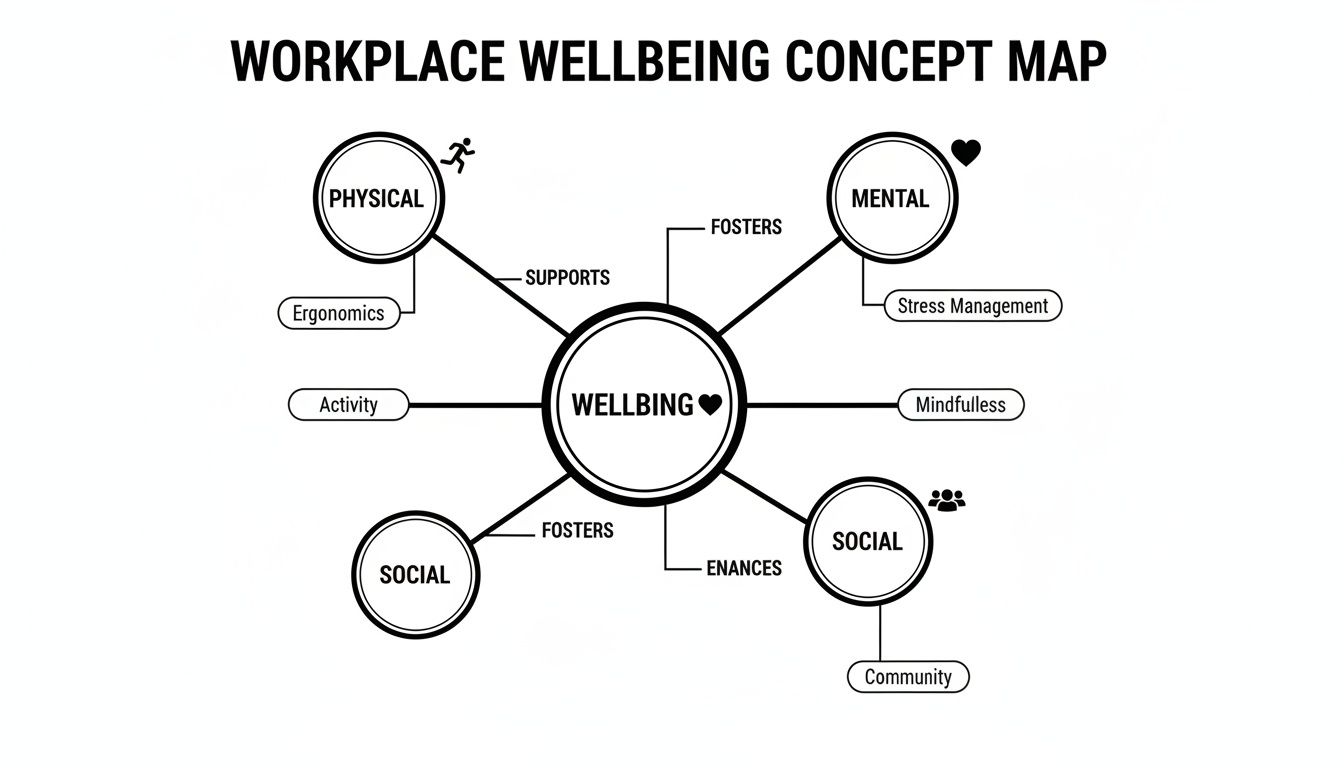
As you can see, a central focus on overall wellbeing branches out to support the essential physical, mental, and social health of every single person on your team.
Physical Wellbeing: Supporting Health and Energy
Physical wellbeing is probably the easiest one to see and feel. It covers everything that affects an employee's bodily health and safety at work. It starts with the absolute basics, like an ergonomic setup to prevent the aches and pains that come from sitting at a desk all day. A good chair and a well-placed monitor aren't just perks; they're essential for preventing chronic pain.
This pillar is also about encouraging people to move. It’s about building a culture where taking a walk at lunch or stepping away from the screen for a quick stretch is seen as a normal, productive part of the day.
Thoughtful amenities make a huge difference here. Providing access to nutritious snacks and high-quality, hydrating drinks helps sustain energy levels far better than a vending machine full of sugary treats. It’s a simple, daily reminder that the company cares about its team’s health.
Mental Wellbeing: Fostering Psychological Safety
Mental wellbeing is all about creating a space where people feel psychologically safe, supported, and able to manage stress. This pillar has rightly gained a lot of attention recently. It’s the bedrock of creativity, focus, and the ability to bounce back from challenges.
A huge part of this is taking the stigma out of conversations around mental health. When leaders openly talk about the importance of managing stress and encourage people to use the resources available, it builds a culture of trust. It tells employees it’s okay to not be okay, and that support is there without judgement.
The cost of getting this wrong is staggering. According to a recent report, work-related stress, depression, and anxiety accounted for 17.1 million lost working days in the UK, making up 50% of all work-related ill health. With 67% of employees reporting more stress over the past two years, being proactive is no longer optional. Discover more insights into UK workplace stress statistics on work.life.
An environment that prioritises mental wellbeing doesn’t just prevent burnout; it unlocks potential. When employees aren’t running on empty, they have the cognitive and emotional resources to solve complex problems and collaborate effectively.
Social Wellbeing: Building Connection and Belonging
Humans are social animals, and for many of us, the workplace is a key community. Social wellbeing is about fostering positive relationships, encouraging real connections, and building a powerful sense of belonging among colleagues.
This goes way beyond awkward, forced team-building days. It’s about creating spaces and moments for organic interaction to happen. A comfortable breakout area with excellent coffee can become a natural hub for conversation, a place where ideas get shared and friendships are made. These informal connections are the glue that holds a strong culture together.
True social wellbeing also depends on inclusivity. It means making sure every single person feels respected, heard, and valued for who they are. When people feel they belong, they are far more likely to:
- Collaborate openly: Sharing ideas without fearing criticism.
- Support their colleagues: Pitching in to help and celebrating team wins.
- Commit to shared goals: Feeling a personal stake in the company’s mission.
Financial Wellbeing: Easing Monetary Stress
Financial stress is a heavy burden that can seriously impact an employee's focus, health, and general happiness. The pillar of financial wellbeing is about tackling this head-on by promoting economic security and stability.
The foundation, of course, is fair and competitive pay. Paying people what they’re worth is the most basic way to show you value them. Beyond that, though, companies can offer resources that empower employees to manage their money well. This might include access to financial advisors, workshops on budgeting, or clear guidance on retirement plans.
By helping to ease financial worries, employers free up their team's mental bandwidth. This allows people to be more present and engaged at work, knowing their employer supports their long-term stability.
Environmental Wellbeing: Creating Inspiring Spaces
Finally, environmental wellbeing is all about the physical workspace itself and how it makes people feel. A poorly designed office—with harsh lighting, stuffy air, or constant noise—can be a source of daily, low-level stress.
On the flip side, a thoughtfully designed environment can be a source of comfort and inspiration. The key elements include:
- Natural Light: Getting as much daylight as possible has been proven to boost mood and improve sleep.
- Air Quality: Good ventilation and air filtration reduce tiredness and help people think more clearly.
- Acoustic Comfort: A mix of collaborative and quiet zones lets people work without constant interruptions.
- Biophilic Design: Adding natural elements like plants can lower stress and boost creativity.
The office environment sends a clear message. A clean, comfortable, and inviting space tells employees that their experience matters, reinforcing a culture of care every single day.
Why Wellbeing Is a Strategic Business Imperative
For a long time, workplace wellbeing was seen as a ‘nice-to-have’—a fluffy extra reserved for companies with big budgets. That mindset is now a relic of the past.
Today, a proactive wellbeing strategy is one of the sharpest tools a business can possess. It’s not an expense; it’s a direct investment in your most valuable asset: your people.
Understanding what workplace wellbeing is really about reveals its true power. It’s about building a sustainable foundation for long-term growth and resilience, transforming your workforce from a group of individuals into a connected, motivated, and high-performing team.
Investing in your employees' health is no longer just the right thing to do; it’s a critical business decision with a clear and compelling return.
The Tangible ROI of a Supported Workforce
When employees feel properly supported, the benefits ripple across the entire organisation. One of the most immediate impacts is on productivity. A team that isn't weighed down by stress or burnout has the mental and physical energy to innovate, solve problems, and deliver outstanding work.
The connection between support and performance is undeniable. Recent data shows that employee priorities have shifted dramatically; a striking 58% of UK employees now prioritise their wellbeing more than they did just six months ago.
What’s more, 84% are willing to stay longer in jobs offering better mental and physical support, and 81% note that wellbeing directly impacts their productivity. You can discover more key findings in the full workplace wellbeing report from rewardgateway.com.
These numbers paint a clear picture. A supported team isn't just happier—it's more stable and more effective.
Slashing Costs Through Higher Retention
Employee turnover is one of the biggest hidden costs for any business. The expenses tied to recruiting, hiring, and training new staff can be enormous, not to mention the loss of institutional knowledge when a valued team member walks out the door.
This is where a strong wellbeing culture becomes a powerful financial lever. By creating an environment where people feel cared for and valued, you significantly boost loyalty and make them far less likely to look for opportunities elsewhere.
Lower staff turnover means:
- Reduced recruitment fees and advertising costs.
- Less time spent by managers on interviewing and onboarding.
- Greater stability and consistency within teams.
Investing in wellbeing is fundamentally an investment in retention. It transforms the work environment into a place where people choose to stay and build their careers, protecting your bottom line from the constant drain of attrition.
Gaining a Powerful Competitive Edge
In a tight labour market, your company’s reputation as an employer is everything. A genuine commitment to wellbeing is a major differentiator that helps you attract—and keep—the very best talent.
Top performers aren't just looking for a good salary; they’re seeking a workplace that respects their health, supports their growth, and provides a positive daily experience.
This enhanced employer brand does more than just fill vacancies. It builds a reputation that resonates with customers and partners, signalling that your organisation is a responsible, forward-thinking business. In this way, wellbeing transforms from an internal policy into a powerful external statement about your company's values and its vision for the future.
The Evolving State of Wellbeing in UK Workplaces
To really get to grips with workplace wellbeing, we first need to look at how the world of work has changed. It's a different landscape now, and the pressures on UK employees have shifted right along with it. Understanding this context is crucial, because it shows why a proper wellbeing strategy is no longer a nice-to-have, but a must-have for any modern business.
The current state of employee wellbeing tells a complicated story. After a surprising peak in 2020 when everyone first shifted to remote work, recent trends show a worrying decline. This dip highlights the real growing pains of adapting to hybrid models, dealing with ongoing economic uncertainty, and just trying to keep up with technology.
These challenges create an environment where being proactive is everything. The businesses that see these pressures for what they are will be the ones that build a resilient, engaged, and loyal team.
The Post-Pandemic Reality Check
That initial jump to remote work was a breath of fresh air for many. It brought more freedom and flexibility. But as hybrid work settles in as the new normal, it’s brought its own set of problems. The lines between home and work have blurred into an ‘always-on’ culture that makes it incredibly difficult for people to properly switch off and recharge.
This constant digital connection is taking its toll. While everyone loves flexibility, the lack of clear boundaries is pushing stress levels up and leaving many people feeling permanently drained.
Today’s wellbeing challenges aren’t just about managing workloads. They’re about managing energy, boundaries, and human connection in a work model that we’re all still figuring out. A great strategy has to tackle the unique strains of hybrid work head-on.
Economic and Technological Pressures
On top of all this, you’ve got the twin pressures of a shaky economy and disruptive tech. The rising cost of living creates serious financial stress—a heavy burden that follows employees into their workday and hits their focus and mental health hard. This has made financial wellbeing a more critical pillar than ever before.
At the same time, the rapid arrival of new technologies, especially AI, is changing jobs and creating a lot of uncertainty. While these tools have amazing potential, they also bring real anxieties about job security and the need to constantly learn new skills. These are powerful external forces reshaping the employee experience from the outside in.
A sobering five-year study has tracked this exact decline in the UK. After that 2020 peak, employee wellbeing has been on a steady slide, hitting under-35s and frontline managers the hardest. This trend is a direct reflection of the struggles with hybrid work, money worries, and AI-driven changes. You can read the full research on workplace wellbeing from greatplacetowork.co.uk.
Why a Proactive Stance Is Crucial
This whole picture is a clear call to action. Ignoring these trends simply isn’t an option for businesses that want to succeed. A reactive approach—waiting for problems like burnout or high turnover to show up—is far more expensive than investing in support from the start.
By truly understanding the state of wellbeing in the UK today, leaders can put meaningful, targeted strategies in place that tackle real-world challenges. This means:
- Creating clear guidelines for hybrid work that actually protect work-life balance.
- Providing resources for financial literacy and mental health support.
- Fostering a culture of learning and open conversation around new technology.
Ultimately, building a human-first work culture is the most effective way to turn these negative trends around and create a supportive environment where people can genuinely thrive.
How Your Office Environment Shapes Wellbeing
Your office is more than just a place to get work done. It’s a powerful, non-verbal communicator of your company's values. Every detail, from the lighting to the layout, sends a daily message to your team about how much you value their comfort, health, and happiness.
A thoughtfully designed environment can become one of the most effective tools in your wellbeing strategy. It’s about recognising that a workspace can either be a source of low-level, daily stress or a place that actively helps people feel good and perform at their best.

The Power of Intentional Breakout Spaces
The moments between tasks are just as important as the tasks themselves. This is where intentional breakout spaces come in. These aren't just leftover corners with a few chairs; they are purposefully designed hubs for connection, relaxation, and informal collaboration.
A great breakout area gives people permission to step away from their desks and truly recharge. It breaks the monotony of the workday and provides a change of scene that can spark new ideas. Whether it’s a quiet nook for reading or a communal table for a lively chat, these spaces cater to different needs and energy levels.
This is a direct investment in the social pillar of wellbeing. It’s in these informal moments—the spontaneous conversations that build strong team bonds—that some of the most creative problem-solving happens.
The physical environment is a silent partner in your company culture. An inviting, comfortable space reinforces messages of care and appreciation, demonstrating a commitment to wellbeing that words alone cannot convey.
Elevating the Daily Ritual with Quality Refreshments
Think about the small rituals that punctuate the workday. Grabbing a coffee, making a tea, or reaching for a snack are universal moments of pause. By elevating these simple experiences, you can have a surprisingly powerful impact on an employee’s day.
Providing premium refreshments is a tangible, daily signal that you care. It’s a small detail that speaks volumes about your company’s standards and appreciation for its people. It transforms a routine break into a genuinely restorative experience.
For instance, offering speciality coffee from a high-quality bean-to-cup machine brings a touch of café culture into the office. This small luxury can significantly boost morale and create a natural focal point for social connection. It’s a small investment that reinforces a culture of care, making employees feel genuinely valued.
Small Details That Make a Big Difference
Beyond dedicated breakout areas, several other environmental factors contribute massively to what wellbeing feels like day-to-day. Paying attention to these elements shows a deep level of care for the employee experience.
Key environmental factors include:
- Biophilic Design: Integrating natural elements like plants, wood, and stone has been shown to reduce stress and improve creativity.
- Acoustic Comfort: Providing a mix of quiet zones for focused work and social areas for collaboration allows people to choose the environment that best suits their task.
- Natural Lighting: Maximising exposure to daylight is proven to boost mood, regulate sleep cycles, and increase energy levels.
Each of these helps craft an atmosphere where people feel comfortable and supported. It’s about building an office that doesn’t just accommodate work but actively enhances the human experience of doing it.
Your Blueprint for a Successful Wellbeing Strategy
So, you’re ready to move from talking about wellbeing to actually doing something about it. That’s the most important step. Building a successful strategy isn’t about grand, expensive gestures; it’s about a consistent, thoughtful approach that starts with one simple action: listening to your people.

This blueprint is your guide to creating a programme that genuinely resonates with your team. It’s designed to help you move forward with confidence, proving that a human-centric workplace is the ultimate driver of a healthy, high-performing organisation.
The first step is always to figure out what your team actually needs. A one-size-fits-all approach just won’t cut it. Use anonymous surveys, hold a few focus groups, or simply have more one-on-one conversations to understand what people are really struggling with. This is the foundation of everything that follows.
Launching High-Impact Initiatives
Once you have a clearer picture, you can start putting targeted initiatives in place across the five pillars of wellbeing. The key is not to try and boil the ocean. Focus on realistic, high-impact actions you can take, no matter the size of your budget.
Your implementation roadmap should include these key steps:
- Secure Leadership Buy-In: This is non-negotiable. Present your findings to the leadership team, but make sure to connect the dots between employee needs and business outcomes like productivity and retention. A strategy championed from the top is one that sticks.
- Keep the Feedback Loop Open: Wellbeing isn't a "set it and forget it" project. Use regular pulse surveys to check in, see what’s working, and spot areas that need a tweak. It’s an ongoing conversation.
- Measure What Matters: Track key metrics like absenteeism, staff turnover, and engagement scores. This data doesn't just show you what's working; it helps you prove the value of your efforts and refine your approach over time.
A truly effective wellbeing strategy is co-created with your team. It’s an ongoing conversation that adapts to their evolving needs, showing them that their voices are not only heard but are essential to building a better workplace for everyone.
For businesses ready to take the next step, exploring the best corporate wellness programs available in the UK can offer some fantastic ideas. By taking these deliberate steps, you create a cycle of listening, acting, and improving that builds real momentum and fosters a genuine culture of care.
Your Workplace Wellbeing Questions, Answered
Starting to build a wellbeing strategy always brings up a few practical questions. It's one thing to understand the theory, but another to put it into practice. Here are a few common queries we hear from leaders, with straightforward answers to help you get started.
How Can We Measure the ROI of Our Initiatives?
Measuring the return on a wellbeing investment is a mix of art and science—you need to look at both the hard data and the human experience.
On the quantitative side, you can track metrics like employee turnover, absenteeism rates, and even productivity benchmarks. If those numbers start trending in the right direction after you’ve rolled out a new initiative, that’s a strong sign of a positive return.
But the story doesn’t end there. The qualitative data is just as important. Anonymous, regular pulse surveys are perfect for this. They give you a real-time gauge of things like job satisfaction, stress levels, and overall morale. By combining these two streams of feedback, you’ll get a much clearer picture of how your efforts are creating a more engaged and resilient team.
What Are Some Low-Cost Ways to Improve Wellbeing?
You don't need a massive budget to make a meaningful difference. In fact, some of the most powerful changes are cultural, and they cost next to nothing to implement.
Start with the foundations:
- Promote genuine flexibility where roles allow. Trusting people to manage their time is a huge morale booster.
- Encourage proper breaks away from desks. A real mental reset isn't possible when you're eating a sandwich over your keyboard.
- Foster open communication and make it safe for people to give honest feedback.
Simple, tangible perks also go a long way. Think about transforming a tired break room with high-quality refreshments like speciality coffee. It’s a relatively low-cost, high-impact gesture that shows you care, day in and day out. It’s a small thing that sends a big message.
How Do We Get Employees Actively Involved?
Lasting change is built with people, not for them. If you want genuine buy-in, you have to ditch the top-down approach and invite your team to co-create the strategy.
Run a few workshops or send out a survey asking what they actually need to feel supported. You might be surprised by the answers.
A great next step is to form a volunteer ‘wellbeing committee’ with champions from different departments who can help drive initiatives. When you offer a diverse range of options—from mindfulness workshops to social clubs or walking groups—you empower people to choose what genuinely works for them. That sense of ownership is what turns a corporate programme into a thriving culture.
Ready to elevate your team's daily experience? Ue Coffee Roasters brings the quality of a high-street speciality coffee shop directly to your office, creating a workplace people genuinely love. Discover our office coffee solutions today.