

10 Essential Workplace Satisfaction Survey Questions for 2025
In today's competitive landscape, understanding employee sentiment is no longer a luxury, it's a strategic necessity. A well-crafted survey is your most powerful tool for unlocking actionable insights that drive retention, productivity, and a thriving company culture. But generic questions yield generic answers, leaving you with vague data that's difficult to act upon. This guide moves beyond the obvious, providing a comprehensive roundup of impactful workplace satisfaction survey questions designed to reveal what truly matters to your team.
We believe that a truly exceptional workplace is built on a foundation of genuine care and attention to detail. It's about more than just the big policies; it’s about the daily experiences that shape an employee's day. That’s why our curated list covers everything from high-level engagement and manager support to the subtle yet significant impact of workplace amenities, like the quality of the office coffee and the appeal of breakout spaces. To move beyond generic feedback and truly understand employee sentiment, it's crucial to utilise effective ordinal survey question examples that yield actionable insights.
This article provides not just the questions, but the framework to use them effectively. You'll discover how to probe into crucial areas such as team collaboration, wellness, work-life balance, and even how your office environment is perceived by new recruits and visiting clients. By asking the right, specific questions, you can transform employee feedback from a simple metric into a roadmap for meaningful improvement. This demonstrates a genuine commitment to creating an environment where your team doesn't just work, but feels valued, supported, and inspired to contribute their best. Let's build a workplace people are proud to be a part of.
1. Overall Job Satisfaction and Workplace Environment
This foundational question acts as the North Star for your entire employee experience strategy. It’s a powerful, high-level metric that captures an employee's overall sentiment about their role, the company culture, and their daily work environment. By asking this question, you create a vital baseline to measure the impact of every initiative, from new leadership programmes to the introduction of superior workplace amenities.
Think of it as the ultimate litmus test for employee morale. Major platforms like Glassdoor use overall satisfaction as a primary indicator of a company's health, demonstrating its weight in shaping employer reputation. It's one of the most direct workplace satisfaction survey questions you can ask to get a pulse on your organisation's climate.
How to Implement This Question
The most effective way to deploy this question is with a simple, intuitive scale. This allows for easy quantification and tracking over time.
- Question Example: "On a scale of 1 to 10, how satisfied are you with your overall job and the workplace environment at our company?"
- Response Scale: A numerical scale (e.g., 1 = Extremely Dissatisfied, 10 = Extremely Satisfied) is standard. Alternatively, a Likert scale (Strongly Disagree to Strongly Agree) can be used for a statement like, "I am satisfied with my job here."
Pro-Tip: Always follow up a low score with an open-ended question like, "What is the single most important change we could make to improve your experience?" This provides crucial context behind the number.
Actionable Strategies for Maximum Impact
This question becomes truly powerful when used to measure change. For instance, after upgrading your office coffee from instant granules to a premium bean-to-cup machine, you can directly measure the uplift in morale.
- Track Before and After: Survey your team a month before installing a new high-quality coffee or refreshment station and again three months after. This isolates the impact of the investment.
- Segment Your Data: Combine responses with demographic data (department, role, tenure) to see which teams benefit most. You might find your creative team's satisfaction skyrockets with access to speciality coffee.
- Schedule Quarterly Pulses: Don't make it a one-off. Regular, quarterly surveys using this question will help you track trends and demonstrate a sustained commitment to improving the workplace.
2. Satisfaction with Workplace Breaks and Amenities
This question zooms in on a critical component of the daily employee experience: the quality of break times and the amenities that support them. It directly measures how valued employees feel during their downtime, turning a simple coffee break into a powerful indicator of company culture. For organisations investing in premium refreshments, this is the key metric to prove the return on that investment in morale and well-being.

The impact of high-quality break amenities is well-documented. For instance, major tech companies found that installing premium coffee solutions led to a significant increase in break room usage, fostering greater collaboration. These specific workplace satisfaction survey questions help you quantify the effect of turning your break room from a functional space into a desirable destination.
How to Implement This Question
To get precise, actionable feedback, combine a scaled question with targeted follow-ups. This approach gives you both a clear metric and the "why" behind it.
- Question Example: "On a scale of 1 to 5, how would you rate your satisfaction with the quality of our break room facilities and refreshments?"
- Response Scale: A Likert scale is ideal (e.g., 1 = Poor, 5 = Excellent). This provides a clear, consistent way to measure sentiment over time.
Pro-Tip: Include a multi-select follow-up question such as, "Which of the following would most improve your break experience?" with options like "Speciality coffee," "Greater variety of teas," "Healthy snack options," or an "Other" field.
Actionable Strategies for Maximum Impact
Use this question not just to measure, but to guide your investment in workplace culture and demonstrate its success.
- Benchmark Your Upgrade: Survey your team before and after installing a new Ue Coffee Roasters bean-to-cup machine. This creates a compelling case study showing a direct uplift in employee satisfaction from your investment.
- Refine Your Offering: Ask specific questions about preferences. Do employees want to explore single-estate coffees or do they prefer flavoured syrups? This data allows you to tailor your coffee and refreshment programme perfectly.
- Evaluate Equipment Performance: If you're using high-end equipment, add a question about ease of use. This provides valuable feedback on the user experience and ensures everyone can enjoy the benefits.
3. Employee Wellness and Self-Care Perception
This question moves beyond basic satisfaction to gauge whether employees feel genuinely cared for and supported in their personal wellbeing. It assesses the perceived investment your company makes in their mental and physical health, often reflected through the quality and thoughtfulness of your workplace amenities and self-care initiatives. In today’s workplace, demonstrating a commitment to employee wellness is no longer a perk; it's a fundamental expectation.
Gauging this perception is crucial. Major global corporations, for example, have found that well-structured tea and coffee break programmes contributed to a significant reduction in stress-related absence rates. This shows how tangible amenities, when framed as part of a wider wellness strategy, become powerful symbols of employer care. Asking these types of workplace satisfaction survey questions reveals whether your investments are truly landing with impact.
How to Implement This Question
Frame the question to directly link amenities with the concept of wellness. This helps employees see the connection between a quality coffee break and the company's commitment to their mental health.
- Question Example: "On a scale of 1 to 10, how well do you feel we support your personal wellness and self-care through our workplace amenities and initiatives?"
- Response Scale: A numerical scale (e.g., 1 = Not Supported at All, 10 = Exceptionally Well Supported) is ideal for tracking sentiment over time.
Pro-Tip: Include a follow-up question that asks for specific examples. Try, "Which workplace amenity or initiative has had the most positive impact on your personal wellbeing?" This helps identify which benefits are most valued.
Actionable Strategies for Maximum Impact
This question provides a roadmap for investing in initiatives that resonate deeply with your team. Use the data to build a culture where breaks are not just allowed, but actively encouraged as a vital part of the workday.
- Connect Amenities to Narrative: When introducing a new premium coffee machine, don’t just announce the hardware. Frame it as an investment in “mindful moments” and a tool to help staff recharge, reducing stress and boosting creativity.
- Pair with Usage Data: Correlate survey responses with data on break room usage or how often the new coffee station is visited. If high satisfaction scores match high usage, you have a clear win.
- Champion Mental Health Breaks: Use internal communications to explicitly encourage taking short breaks for a coffee or a moment of quiet. This reinforces the message that the company values downtime and employee self-care, validating the purpose behind the amenities.
4. Team Collaboration and Social Connection Through Shared Spaces
This question delves beyond individual satisfaction to assess the very fabric of your company culture: the spontaneous connections that build strong, collaborative teams. It evaluates how shared amenities, especially high-quality refreshment stations, act as social hubs, fostering the informal interactions that are crucial for innovation, trust, and a sense of belonging. These are the spaces where ideas are sparked and inter-departmental barriers dissolve.

The power of these casual collisions is well-documented. A 2023 Slack report noted that 64% of employees credit interactions in break areas with forging stronger team bonds. Measuring this dynamic is one of the most insightful workplace satisfaction survey questions you can ask, linking tangible investments in your office environment directly to the strength of your internal network.
How to Implement This Question
To capture this nuanced social data, your questions need to be a mix of behavioural frequency and qualitative assessment. This combination provides a complete picture of how your amenities are being used.
- Question Example: "How has the quality of our shared break areas (e.g., coffee and tea stations) influenced how often you connect with colleagues from other departments?"
- Response Scale: A Likert scale is ideal here (e.g., 1 = Significantly Decreased Interaction, 5 = Significantly Increased Interaction). You could also use a frequency scale for a question like, "How often do you have meaningful, work-related conversations in the break room?"
Pro-Tip: Ask a follow-up question to uncover the nature of these interactions, such as, "Can you share an example of a time a casual chat over coffee led to a new idea or solved a problem?" This uncovers powerful anecdotal evidence of your amenities' ROI.
Actionable Strategies for Maximum Impact
Use this question to justify and refine your investment in communal spaces. The data can transform a perceived "perk" into a strategic tool for enhancing organisational culture and productivity.
- Map Social Networks: Analyse responses to see if the new speciality coffee machine is fostering connections between, for example, the marketing and engineering teams who rarely interact formally.
- Correlate with Hybrid Attendance: For hybrid teams, track if office visit frequency increases following an upgrade to your refreshment offerings. Buffer's research showed quality on-site refreshments boosted office visits by 41%.
- Guide Future Investments: Use feedback to decide what’s next. If the coffee station is a success, perhaps a comfortable seating area or a premium water dispenser could further boost social connection.
5. Manager and Leadership Support Perception
This question transcends a simple evaluation of management; it gauges how well employees feel the organisation's leaders are invested in their daily experience. Premium workplace amenities, like offering UE Coffee Roasters' speciality coffee, are not just perks. They are powerful, tangible signals that leadership cares about creating a positive, high-quality environment.
When leadership approves investments that directly enhance the workplace, it communicates value and respect far more effectively than words alone. According to Deloitte research, 87% of employees feel more appreciated when their organisation invests in the quality of their break areas. This makes it one of the most insightful workplace satisfaction survey questions for linking leadership action to employee sentiment.
How to Implement This Question
Frame the question to directly connect leadership actions with employee wellbeing and the physical workplace. This provides a clear metric for how leadership support is perceived on the ground.
- Question Example: "To what extent do you agree with the statement: 'Our leadership team demonstrates a genuine investment in my wellbeing through the quality of our workplace amenities and facilities'?"
- Response Scale: A Likert scale is ideal here (e.g., Strongly Disagree, Disagree, Neutral, Agree, Strongly Agree). This captures the nuance of employee perception.
Pro-Tip: Before launching a new amenity, like a UE Coffee Roasters partnership, announce it as a deliberate leadership decision. Frame it as a direct investment in the team's daily experience to strengthen the connection.
Actionable Strategies for Maximum Impact
This question is most effective when used to measure the "before and after" of specific leadership-driven initiatives. It turns an investment in something like premium coffee into a measurable tool for improving perceptions of management.
- Communicate and Measure: Pair the announcement of your new premium coffee system with a survey that includes this question. Survey again a few months later to quantify the positive shift in leadership perception.
- Highlight the "Why": In internal communications, explain that the decision to upgrade coffee was based on employee feedback and a desire to improve the workday. This reinforces that leaders are listening and acting.
- Develop Your Leaders: To cultivate strong leadership and foster high-performing teams, continuous investment in executive coaching and leadership training for high-performing teams is crucial. When leaders are trained to prioritise employee experience, the results show up in these survey scores.
6. Work-Life Balance and Break Time Quality
This question moves beyond simple satisfaction to explore the restorative power of the workday itself. It measures an employee's perception of their ability to recharge and disconnect, which is directly linked to preventing burnout and maintaining long-term productivity. The quality of break spaces and the amenities within them, like premium coffee, are critical components of a truly restorative break.
Assessing break time quality is a sophisticated way to understand work-life integration. Research consistently shows a link between the workplace environment and employee wellbeing; the ADP Research Institute found 52% of employees cite break room quality as a key contributor to their perceived work-life balance. These workplace satisfaction survey questions help you quantify how well your office facilities support mental and physical health.
How to Implement This Question
Frame the question to focus on the outcome of a break, not just its existence. This reveals whether your break areas are genuinely helping employees de-stress and return to their tasks refreshed.
- Question Example: "On a scale of 1 to 10, how would you rate the quality and restorative value of your typical break times?"
- Response Scale: A numerical scale (e.g., 1 = Not at all restorative, 10 = Extremely restorative) provides clear, measurable data for analysis.
Pro-Tip: Ask a follow-up question to pinpoint specific drivers. For example: "What one thing would make your break time more refreshing and valuable?" This can uncover desires for better coffee, quieter spaces, or more comfortable seating.
Actionable Strategies for Maximum Impact
Use this question to measure the direct impact of improvements to your break areas, turning an amenity investment into a measurable wellbeing initiative.
- Benchmark and Remeasure: Before installing a new high-end coffee machine or redesigning a break area, ask this question. Survey again two months after the change to capture the uplift in perceived restorative value.
- Connect to Burnout Metrics: Analyse responses alongside data on stress levels and burnout. You can demonstrate how investing in a superior refreshment station directly contributes to a healthier, more resilient workforce.
- Track Behavioural Changes: Ask about break frequency and duration. You may find that a more inviting break space with better amenities encourages employees to take the regular, short breaks proven to boost focus and creativity.
7. Product Quality and Variety Satisfaction
Beyond simply having amenities, this question drills down into the actual quality and variety of what you offer. It moves the conversation from "Do we have coffee?" to "Is our coffee an experience employees genuinely enjoy?" This targeted feedback is crucial for understanding whether your refreshment offerings are a true perk that elevates the daily workplace experience or just a box-ticking exercise. It's a key metric for measuring the direct impact of premium provisions like speciality coffee and artisanal teas.
This is one of the most specific workplace satisfaction survey questions you can ask to see if your investment in quality is truly paying off. For instance, internal reports from companies that upgrade their office beverage programmes often show a significant boost in satisfaction scores directly correlated with the quality of the coffee provided.

How to Implement This Question
To get meaningful data, be specific and use a clear rating system. This allows you to pinpoint exactly which elements of your refreshment station are hitting the mark and which need improvement.
- Question Example: "On a scale of 1 to 5, how would you rate the quality and variety of the coffee available in the office?"
- Response Scale: A Likert scale (1 = Very Poor, 5 = Excellent) is ideal. You can create separate questions for coffee, tea, hot chocolate, and other available snacks or drinks to gather granular feedback.
Pro-Tip: Always include an open-ended question such as, "If you could add one new item or flavour to our beverage selection (e.g., a specific tea, a new coffee syrup), what would it be?" This provides a direct roadmap for future enhancements.
Actionable Strategies for Maximum Impact
Use this feedback to refine and perfect your workplace refreshment strategy, demonstrating a commitment to employee preferences and wellbeing. It's about creating a desirable, high-street coffee experience right in your office.
- Drill Down into specifics: Ask targeted questions like, "How would you rate the quality of our coffee compared to high-street café standards?" or "How satisfied are you with the selection of syrup flavours (e.g., vanilla, caramel)?"
- Assess Usage and Preferences: Include a frequency scale: "How often do you use the office coffee machine?" (Daily, Weekly, Occasionally, Never). This helps correlate satisfaction with actual usage.
- Evaluate New Offerings: Before introducing a new single-origin coffee or a range of speciality teas, survey staff on their preferences. Follow up after the launch to measure the reception and justify the investment.
8. Convenience and Accessibility of Refreshments
A premium coffee machine is only as good as its accessibility. This question gauges how easily employees can enjoy workplace refreshments during their day. It’s not just about having a high-quality bean-to-cup machine; it’s about whether that machine is conveniently located, simple to use, and available when staff need that crucial pick-me-up. This is a practical, ground-level metric that directly influences daily routines and micro-interactions.
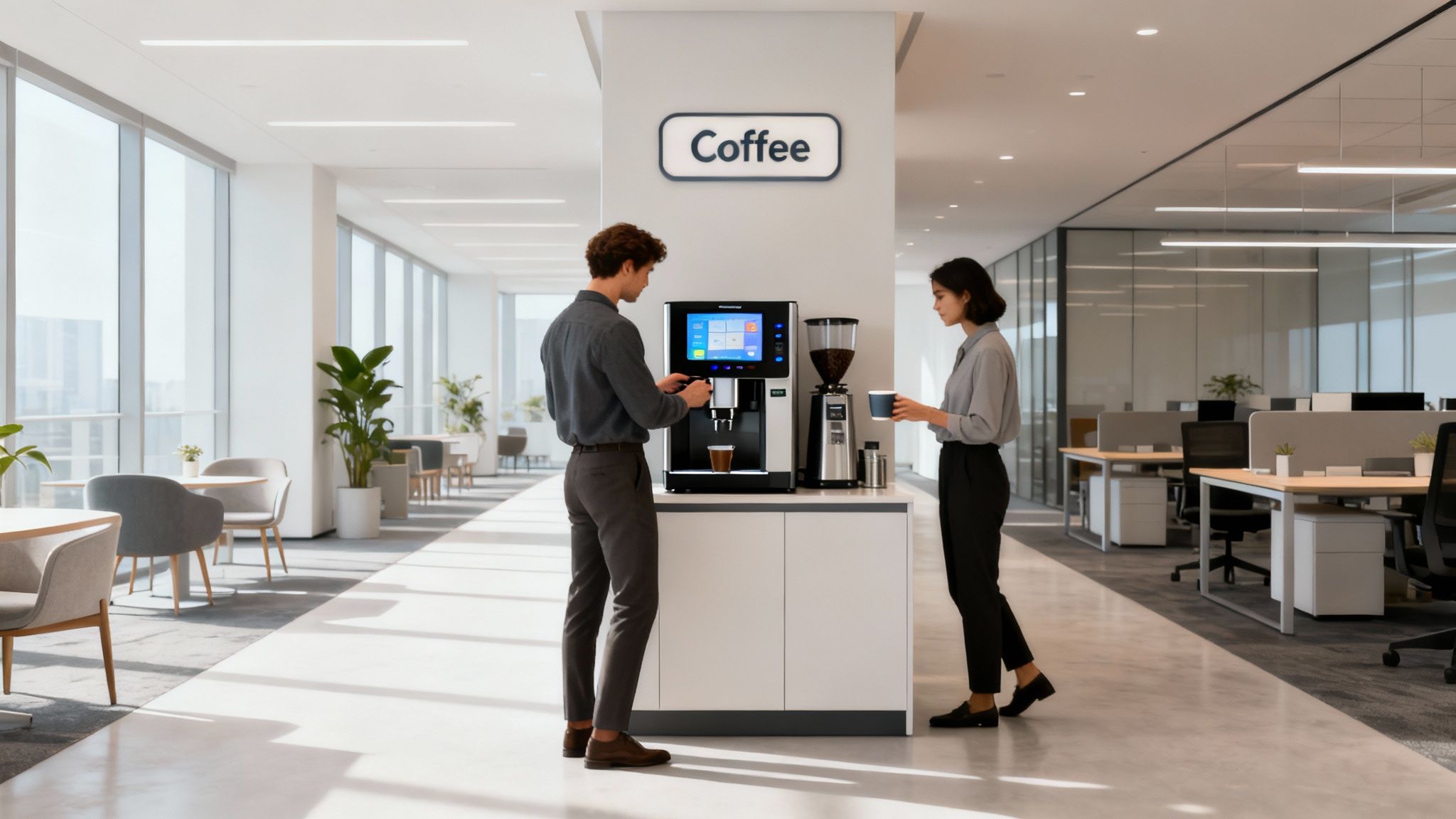
Neglecting accessibility can undermine significant investment in workplace amenities. Placement studies show that positioning refreshment stations near primary work areas can increase usage by 37%. When considering workplace satisfaction survey questions, this one provides direct feedback on the logistical success of your refreshment strategy, ensuring your amenities enhance productivity rather than disrupt it.
How to Implement This Question
Frame this question around the concept of ease and effortlessness. A straightforward scale helps to pinpoint friction in the employee’s daily refreshment experience, highlighting areas for immediate improvement.
- Question Example: "On a scale of 1 to 10, how convenient and accessible are the coffee and refreshment stations during your typical workday?"
- Response Scale: Use a numerical scale where 1 = Very Inconvenient and 10 = Very Convenient. This can be supported by more specific, multiple-choice options about location, wait times, and ease of use.
Pro-Tip: Include a follow-up question asking about specific barriers. For instance, "What is the biggest challenge you face when trying to get a coffee here? (e.g., location, queueing time, machine reliability, empty supplies)."
Actionable Strategies for Maximum Impact
Use the data to optimise the physical layout and operational management of your refreshment hubs. Even small adjustments based on this feedback can lead to a significant boost in employee satisfaction and usage.
- Map the Office Journey: Ask employees to estimate the distance or time it takes to get to the nearest coffee machine. Use this data to identify underserved areas of the office that might need a satellite refreshment point.
- Analyse Peak Times: Ask about wait times during peak hours (e.g., 9 AM, 1 PM). If queues are a common complaint, consider adding another machine or staggering break times for larger teams to ease congestion.
- Evaluate Machine Usability: Include a specific question about your machine’s intuitiveness. Feedback might reveal a need for clearer instructions or a short demonstration for new starters, ensuring everyone can use it confidently.
9. Cost-Value Perception and Access Fairness
This crucial question moves beyond simple satisfaction to explore the perceived value and equity of your workplace amenities programme. It gauges whether employees see investments in high-quality refreshments not as a frivolous expense, but as a genuine commitment to their wellbeing and a smart use of company resources. Addressing cost and fairness head-on builds trust and ensures your initiatives are viewed as inclusive benefits rather than exclusive perks.
Think of this as an audit of your investment's cultural impact. Research from firms like Mercer shows that framing refreshment spending as a wellness initiative dramatically increases employee approval. Similarly, studies highlight that employees often perceive high-quality coffee systems as being equivalent to a tangible 3-4% compensation benefit, demonstrating a clear return on investment in perceived value. These workplace satisfaction survey questions help you quantify that perception.
How to Implement This Question
Deploy a combination of scaled and multiple-choice questions to capture both sentiment and specific concerns about value and accessibility.
- Question Example 1: "To what extent do you agree with the statement: Our premium workplace refreshments represent a good value for the organisation's investment in employee wellbeing."
- Question Example 2: "Are the high-quality refreshment facilities (e.g., speciality coffee machines) equally accessible to all employees, regardless of their department, role, or office location?"
- Response Scale: Use a Likert scale (Strongly Disagree to Strongly Agree) for the value question. For the accessibility question, a simple "Yes / No / I'm not sure" scale followed by an optional comment box is highly effective.
Pro-Tip: Include a question that asks employees to compare the office offering to external options. For instance, "How does the quality of our office coffee compare to what you would typically purchase from a high-street coffee shop?" This provides a direct commercial benchmark for your investment.
Actionable Strategies for Maximum Impact
Use the data from this question to refine your communications and justify your investment, ensuring everyone feels included and valued.
- Frame the Investment: In internal communications, consistently position your refreshment programme as a core part of your wellness and productivity strategy, not just a "nice-to-have" perk.
- Address Inequity Head-On: If survey results show certain departments or floors feel left out, take immediate action. This could mean installing a new bean-to-cup machine in an under-served area or creating a central, high-spec refreshment hub accessible to all.
- Showcase the ROI: Use positive data to demonstrate the value of your programme to leadership. Highlight how providing a premium, in-house option reduces time spent on external coffee runs and boosts morale, making it a sound business decision.
10. Office Attractiveness to Recruits and Client Impressions
Your office environment is a powerful, living advertisement for your brand. This question assesses how your workplace amenities, particularly refreshment quality, shape the perception of your company among crucial external audiences: potential new hires and valuable clients. It gauges whether your investment in the workplace experience translates into a competitive advantage in recruitment and client relations.
This is more than just a survey question; it’s a tool for measuring your employer brand’s real-world impact. Research from LinkedIn Talent Solutions shows that 64% of job candidates consider office amenities when making job decisions. A premium refreshment offering can be the subtle differentiator that elevates your organisation from a contender to a top choice, signalling a culture of care and excellence from the first impression.
How to Implement This Question
Frame questions to capture the perceived impact of your office on external stakeholders, as seen through the eyes of your current team. This provides a quantifiable measure of your environmental brand strength.
- Question Example: "On a scale of 1 to 10, how confident are you that our office’s refreshment quality positively impresses visitors and potential new hires?"
- Response Scale: A numerical scale is ideal (e.g., 1 = Not at all Confident, 10 = Extremely Confident). Alternatively, a statement like, "Our office environment makes a strong, positive impression on clients and candidates," can be used with a Likert scale (Strongly Disagree to Strongly Agree).
Pro-Tip: Ask your recruitment team this question specifically. Follow up with an open-ended question like, "What feedback, if any, have you received from candidates about our office amenities during their visit?"
Actionable Strategies for Maximum Impact
Use these insights to directly link your workplace investments to recruitment success and brand perception. This transforms an office amenity from a cost into a strategic asset.
- Survey New Hires: As part of your onboarding process, ask new starters about their impressions during the interview stage. A question like, "Did the quality of our office facilities and amenities influence your decision to accept our offer?" provides direct evidence.
- Track Recruitment Metrics: Correlate survey scores with key recruitment data like offer acceptance rates. If you upgrade your coffee system, monitor if acceptance rates for in-person final interviews increase over the next six months.
- Empower Your Team as Ambassadors: Ask your staff, "How likely are you to recommend our company as a great place to work based on the office environment?" This is one of the most vital workplace satisfaction survey questions for turning employees into powerful advocates for your talent acquisition efforts.
10-Item Workplace Satisfaction Survey Comparison
| Item | Implementation complexity | Resource requirements | Expected outcomes | Ideal use cases | Key advantages |
|---|---|---|---|---|---|
| Overall Job Satisfaction and Workplace Environment | Low — single Likert/numeric question | Minimal — survey tool, analysis time | Baseline morale metric; trend tracking | Quarterly pulse surveys; pre/post amenity changes | Quick to implement; easy trend and ROI signals |
| Satisfaction with Workplace Breaks and Amenities | Low–Medium — targeted questions and subitems | Survey design, usage data, break-room auditing | Direct amenity performance and preference insights | Post-installation evaluation; benchmarking refreshments | Clear ROI evidence; actionable on beverage offerings |
| Employee Wellness and Self-Care Perception | Medium — careful framing to avoid bias | Survey with wellness items; pairing with wellbeing metrics | Perceived employer support for wellbeing; retention signal | Wellbeing initiatives; employer-branding campaigns | Links amenities to wellbeing; supports retention/recruitment |
| Team Collaboration and Social Connection Through Shared Spaces | Medium — frequency + qualitative questions | Surveys, observational or usage metrics, cross-team data | Measure informal interactions and culture-building effects | Hybrid reintegration; culture and engagement programs | Demonstrates collaboration ROI; encourages office attendance |
| Manager and Leadership Support Perception | Medium — indirect, contextual questions | Survey, leadership communications tracking | Perceived managerial investment; engagement shifts | Leadership alignment; change-communication initiatives | Signals organizational values; enhances employer brand |
| Work-Life Balance and Break Time Quality | Medium — restorative-value focused items | Survey, break duration/frequency data, burnout metrics | Perceived break quality and microbreak restorative value | Burnout prevention; wellbeing and productivity programs | Ties amenities to balance and productivity; supports retention |
| Product Quality and Variety Satisfaction | Low–Medium — specific product-rating questions | Detailed feedback collection, taste tests, usage stats | Direct product performance data and preference gaps | Product selection, supplier evaluation, menu updates | Actionable product feedback; drives continuous improvement |
| Convenience and Accessibility of Refreshments | Low–Medium — location/usability questions | Site assessments, uptime/queue measurements, training | Operational insights on access, queues, reliability | Installation planning; layout and deployment optimization | Identifies adoption barriers; improves uptime and reach |
| Cost-Value Perception and Access Fairness | Medium — sensitive, equity-focused questions | Survey, cost comparisons, demographic analysis | Perceived ROI and fairness; willingness-to-pay signals | Budget justification; equity and access policy reviews | Validates investment; surfaces equity and cost concerns |
| Office Attractiveness to Recruits and Client Impressions | Medium — requires external and internal feedback | Candidate/client surveys, visitor feedback, recruitment metrics | Employer brand impact; candidate and client perception | Recruitment branding; client-facing office upgrades | Strengthens recruitment and client impressions; differentiator |
| Team Collaboration and Social Connection Through Shared Spaces (alt row for image-rich examples) | Medium — includes observational prompts | Photo/mockup assets, surveys, usage tracking | Visual and metric evidence of social interaction | Showcasing amenity-led culture in proposals | Helps sell cultural benefits; visual proof for stakeholders |
From Feedback to Fulfilment: Creating a Workplace That Cares
We’ve journeyed through a comprehensive collection of workplace satisfaction survey questions, from high-level enquiries about engagement and leadership to the granular details that define the daily office experience, like the quality of your coffee. This extensive list is more than just a template; it's a strategic toolkit designed to help you listen intently to the heartbeat of your organisation. Asking these questions is the vital first step, but the real transformation begins when you commit to acting on the answers.
The insights you gather are not mere data points on a spreadsheet. They are the collective voice of your team, offering a clear and honest roadmap toward a more supportive, engaging, and fulfilling work environment. By dissecting feedback on everything from manager support and work-life balance to the social value of shared break spaces, you gain a panoramic view of what truly matters to your people.
The Power of Tangible Investment
One of the most powerful takeaways from this process is understanding the immense impact of tangible, daily experiences. While strategic initiatives and leadership development are crucial, the small, consistent signals of appreciation often resonate most deeply. A commitment to improving workplace amenities, particularly high-quality refreshments, is a direct and visible investment in employee wellbeing.
Think about the difference between a lacklustre instant coffee and a perfectly brewed cup of speciality coffee. This isn't just about flavour; it's a message. It says:
- "We value your wellbeing." We believe you deserve a proper break to recharge and reset.
- "We encourage connection." We want to provide a central hub where colleagues can gather, collaborate, and build relationships.
- "We care about quality." Our commitment to excellence extends to every part of your experience here.
This seemingly small detail becomes a powerful symbol of a larger cultural commitment. It transforms a simple coffee break from a routine necessity into a moment of genuine respite and connection. It helps make the office a destination, a place where people feel cared for and are proud to belong.
From Listening to Leading: Your Action Plan
Now, the responsibility shifts from asking questions to driving change. The feedback you've collected is your mandate for action. Don't let it become a forgotten report. Instead, turn it into a living document that guides your people-centric strategy.
Your next steps are clear:
- Analyse and Share: Digest the survey results and, crucially, share the key findings with your entire team. Transparency builds trust and shows that their input was heard.
- Prioritise with Impact: Identify the "quick wins" (like upgrading your coffee station) alongside longer-term strategic goals (like leadership training). Focus on actions that will deliver the most visible and meaningful impact first.
- Implement and Communicate: Take decisive action. Whether you're introducing a new bean-to-cup machine or launching a wellness programme, communicate these changes as a direct response to the feedback you received.
- Measure and Iterate: Workplace satisfaction is not a one-time project. Make this a continuous cycle of listening, acting, and measuring. Use future surveys to track progress and refine your approach.
By embracing this cycle, you move beyond simply measuring satisfaction and begin actively cultivating it. You demonstrate that employee feedback is not just welcomed but is the very foundation upon which a better, more human-centric workplace is built. This is how you create an environment where every individual feels seen, valued, and empowered to do their best work.
Ready to make a tangible investment in your team's daily satisfaction? Ue Coffee Roasters provides premium, ethically sourced speciality coffee and state-of-the-art machine solutions designed to elevate your workplace and show your employees you care. Explore our tailored office coffee solutions at Ue Coffee Roasters and turn your refreshment offering into a cornerstone of your company culture.